
How Much Does It Cost to Move to Canada
Reviewed by Mohsen Khorvash and Mahsa Barati
Moving to Canada costs far more than the application fee people usually quote. A single adult applying for permanent residence pays about CAD 1,590 to IRCC, but will also spend several hundred dollars on documents and must show roughly CAD 15,263 in settlement money before the application is approved. This guide separates what you pay the government, what you pay third parties, what you keep, and what the first months in Canada actually cost.
Cost to Move to Canada: What Your Budget Needs to Cover
It helps to split the money into four parts, because only two of them are costs you lose. The other two stay in your pocket or buy you something tangible.
The Four Parts of a Move to Canada
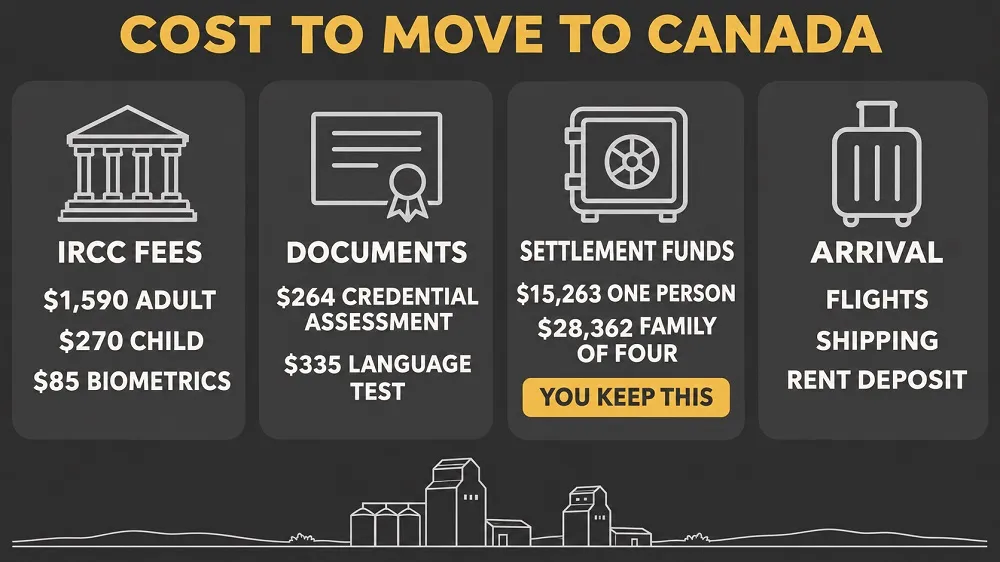
Government application fees go to IRCC and are mostly non-refundable. They are the part people quote, and almost always the smallest of the four. Biometrics at 85 dollars a person are typical of the scale. Document costs go to language test providers, credential assessment bodies, panel physicians and translators. Settlement funds are your own savings, shown as proof of funds, and you keep every dollar. Arrival costs are the flights, shipping, deposits and insurance that begin the day you land.
Permanent Residence Pathways and What They Change
The pathway you qualify for sets both the government fee and whether settlement funds apply at all. Express Entry carries the standard economic permanent residence fee, and that fee is the same whether you are invited under the Federal Skilled Worker Program or the Canadian Experience Class. It does not rise or fall with your CRS score. A Provincial Nominee Program application adds a provincial fee on top, set independently by each province and ranging from a few hundred dollars to well over a thousand. Spousal sponsorship is the cheapest permanent route of the three, and it carries no settlement funds requirement at all.
One warning applies to every route. IRCC returns applications that arrive with an incorrect fee rather than correcting them, so you start again and lose your place in the queue. Confirm the amount on the day you pay, not the day you began preparing the file.
Temporary Permits as a Lower-Cost First Step
Many people arrive on a temporary status first and apply for permanent residence from inside Canada. The upfront cost is far smaller. A work permit or a study permit runs to a few hundred dollars once biometrics are added, against roughly 1,590 for permanent residence, and a visitor visa or an Electronic Travel Authorization costs less again.
The saving is real but it is not free. A study permit brings its own financial requirement and tuition at international rates, which over two years dwarfs the permanent residence fee. The honest comparison is not permit against permit, it is the total cost of each route from today until you hold status.
Worked Examples for Two Household Sizes
The table below uses current IRCC amounts and published third-party fees. Medical exams, police certificates and translation are left out because they are priced locally and vary too widely to total honestly.
| Cost | Single applicant (CAD) | Couple with one child (CAD) |
|---|---|---|
| IRCC processing fee and Right of Permanent Residence Fee | 1,590 | 3,450 |
| Biometrics | 85 | 170 (family maximum) |
| Educational credential assessment | 264 | 264 to 528 |
| Language test | 335 to 361 | 670 to 722 |
| Subtotal paid out | About 2,274 to 2,300 | About 4,554 to 4,870 |
| Settlement funds to show (kept, not spent) | 15,263 | 23,360 |
Document Costs IRCC Does Not Collect
These are the costs applicants underestimate most, because they are paid to private organizations before the application is even submitted and none of them is refundable.
Language Test Fees
Every economic immigration applicant needs an approved language test result. Prices are set by the test provider in each country, so there is no single global figure. IDP, which runs IELTS in Canada, lists CAD 335 to 361 before tax for IELTS General Training, and the same price applies to the Academic version. CELPIP and PTE Core sit in a broadly similar range. If you retake a test to lift your score, you pay again in full.
Timing matters as much as price. IRCC will not accept a language test result that is more than two years old at the time you apply, so a test taken too early becomes money spent twice. Candidates who sit in the pool for a long stretch often have to retest before an invitation arrives.
Educational Credential Assessment Fees
If you claim foreign education, you need an assessment from an IRCC-designated organization. World Education Services lists CAD 264 for its assessment for immigration purposes, with delivery charges from 14 to 97 dollars depending on method, plus HST where it applies. Other designated organizations price in the same broad range but take longer. Each credential you claim needs its own assessment, so two degrees means two fees.
An assessment report is valid for five years, which is longer than a language test and makes it the safer item to buy first. Where a regulated profession is involved, the assessment carried out by the professional body is a separate and usually more expensive process, and it does not replace the one IRCC asks for.
Medical Exams, Police Certificates and Translation
The immigration medical exam is billed by the panel physician, not by IRCC, and the amount depends on the country and the clinic. IRCC does not publish or cap it. Police certificates are priced by each country's own authority and can be anything from a nominal administrative charge to a substantial fee. Certified translation is charged per page by the translator, so the cost depends entirely on how many non-English or non-French documents you hold.
Settlement Funds Required to Move to Canada
This is the largest number in most budgets and the one most often misread. It is not a payment. It is savings you must prove you hold, and you keep all of it after you land. IRCC wants an official letter from each financial institution rather than a printed statement, which is the point most applicants get wrong.
Minimum Funds by Family Size
IRCC sets the amounts by household size, based on half the low income cut-off figures. The table below reflects the amounts shown on IRCC's proof of funds page, last updated July 7, 2025.
| Family members | Funds required (CAD) |
|---|---|
| 1 | 15,263 |
| 2 | 19,001 |
| 3 | 23,360 |
| 4 | 28,362 |
| 5 | 32,168 |
| 6 | 36,280 |
| 7 | 40,392 |
| Each additional member | 4,112 |
Applicants Who Do Not Need to Show Funds
The requirement applies to the Federal Skilled Worker and Federal Skilled Trades programs. You are exempt if you are invited under the Canadian Experience Class, or if you are authorized to work in Canada and hold a valid job offer. Exempt applicants still have to upload a letter explaining which exemption applies, because the system asks everyone for the document. Family size counts your spouse and dependent children even if they are not coming with you.
Moving and First-Month Costs in Canada
Once the application is approved, a second budget begins. These amounts are not set by anyone and depend on your route, your household and the city you land in, so treat the categories as a checklist rather than a price list.
Flights, Shipping and Bringing a Vehicle
Flights for the whole family are the obvious cost. Shipping household goods by sea container is the larger one, and quotes vary enormously by origin port and volume. Personal effects you have owned and used before moving can usually enter duty free under settler's effects rules, but the exemption has conditions and does not cover everything. Importing a car is the item that most often surprises people, because the vehicle must meet Canadian admissibility standards and may need modifications, inspection and registration before it can be driven.
Housing Deposits, Health Coverage and Setup
Most landlords in Canada ask for first and last month's rent upfront, which in a major city is a four-figure sum before you own a single piece of furniture. Provincial health coverage does not always start on arrival. Some provinces impose a waiting period of up to three months, and private interim insurance is the normal way to bridge it. Add phone plans, transit passes, winter clothing and furniture, and the first month in Canada routinely costs more than the entire application did.
This is the real reason the settlement funds figure exists. It is not an arbitrary threshold. It is roughly what IRCC expects a household to need before any Canadian income starts arriving, and landing with only the minimum leaves very little margin if a job search runs long.
Two costs are worth singling out because they are easy to forget and hard to defer. Credentials earned abroad often need a second, profession-specific assessment before you can work in a regulated field in Canada, and that process is separate from the one IRCC asks for. Driving is the other. A licence from outside Canada can usually be exchanged or used for a limited period, after which provincial testing applies, and insurance for a newly licensed driver is priced without regard to decades of experience elsewhere.
Budgeting for a move to Canada is easier once you know which program you qualify for, because the program decides both the fees and whether settlement funds apply to you at all. SEP Immigration can review your situation and set out the real numbers for your household before you commit to a pathway.
This page is general information, not legal advice, and program fees change. Confirm the exact amount for your application on the Government of Canada's fee list, current as of November 2026, before you pay.
Frequently asked questions
01How much money do you need in your bank account to move to Canada?
If you are invited under the Federal Skilled Worker or Federal Skilled Trades programs, IRCC requires CAD 15,263 for one person, 19,001 for two and 28,362 for a family of four. This is settlement money you keep, not a fee. Canadian Experience Class applicants, and those authorized to work in Canada with a valid job offer, do not have to show it.
02Are settlement funds the same as the application fee?
No, and confusing the two is the most common budgeting mistake. The application fee is paid to IRCC and you do not get it back. Settlement funds are your own savings, shown in a bank letter to prove you can support yourself on arrival. You keep every dollar and spend it on your own rent, food and transport in Canada.
03How much should you budget for documents before you apply?
Document costs are paid to private organizations before you submit anything. A credential assessment from World Education Services is CAD 264 plus delivery, and a language test in Canada is CAD 335 to 361 before tax. Medical exams, police certificates and certified translation are priced locally, so budget for them without assuming a fixed figure.
04Do you still need settlement funds if you have a Canadian job offer?
Not if both conditions are met. You are exempt from proof of funds under the Federal Skilled Worker and Federal Skilled Trades programs when you are authorized to work in Canada and hold a valid job offer. A job offer on its own, without authorization to work in Canada, does not exempt you.
05Does hiring an immigration consultant increase the government fees?
No. IRCC charges the same amount whether you apply alone or through a representative. A consultant's professional fee is separate and is set by the representative, not the government.
06Which immigration costs are not refunded if you are refused?
Almost all of them. Processing fees and biometrics fees are not returned once IRCC opens your file, and money already spent on language tests, credential assessments, medical exams and translation is gone regardless of the outcome. Only the Right of Permanent Residence Fee comes back.
Stay informed
Get our immigration updates first on Google
Add SEP Immigration as a preferred source and our latest news and guides appear more often in your Google results.
About the Author

Sepehr Falahati
CEO of SEP Immigration
- CICC Licensed
- RCIC #R533959
- RCIC-IRB
Sepehr Falahati is a Regulated Canadian Immigration Consultant (RCIC #R533959), licensed by the College of Immigration and Citizenship Consultants (CICC).
Read more about Sepehr FalahatiReviewed By


Continue Reading