
Immigrate to Canada as a Truck Driver in 2026
Reviewed by Mohsen Khorvash and Mahsa Barati

Canada still needs commercial drivers, but the routes that bring them here have narrowed in the past three years. Several of the pathways you will find described online, including occupation-specific Express Entry draws and a dedicated Saskatchewan truck driver project, no longer apply to this occupation. What remains is a smaller set of real options, and knowing which ones your profile fits saves months of wasted effort.
Truck Driver Immigration to Canada Starts With NOC 73300
Every immigration program measures your experience against a National Occupational Classification code, and that code decides which doors are open. A mismatch between your code and your actual duties is a common refusal reason.
Duties and Experience That Fall Under NOC 73300
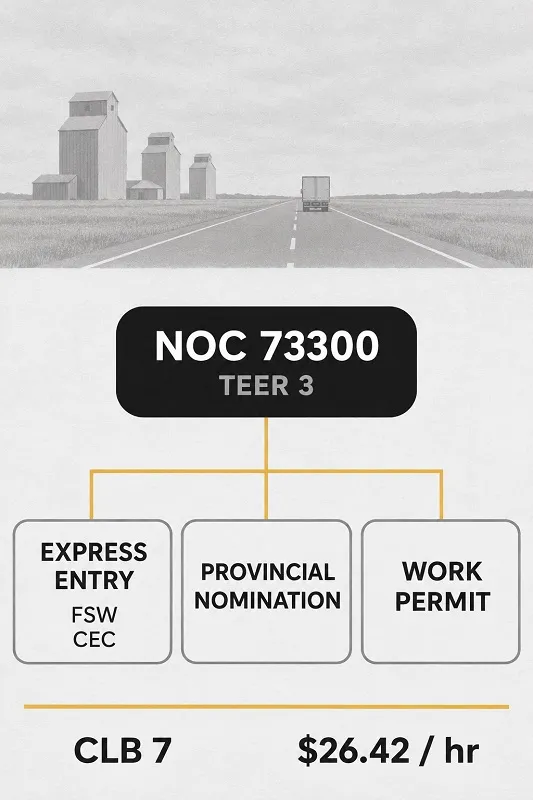
Transport truck drivers sit under NOC 73300, classified as TEER 3. The code covers drivers of straight trucks and tractor-trailers moving freight, including long-haul drivers on interurban, provincial and international routes as well as short-haul and local drivers. Separate codes exist for bus and transit operators, taxi drivers and delivery drivers, so experience in those roles does not count toward NOC 73300.
TEER 3 matters because federal economic programs draw their eligibility line there, so drivers qualify where TEER 4 and 5 workers do not.
Licence Classes and Endorsements Canadian Employers Require
Immigration eligibility and employability are two different tests. According to Job Bank, the federal labour market service, the employment requirements for NOC 73300 are:
| Requirement | Detail |
|---|---|
| Education | Completion of secondary school is usually required |
| Training | On-the-job training, plus an accredited driver training course of up to three months from a vocational school or community college in some cases |
| Straight-body trucks | Class 3 or Class D licence |
| Long combination vehicles | Class 1 or Class A licence |
| Air brakes | Air brake (Z) endorsement |
| Hazardous loads | Transportation of Dangerous Goods certification |
Licensing is provincial, so a foreign licence is not always transferable on arrival. Job Bank also records regulated driving roles in Alberta, British Columbia, Ontario and Saskatchewan, each under a named provincial regulator.
What Transport Truck Drivers Earn Across Canada
Job Bank reports a national hourly range for NOC 73300 of $19.45 low, $26.42 median and $37.00 high, from Statistics Canada Labour Force Survey data for the 2023 to 2024 reference period. Those figures matter for the Express Entry section below, because wage levels now feed directly into how job offers are scored.
Express Entry Pathways Open to Transport Truck Drivers
Truck drivers can still use Express Entry, but only through the general programs rather than the targeted draws that get the most attention online.
Federal Skilled Worker Program Requirements for NOC 73300
The Federal Skilled Worker Program accepts TEER 0 to 3 experience, so NOC 73300 qualifies. Applicants need one year of continuous paid work, or 1,560 hours, gained within the previous ten years. The language bar stops most drivers: the program requires Canadian Language Benchmark 7 in all four abilities, and anything below that is a hard stop rather than a points deduction. Applicants also need a credential with an Educational Credential Assessment if it is foreign, and 67 points out of 100 on the selection grid.
Canadian Experience Class for Drivers Already in Canada
Drivers already working in Canada on a valid permit are often better placed under the Canadian Experience Class. It requires one year of skilled Canadian work, or 1,560 hours, in the three years before applying, and accepts TEER 0 to 3 experience across more than one job or NOC code. No education credential is required, and language scores are set by an approved test rather than the CLB 7 threshold.
The Transport Occupations Category Excludes Truck Drivers
Category-based Express Entry draws do include a Transport occupations category, but on the IRCC category page published 16 October 2026 it contains only four codes: aircraft mechanics and inspectors (72404), air pilots and flight engineers (72600), aircraft instrument and avionics technicians (22313), and automotive service technicians and truck and bus mechanics (72410). NOC 73300 is not among them, nor in the Trade occupations category.
Drivers were targeted in transport draws in earlier years, which is why the claim persists online. Under the current list a driver cannot be invited through a category draw and must compete in general draws on CRS score alone. IRCC also removed NOC 73300 from the occupations eligible for a certificate of qualification in November 2023, as reported by law firm Miller Thomson, ending the 50 CRS points it once carried.
Provincial Nominee Program Routes for Truck Drivers
A provincial nomination remains the strongest lever available, because it adds points that put mid-range candidates in reach of an invitation. Provinces set their own occupation lists, and those change more often than the federal ones.
Ontario Workforce Priority Stream Rules for Truck Drivers
The Ontario Workforce Priority Stream accepts truck drivers with an employer job offer, but it singles the occupation out for stricter treatment. NOC 73300 and NOC 73301 must show at least six months of consecutive paid full-time experience in the offered position, gained in the 12 months before applying, and neither a licence nor recent-graduate status can substitute for that experience, as Ontario sets out on its Workforce Priority stream page, last updated 20 October 2026. Holding a licence also does not satisfy the education requirement for these two occupations, so a secondary school credential or its equivalent is still needed.
Saskatchewan Routes After the Long-Haul Truck Driver Project
Saskatchewan ran a dedicated Long-Haul Truck Driver Project for years, and it is still listed on many immigration websites. It no longer appears among the sub-categories published under the SINP Worker with Saskatchewan Work Experience category, which now lists Skilled Worker With Existing Work Permit, Agriculture Talent Pathway, Students, Health Talent Pathway and Innovation and Tech Talent Pathway. Drivers working in the province on a valid permit would look at the existing work permit sub-category instead.
Work Permits and LMIA Requirements for Truck Driver Jobs
Most drivers reach permanent residence by working in Canada first, which makes the temporary route the practical starting point.
Employer-Driven Hiring Through the Temporary Foreign Worker Program
Under the Temporary Foreign Worker Program, a Canadian employer who cannot fill a driving position locally applies for a Labour Market Impact Assessment. A positive assessment lets the named worker apply for an employer-specific work permit. Time driving in Canada on that permit is what later builds Canadian Experience Class eligibility, which is why most successful cases follow the permit-then-PR sequence.
How the November 2026 Job Offer Points Change Affects Drivers
IRCC changed how Express Entry awards job offer points from 3 November 2026. A qualifying offer no longer needs an LMIA to earn points, but the points are now restricted to high-wage occupations and scaled by wage: 100 points at twice the median wage or more, 70 at 1.5 times or more, and 50 at 1.3 times or more. Canadian work experience in a high-wage occupation earns a separate bonus, and a candidate receives whichever is higher, not both.
Given the wage figures above, most truck driving offers will fall short of the 1.3 times threshold, so drivers should not count on job offer points when estimating a CRS score. IRCC publishes the current rules and category lists on its category-based selection page.
Every driver's position turns on licence class, language scores and whether a Canadian employer is already in the picture. A short eligibility review will show which of these routes is worth pursuing before you commit to one.
This page is general information, not legal advice, and immigration program criteria change frequently. Confirm current requirements on canada.ca and the relevant provincial immigration website, or with a licensed representative; the position described here reflects published guidance as of November 2026.
Frequently asked questions
01Can truck drivers still immigrate to Canada in 2026?
Yes. NOC 73300 is TEER 3, which keeps it eligible for the Federal Skilled Worker Program and the Canadian Experience Class, as well as provincial streams such as the Ontario Workforce Priority Stream. What is no longer available is selection through a transport category draw.
02Is NOC 73300 included in Express Entry category-based draws?
No. The Transport occupations category currently contains only four codes, covering aircraft mechanics, pilots, avionics technicians, and automotive and truck and bus mechanics. Truck drivers are not listed in that category or in the Trade occupations category.
03What licence does a truck driver need to work in Canada?
Job Bank lists Class 3 or D for straight-body trucks and Class 1 or A for long combination vehicles, plus an air brake endorsement where applicable and Transportation of Dangerous Goods certification for hazardous loads. Licensing is issued provincially.
04Does a job offer still raise a truck driver's CRS score?
Only if the offer is in a high-wage occupation paying at least 1.3 times the median wage. Since the national median for NOC 73300 is $26.42 per hour, most driving offers will not meet that threshold under the rules in force from 3 November 2026.
05Do truck drivers need CLB 7 to immigrate to Canada?
Under the Federal Skilled Worker Program, yes, in all four abilities. The Canadian Experience Class sets its language requirement through an approved test rather than that single threshold, so drivers with Canadian work experience may have more room.
Stay informed
Get our immigration updates first on Google
Add SEP Immigration as a preferred source and our latest news and guides appear more often in your Google results.
About the Author

Sepehr Falahati
CEO of SEP Immigration
- CICC Licensed
- RCIC #R533959
- IRB Member
Sepehr Falahati is a Regulated Canadian Immigration Consultant (RCIC #R533959), licensed by the College of Immigration and Citizenship Consultants (CICC).
Read more about Sepehr FalahatiReviewed By


Continue Reading