
PTE Core for Canada Immigration and PR
Reviewed by Mohsen Khorvash and Mahsa Barati

PTE Core is one of three English tests Immigration, Refugees and Citizenship Canada (IRCC) accepts for permanent residence, alongside IELTS General Training and CELPIP-General. A valid PTE Core result can be used to qualify for Express Entry, to claim language points in the Comprehensive Ranking System, and to meet the language requirement in most other economic immigration and temporary residence applications that ask for a test.
PTE Core reports scores on a 10 to 90 scale, and none of those numbers are Canadian requirements on their own. Every threshold that matters is set as a Canadian Language Benchmark level, so a score of 65 means nothing until it is converted for the specific ability. You can check your equivalent level using our Language Converter. This guide sets out the conversion chart, the minimum PTE Core score for each program, how results affect your ranking, and the practical points about booking, cost and validity that decide whether a result is still usable when you need it.
PTE Core Accepted for Canada PR and Express Entry Programs
IRCC names PTE Core specifically in its list of approved tests, and the same result can serve several applications over the life of your immigration file.
PTE Core Versus PTE Academic for Canadian Immigration
Pearson runs several tests under the PTE name, and only PTE Core is designated for Canadian immigration. PTE Academic is designed for university admission and for visa routes in other countries. An Academic result cannot be used for a permanent residence application, however high it is, and there is no way to convert one into the other. Both are booked through the same myPTE account, so the test name on the booking confirmation is worth checking before payment.
Federal Skilled Worker, Canadian Experience Class and Skilled Trades Applications
All three federal Express Entry programs accept PTE Core. The Federal Skilled Worker Program requires CLB 7 in every ability and awards up to 24 selection-grid points for your first official language. The Canadian Experience Class sets CLB 7 for TEER 0 or 1 jobs and CLB 5 for TEER 2 or 3 jobs. The Federal Skilled Trades Program has the lowest bar, CLB 5 in speaking and listening and CLB 4 in reading and writing.
PNP, PGWP and Citizenship Applications That Accept PTE Core
Provincial programs set their own language rules. The Ontario Immigrant Nominee Program accepts PTE Core across its streams, and the Alberta Opportunity Stream has accepted it for applications submitted on or after April 1, 2025. Confirm the accepted tests for any other stream before you book, because provincial lists are updated separately from federal ones.
A post-graduation work permit applicant must prove CLB 7 after a university degree or CLB 5 after a college program, and PTE Core is accepted for both. For Canadian citizenship, applicants aged 18 to 54 need CLB 4 in speaking and listening, which on PTE Core means at least 42 in speaking and 28 in listening.
PTE Core Score Requirements for Canada PR by Program
IRCC converts each of your four PTE Core scores separately, then compares each one against the program minimum.
Minimum PTE Core Scores for FSW, CEC and FSTP
The table below shows the lowest score in each ability that meets the federal minimum. These are entry thresholds for the Express Entry pool, not scores that are likely to earn an invitation.
| Program | CLB minimum | Speaking | Listening | Reading | Writing |
|---|---|---|---|---|---|
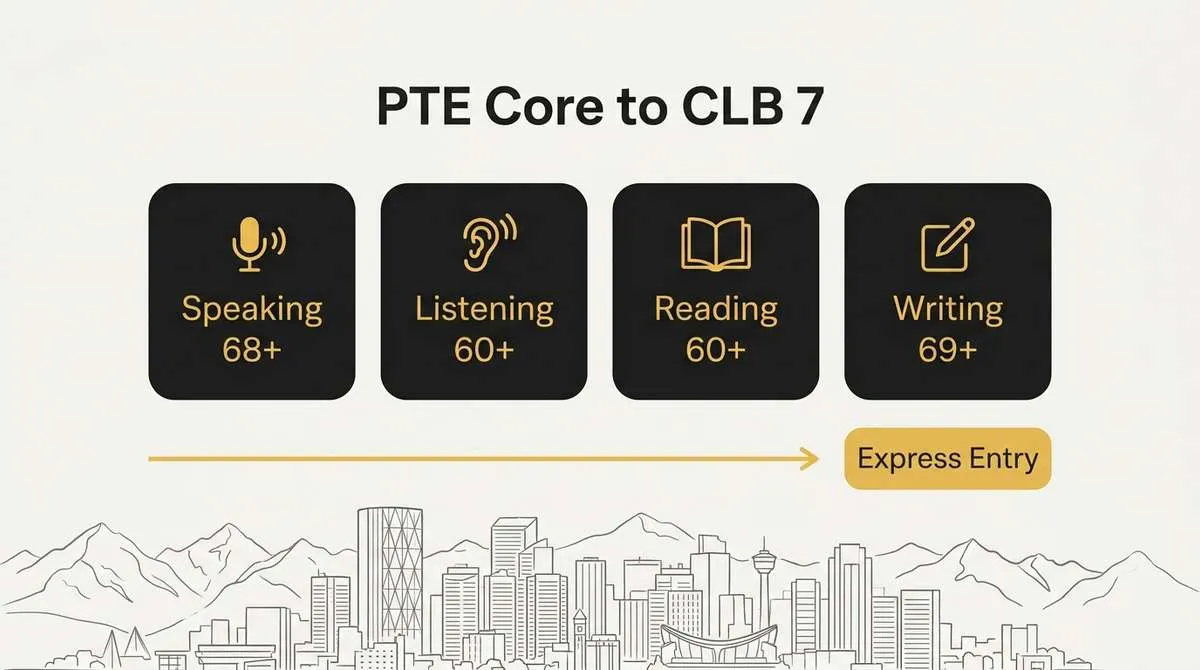
| Federal Skilled Worker Program | CLB 7 in all four | 68 | 60 | 60 | 69 |
| Canadian Experience Class, TEER 0 or 1 | CLB 7 in all four | 68 | 60 | 60 | 69 |
| Canadian Experience Class, TEER 2 or 3 | CLB 5 in all four | 51 | 39 | 42 | 51 |
| Federal Skilled Trades Program | CLB 5 speaking and listening, CLB 4 reading and writing | 51 | 39 | 33 | 41 |
| Canadian citizenship (ages 18 to 54) | CLB 4 speaking and listening | 42 | 28 | Not assessed | Not assessed |
PTE Core CLB Level Conversion Chart
This is IRCC's official equivalency for PTE Core. For conversions from IELTS, CELPIP, TEF Canada and TCF Canada on the same scale, see our CLB conversion charts.
| CLB level | Speaking | Listening | Reading | Writing |
|---|---|---|---|---|
| 10 and above | 89 to 90 | 89 to 90 | 88 to 90 | 90 |
| 9 | 84 to 88 | 82 to 88 | 78 to 87 | 88 to 89 |
| 8 | 76 to 83 | 71 to 81 | 69 to 77 | 79 to 87 |
| 7 | 68 to 75 | 60 to 70 | 60 to 68 | 69 to 78 |
| 6 | 59 to 67 | 50 to 59 | 51 to 59 | 60 to 68 |
| 5 | 51 to 58 | 39 to 49 | 42 to 50 | 51 to 59 |
| 4 | 42 to 50 | 28 to 38 | 33 to 41 | 41 to 50 |
Your Lowest PTE Core Ability Sets Your Eligibility
Eligibility is never averaged. A candidate with CLB 9 in speaking, listening and reading but a writing score of 68 sits at CLB 6 in writing and does not meet a CLB 7 requirement. There is no rounding either: 68 is one point short of 69, and the only remedy is a new sitting of the full test. Writing and speaking are the abilities that most often fall short on PTE Core, because their CLB 7 thresholds start higher on the 90-point scale than reading and listening do.
PTE Core Scores and Your Express Entry CRS Ranking
Meeting the minimum gets you into the pool. Your actual PTE Core scores then decide how many language points you carry into each round of invitations.
CLB 9 Thresholds That Unlock Skill Transferability Points
Core language points rise with every CLB level up to 10, but CLB 9 matters most. At CLB 9 in all four abilities, your language result combines with your education and your foreign work experience to unlock the top tier of skill transferability points, on top of the higher language points themselves. On PTE Core, CLB 9 means at least 84 in speaking, 82 in listening, 78 in reading and 88 in writing. The writing threshold is the steepest climb, and it is usually the one worth targeting in a retest. Our CRS score calculator shows how much each level is worth for your own profile.
Spouse or Partner PTE Core Results
An accompanying spouse or common-law partner can add up to 20 CRS points through their own language test, at up to 5 points per ability. CLB 5 or 6 earns 1 point per ability, CLB 7 or 8 earns 3, and CLB 9 or higher earns 5. A partner who scores well on PTE Core can lift a household's ranking by enough to matter in a close round, so their test is often worth booking alongside yours.
PTE Core Test Format, Fees and Results in Canada
PTE Core is computer-based, delivered at Pearson test centres, and scored by an automated system with human oversight.
Three Parts of the PTE Core Exam
The test takes about two hours in a single sitting and is divided into three parts. Speaking and Writing runs about 50 minutes and includes tasks such as reading aloud, repeating sentences, describing an image, responding to a situation and writing an email. Reading takes about 30 minutes, with gap-fill, multiple choice and paragraph reordering. Listening takes about 30 minutes, and each recording plays only once. Speaking is recorded through a headset rather than conducted as an interview, and the microphone stops recording after a short silence, which is the format point that catches most first-time candidates.
PTE Core Exam Fee and Test Centres in Canada
The fee in Canada has sat between roughly CAD 340 and CAD 360 including tax during 2026, depending on when and where the booking was made. Pearson sets prices in local currency, so the fee outside Canada will differ. Confirm the amount at checkout rather than relying on a figure quoted elsewhere. Seats are available in most major Canadian cities and in more than 115 countries, and there is no reduced rate for a retake.
Results Timing and Two-Year Validity for Canada PR
Pearson typically releases results within about two days, although some take longer. The two-year rule is where the real timing pressure lies. Your results must be less than two years old when you complete your Express Entry profile and again when you submit your permanent residence application, and IRCC refuses an application filed with an expired result. The IRCC language test requirements for Express Entry set out the options if your results will lapse while you wait: retest, apply before the expiry date, or decline the invitation and return to the pool. Enter your raw PTE Core numbers in the profile, not CLB levels, and keep them identical to your score report.
PTE Core Compared With IELTS General Training and CELPIP
IRCC treats all three English tests equally once they are converted to CLB levels, so the choice comes down to format and logistics.
Choosing the Right English Test for Your Express Entry Profile
| Feature | PTE Core | IELTS General Training | CELPIP-General |
|---|---|---|---|
| Delivery | Computer, test centre | Computer or paper, test centre | Computer, test centre |
| Speaking | Recorded, scored by automated system | Face-to-face with an examiner | Recorded, scored by raters |
| Score scale | 10 to 90, converted to CLB | Bands 1 to 9, converted to CLB | Levels that match CLB directly |
| Length | About 2 hours | About 2 hours 45 minutes | About 3 hours |
| Availability | More than 115 countries | Widely available worldwide | Canada and selected countries |
PTE Core tends to suit candidates who type quickly, handle strict timers well and want a result fast. IELTS suits those who speak better to a person. CELPIP suits candidates already in Canada who want scores that read straight across to CLB. No test is scored more generously, so a scored practice test in your preferred format is a better guide than any claim that one is easier.
Language is the factor most candidates can still move once their education and work history are fixed. SEP Immigration, led by Sepehr Falahati (RCIC #R533959, licensed by the CICC), reviews your PTE Core score report against the programs and draws you are targeting and identifies which ability is worth a retest.
Frequently asked questions
01Is PTE accepted in Canada for PR?
Yes, but only the PTE Core version. IRCC accepts PTE Core for Express Entry and other permanent residence applications that require an English test. PTE Academic is not accepted for permanent residence, whatever the score.
02Which PTE is required for Canada PR?
PTE Core. Pearson sells both tests through the same booking account and at a similar price, so check that the booking confirmation names PTE Core before you pay. A PTE Academic result has to be replaced with a new PTE Core sitting before it can be used in an immigration application.
03What PTE Core score do I need for CLB 7?
CLB 7 starts at 68 in speaking, 60 in listening, 60 in reading and 69 in writing. Each ability must reach its own threshold, so an overall score of 70 does not guarantee CLB 7 if writing sits at 66.
04How long is PTE Core valid for Canada PR?
Results must be less than two years old when you complete your Express Entry profile and again when you submit your permanent residence application. If they will expire while you are in the pool, retest, apply before they lapse, or decline an invitation and return to the pool.
05Can I use an old PTE Core result for my citizenship application?
Yes, if you submitted that result with your permanent residence application. IRCC accepts it for citizenship even after it has expired, as long as it shows at least 28 in listening and 42 in speaking.
06Do I enter PTE Core scores or CLB levels in my Express Entry profile?
Enter the raw PTE Core scores exactly as they appear on your score report, one per ability, along with any test details the system requests. The profile converts them to CLB levels itself. Every number must match the report, because IRCC compares your profile with the result you submit after an invitation.
07Can I take the PTE Core exam outside Canada?
Yes. Pearson delivers PTE Core at test centres in more than 115 countries, and a result from any of them is treated the same way by IRCC. Fees are set in local currency, so the price outside Canada will differ from the Canadian fee.
This page is general information, not legal advice, and test fees, formats and program requirements change. Confirm score conversions and minimum levels against IRCC's Express Entry language test results page before relying on them; information current as of October 2026.
Stay informed
Get our immigration updates first on Google
Add SEP Immigration as a preferred source and our latest news and guides appear more often in your Google results.
About the Author

Sepehr Falahati
CEO of SEP Immigration
- CICC Licensed
- RCIC #R533959
- IRB Member
Sepehr Falahati is a Regulated Canadian Immigration Consultant (RCIC #R533959), licensed by the College of Immigration and Citizenship Consultants (CICC).
Read more about Sepehr FalahatiReviewed By


Continue Reading