
Schooling in Canada for Newcomers
Reviewed by Mohsen Khorvash and Mahsa Barati
Schooling in Canada is usually one of the first things newcomer parents have to organize after landing. Along with finding a home and applying for a provincial health card, registering your child at a local school tends to happen in the first week or two, and the rules you meet depend on the province you settle in and on your family's immigration status.
This guide explains how the Canadian school system is organized, what kindergarten is called in different provinces, when children start and finish school, what public education costs, and how a child's status affects enrolment. If you are coming as a worker or international student, your child's access to school is tied to your own work permit or study permit, and our article on bringing your family to Canada on a student visa covers the permit side in more detail. Families who arrive with Canadian permanent residence have the simplest path, since their children are treated as residents from the start.
How the Canadian School System Is Structured
Canada has no national school system, but the basic shape of schooling is similar across the country.
Provinces and Territories Run Education
Education is a provincial and territorial responsibility, so each of the 13 jurisdictions sets its own curriculum, calendar, starting age and graduation requirements. Day-to-day, schools are run by local school boards, which some provinces call school districts and Quebec calls school service centres for its French-language system. The board decides which school serves your address, handles registration, and runs services such as busing and language support.
Elementary School in Canada
Elementary school, also called primary school, starts with kindergarten and runs to Grade 5, 6 or 8 depending on the board. Children study reading and writing, mathematics, science, social studies, the arts and physical education, and most English-language schools add some French. In the early grades, one homeroom teacher usually teaches most subjects.
The age at which school becomes compulsory is set by each province. It starts at 5, 6 or 7 and ends at 16 or 18. In Ontario, for example, children must attend from age 6 until they turn 18.
Middle School and Junior High
Many boards add a middle stage between elementary and high school, covering roughly Grades 6 to 8 or 7 to 9. It may be called middle school, junior high or intermediate school, and some boards skip it altogether by running elementary schools up to Grade 8. At this stage students usually move between teachers for different subjects and begin choosing a few electives.
High Schools in Canada
High school, also called secondary school, generally runs from Grade 9 or 10 to Grade 12. Students earn credits in compulsory and elective courses, and the province awards a secondary school diploma once its course and credit requirements are met. Most students graduate at 17 or 18.
Quebec works differently. Secondary school runs from Secondary I to Secondary V, which ends after the equivalent of Grade 11, and most students then attend CEGEP, a two-year pre-university or three-year technical college program, before going on to university or work.
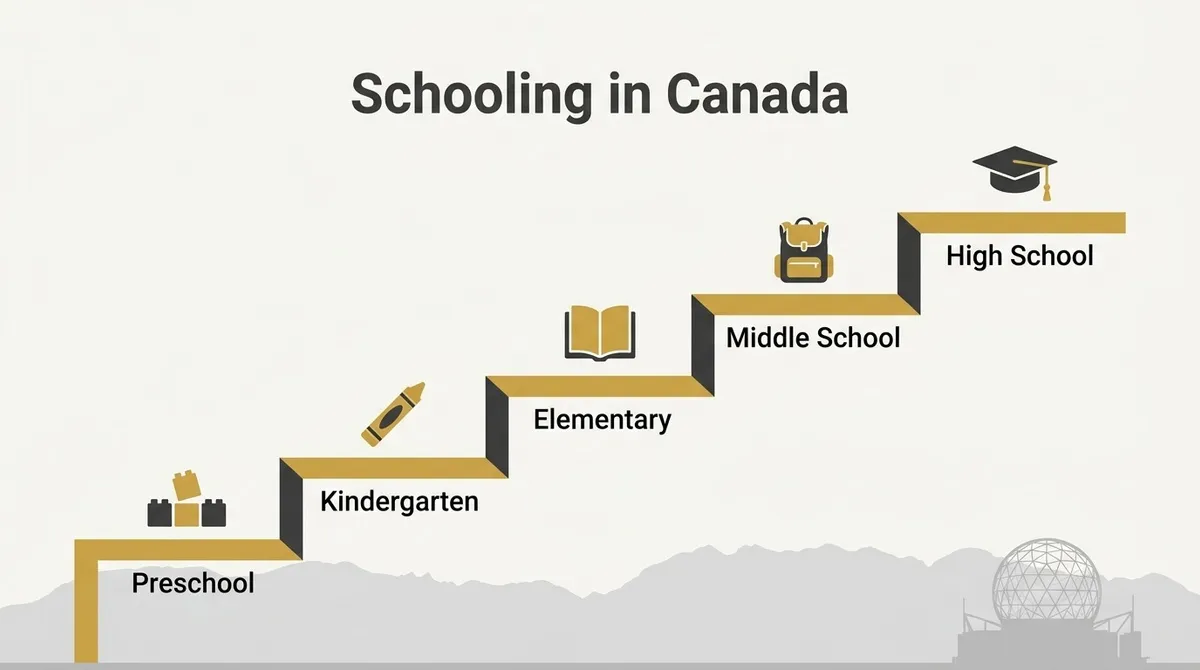
| Stage | Typical grades | Typical ages |
|---|---|---|
| Preschool and child care | Before school entry | Infancy to 4 |
| Kindergarten | K (JK and SK in Ontario) | 4 to 5 |
| Elementary school | Grades 1 to 5, 6 or 8 | 6 to 13 |
| Middle school or junior high | Grades 6 to 8 or 7 to 9 | 11 to 15 |
| High school | Grades 9 or 10 to 12 (Secondary I to V in Quebec) | 14 to 18 |
Preschool and Kindergarten in Canada
The early years are where provinces differ most, both in what programs are called and in what they cost.
Preschool and Child Care Options
In Canada, preschool is the stage before kindergarten. It usually means a part-time, play-based early learning program for children of about 3 to 4, run by community centres, co-operatives or private operators, and children leave it when they start kindergarten at 4 or 5, depending on the province. Licensed child care centres, often called daycares, and licensed home child care take children from infancy and are mainly used by working parents. None of these is compulsory.
Preschool and daycare are generally paid services. Under the Canada-wide early learning and child care agreements, provinces and territories committed to bringing regulated child care fees for children under 6 down to an average of $10 a day by March 2026. Several provinces now charge a set fee of $10 a day or less, and Quebec's subsidized daycares have charged a low fixed fee for many years, but parents in other provinces still pay considerably more. Waitlists for licensed spaces are long in most cities, so it makes sense to apply as soon as you know where you will live.
Free Public Programs for Four-Year-Olds
The closest thing to free preschool in Canada is a public-school program for 4-year-olds. Ontario's Junior Kindergarten, Nova Scotia's Pre-primary program and Quebec's kindergarten for 4-year-olds (maternelle 4 ans) are all free. Quebec is still rolling out its program, so places can be limited to certain schools. In most other provinces, free public schooling begins with kindergarten at age 5.
What Kindergarten Is Called in Canada
Kindergarten is the standard term in most of the country and means the school year before Grade 1. A few provinces use their own names and age cut-offs.
| Province | Name of the first school year | Age rule |
|---|---|---|
| Ontario | Junior Kindergarten (JK) and Senior Kindergarten (SK) | A free two-year program for 4- and 5-year-olds |
| Nova Scotia | Pre-primary (optional), then Grade Primary | 4 and 5 years old on or before December 31 |
| Quebec | Maternelle, with maternelle 4 ans in some schools | 5 (or 4) years old on or before September 30 |
| Other provinces and territories | Kindergarten | Usually 5 during the school year; cut-off dates vary by board |
Kindergarten Age and Attendance Rules
In most provinces, children start kindergarten in the September of the year they turn 5, while Ontario starts a year earlier with Junior Kindergarten at 4. Whether kindergarten is mandatory depends on the province. In Ontario both kindergarten years are optional, and attendance becomes compulsory at 6. In Quebec school is compulsory from 6, so maternelle is optional even though most families use it. Even where it is not required, kindergarten gives a child who is still learning English or French a much easier start in Grade 1.
Types of Schools and the Cost of Education in Canada
Most newcomer children attend the public school closest to home, but families do have other options.
Public Schools and Fees for Newcomer Families
Public elementary and secondary schools are funded through taxes, so residents pay no tuition. Children of Canadian citizens and permanent residents attend free, and in most provinces so do children whose parents hold a valid work permit or study permit. Some school boards charge international student tuition when a parent does not hold qualifying status, for example when the family is in Canada only as visitors, so confirm your child's fee status with the board before you arrive. Free schools still come with small costs for supplies, field trips, lunch programs and winter clothing.
Private Schools
Private and independent schools charge tuition, and the amount varies widely depending on the school and whether it offers boarding. Many follow the provincial curriculum with smaller classes or a particular approach, such as religious instruction, the International Baccalaureate or Montessori, and admission is often selective. Some provinces, including Quebec, partly fund private schools that meet provincial standards, which lowers the tuition parents pay.
Catholic School Boards
In Ontario, Alberta and Saskatchewan, publicly funded Catholic school boards operate alongside the public boards, so families may be able to choose between two free systems at the same address. Admission rules for children who are not Catholic vary from board to board, especially at the elementary level, so ask before you register.
English, French and Immersion Programs
Public schools teach in English or French. Outside Quebec, many English-language boards offer French immersion, where a large share of the day is taught in French, and each province also has French-language school boards with their own admission rules. Students who are still learning the language of instruction usually receive English or French language support. Quebec has separate rules about who may attend English schools, explained further below.
School Hours, the School Year and After-School Programs
The rhythm of the Canadian school week can take newcomer families by surprise, especially the mid-afternoon finish and the long summer break.
How Long a School Day Is in Canada
School runs Monday to Friday. A typical day starts between 8:00 and 9:00 a.m. and finishes between 2:30 and 3:30 p.m., with a lunch break and one or two recesses, so children spend about six to six and a half hours at school. Each province sets its own minimum instruction time. Ontario, for example, requires at least five hours of instruction a day for school-age students and full-day kindergarten, not counting recess, and classes must fall between 8 a.m. and 5 p.m.
The Canadian School Year
The school year runs from late August or early September to late June. It includes a winter break of about two weeks over the holidays, a spring break in March, statutory holidays and several professional development days when students stay home. In Ontario, the regular school year runs from September 1 to June 30 and must contain at least 194 school days, as set out in the province's school year calendar rules. Each board then publishes its own calendar with exact dates.
Before- and After-School Programs
Because the school day ends mid-afternoon, many working parents rely on before- and after-school programs. These are run in or near schools by licensed child care operators, YMCAs, municipal recreation departments and non-profit groups, and they usually cover the time before the first bell and until about 6 p.m. Most charge a fee, and some qualify for provincial child care subsidies. Ask your school which provider operates on site, and check your city's recreation listings for afterschool programs near you, since spaces fill quickly in September. School clubs, sports teams and music programs are separate and are usually free or low cost.
Study Permit Rules for Children in Canada
For families who are not yet permanent residents, a child's right to attend school depends on the child's own status and on the parents' status.
When Children Can Study Without a Study Permit
A minor child who is already in Canada can attend preschool, primary or secondary school without a study permit when accompanied by a parent who is authorized to work or study in Canada. Minor children who are in Canada without a parent can also attend school at these levels without a permit, and the same applies to children of refugee claimants. IRCC lists these exemptions on its official page about who can study in Canada without a study permit.
When a Child Needs a Study Permit
A study permit is still required in several situations. Children applying from outside Canada to accompany a parent who will work or study here are expected to apply for a study permit before entering, and IRCC assesses them as students rather than visitors. Children whose parents are in Canada only as visitors, without permission to work or study, also need one.
A permit can be worth having even when it is optional. It allows a teenager to apply for a secondary school co-op work permit and to move between education levels without a new application. Once a child reaches the age of majority, which is 18 or 19 depending on the province, they need their own study permit to keep studying.
Quebec Rules for English-Language Schools
Under Quebec's Charter of the French Language, most children of immigrants attend French-language public schools. Children whose parents are in Quebec temporarily on a work or study permit can receive temporary authorization to attend an English public school, but since the 2022 amendments to the Charter, that authorization lasts a maximum of three years and cannot be renewed. Families who become permanent residents generally move into the French system unless the child qualifies for English schooling on other grounds, such as a parent's English elementary schooling in Canada. Non-subsidized private English schools remain an option at full cost.
How to Register Your Child for School in Canada
Registration is handled by the local school board, and you can usually start as soon as you have a Canadian address.
Find Your School Board and Catchment School
Search for the school board that serves your new address, or call the nearest school. Public schools admit students mainly by catchment area, so your address normally decides which school your child attends. Many boards let you begin the process before you arrive, and children can join partway through the year, so there is no need to wait for September. Registration for kindergarten in the following fall usually opens in winter.
Documents for School Registration
Requirements differ between boards, but most ask for:
- Proof of age, such as the child's birth certificate or passport.
- Proof of address, such as a lease, purchase agreement or utility bill.
- Proof of immigration status for the child and parents, such as a PR card or Confirmation of Permanent Residence, or a valid work permit, study permit or visitor record.
- Immunization records, ideally translated into English or French.
- Previous report cards or transcripts, translated if possible.
- Custody or guardianship documents, where they apply.
Placement Assessment and Newcomer Support
Students arriving from another school system are usually assessed for language level and, in some boards, mathematics, so the school can place them in the right grade and arrange language support. Many schools also have Settlement Workers in Schools (SWIS), who help newcomer families with registration, orientation and community services at no cost. Once classes begin, parents can meet teachers at parent-teacher interviews after each report card and can join the school's parent council.
Where you settle and which permit you hold both shape your children's schooling in Canada, from fees to the language of instruction. SEP Immigration can review your family's work, study or permanent residence options so your children can start school on the right footing.
This guide is general information, not legal advice, and school rules, fees and immigration requirements change. Confirm current details with your provincial ministry of education, your school board and IRCC; this information is current as of October 2026.
Frequently asked questions
01What is kindergarten called in Canada?
Most provinces call it kindergarten. Ontario splits it into Junior Kindergarten (JK) and Senior Kindergarten (SK), Nova Scotia calls it Grade Primary, and in Quebec it is maternelle.
02What age is kindergarten in Canada?
Most children start kindergarten in the September of the year they turn 5. Ontario's Junior Kindergarten starts at 4, and Nova Scotia and some Quebec schools also run free programs for 4-year-olds.
03Is education free in Canada?
Public schools from kindergarten to Grade 12 are free for children of citizens and permanent residents, and in most provinces for children of work and study permit holders. Families still pay for supplies, trips and lunches, and colleges and universities charge tuition.
04Is preschool free in Canada?
Generally not. Regulated child care fees have dropped under the Canada-wide $10-a-day agreements, but parents still pay. The free options are public-school programs for 4-year-olds, such as Ontario's Junior Kindergarten and Nova Scotia's Pre-primary.
05How long is a school day in Canada?
Children are usually at school for about six to six and a half hours, roughly from 8:30 or 9:00 a.m. to 3:00 or 3:30 p.m., including lunch and recess. Actual instruction time is about five hours.
06How many years is school in Canada?
Thirteen years from kindergarten to Grade 12 in most provinces, or fourteen if a child also attends Ontario's Junior Kindergarten. In Quebec, students finish secondary school after Secondary V and usually attend CEGEP before university.
Stay informed
Get our immigration updates first on Google
Add SEP Immigration as a preferred source and our latest news and guides appear more often in your Google results.
About the Author

Sepehr Falahati
CEO of SEP Immigration
- CICC Licensed
- RCIC #R533959
- IRB Member
Sepehr Falahati is a Regulated Canadian Immigration Consultant (RCIC #R533959), licensed by the College of Immigration and Citizenship Consultants (CICC).
Read more about Sepehr FalahatiReviewed By

Continue Reading