
Canadian Citizenship by Descent Under Bill C-3
Reviewed by Mohsen Khorvash and Mahsa Barati
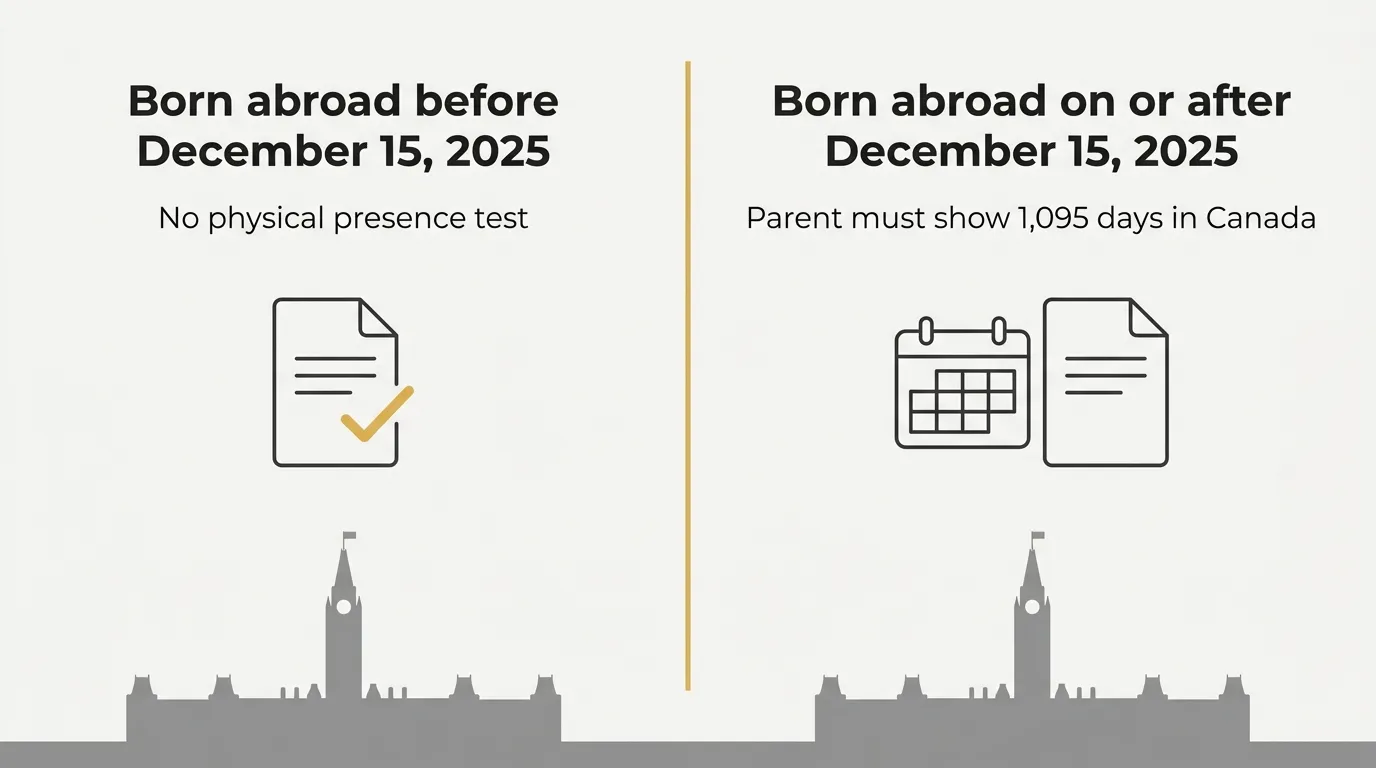
A change to the Citizenship Act that took effect on December 15, 2025 made a large number of people Canadian citizens without their knowing it. Bill C-3 removed the first-generation limit that had capped citizenship by descent since 2009, and it did so retroactively. If a parent, grandparent or more distant ancestor was born or naturalized in Canada, and the line of citizenship between that person and you was never broken, you may hold Canadian citizenship today.
This is a different route from naturalization, which is the path a permanent resident follows to apply for Canadian citizenship after meeting the residence requirement. There is no language test, no citizenship test and no requirement to have ever set foot in Canada. What there is instead is a documentary burden, and it is where nearly every claim of this kind succeeds or stalls.
Because the status sits alongside whatever nationality you already hold, most people who confirm a claim end up holding dual citizenship. This page covers who qualifies, what the application involves, and the records that decide it.
Bill C-3 Removed the First-Generation Limit on Citizenship by Descent
Between April 2009 and December 2025, citizenship by descent stopped at the first generation born outside Canada. A Canadian who had themselves been born abroad could not pass citizenship to a child also born abroad. The rule split families along an arbitrary line. Two siblings could end up with different status purely because of where a parent happened to have been living at the time of each birth.
The Ontario Superior Court of Justice found that limit unconstitutional in December 2023. The federal government chose not to appeal, an interim measure ran through 2025 while Parliament worked on a replacement, and Bill C-3 amended the Citizenship Act with effect from December 15, 2025. The ceiling is gone. In its place sits a condition attached to the parent, and that condition applies only to births and adoptions from the date the law changed.
Eligibility for Canadian Citizenship by Descent Depends on Your Date of Birth
The single most important fact in any descent claim is when you were born. It decides which of two entirely different tests applies, and a great deal of the advice circulating online applies the wrong one.
Born Outside Canada Before December 15, 2025
If you were born outside Canada before that date, and there is an unbroken line of Canadian citizenship running from an ancestor down to you, you are in most cases automatically a Canadian citizen. Generational distance is no longer a barrier. It does not matter whether your parents or grandparents ever lived in Canada as adults, held Canadian passports, or thought of themselves as Canadian.
No physical presence requirement attaches to this group. Nothing in the amended Act asks you or your parent to have spent time in Canada. If you qualify and would prefer not to hold the status, there is a process to renounce it.
Born or Adopted Outside Canada On or After December 15, 2025
A different rule governs children born or adopted abroad from the date the law changed, where the Canadian parent was also born or adopted abroad. In those cases the parent must show a substantial connection to Canada, defined as at least 1,095 cumulative days of physical presence in Canada before the birth or adoption. The days do not have to run consecutively.
The test does not reach every family. A child born in Canada is a citizen at birth regardless of the parent's history. The requirement also does not apply where the Canadian parent was serving outside Canada with the Canadian Armed Forces, the federal public administration, or a provincial or territorial public service in something other than a locally engaged role.
Adopted Children Follow a Separate Grant Process
Adoption is handled differently from birth. A child born and adopted outside Canada in the second generation or later is not automatically a citizen. Instead the family applies for a direct grant of citizenship for adopted persons, subject to the same generational logic and, for adoptions finalized from December 15, 2025 onward, the same parental presence condition.
| Factor | Born abroad before December 15, 2025 | Born abroad on or after December 15, 2025 |
| Generational limit | None | None, subject to the parental condition |
| Parental physical presence | Not required | 1,095 cumulative days, where the parent was also born abroad |
| How status arises | Automatically, by operation of law | Automatically where the condition is met |
| Application filed | Proof of citizenship | Proof of citizenship, with physical presence evidence |
| Additional form | None | CIT 0555 physical presence calculation |
Canadian Citizenship by Descent for Americans With Canadian Ancestry
Applicants in the United States have made up the largest single group of new claims since the law changed, and the reason is historical. Between roughly 1840 and 1930, hundreds of thousands of French Canadians left Quebec for the mill towns of New England, and further waves of migration continued through the twentieth century into New York, Michigan, Washington and beyond. Many of those descendants now sit inside the group Bill C-3 reaches.
An American claim carries two practical wrinkles. Vital records are held at state and county level rather than nationally, so one family line can require requests to several registries, each with its own turnaround and certification standards. And where a line runs back through Quebec, parish registers often do the work that civil registration does elsewhere, with entries in French that need accurate translation before an officer can follow the chain.
Proof of Citizenship Is the Application That Confirms Your Status
If Bill C-3 reaches you, you do not apply to become a citizen. You apply for proof of the citizenship you already hold, and what IRCC issues is a citizenship certificate. That certificate is what allows you to apply for a Canadian passport, take up work in Canada without a permit, and cross the border as a Canadian.
The application is form CIT 0001, and the fee is CAD 75 per applicant for adults and minors alike. Some applicants can file online while others must file on paper, depending on date of birth and the nature of the request. There is no interview in the ordinary course, although IRCC runs a quality assurance program that selects a proportion of files at random for verification, which can include an interview and, where parentage is in question, DNA testing.
Documents Required to Prove a Citizenship by Descent Claim
Eligibility is usually the easy part. Officers assess a chain of relationships, and the chain has to hold at every link, in documents that name the same people consistently across decades and sometimes across countries.
Long-Form Records for Every Generation in the Chain
Each person between you and the anchor ancestor needs a long-form birth record showing parentage. Short-form or wallet certificates almost never suffice, because they omit exactly the detail the officer needs. Photocopies must be clear colour copies of authentic documents, and a genealogy printout or family tree export is not a substitute for a vital record.
Marriage Records That Connect a Female Ancestor's Two Names
This is the single most common failure point, and it is worth understanding before you order anything. A woman typically appears under her maiden name on her own birth or baptismal record, and under her married name on her child's. To an officer reading the file cold, those read as two different people, and the chain breaks. Her marriage record is what proves the two names belong to one woman.
IRCC removed the dedicated field for grandparents' marriage details from the application form in late August 2026, and the fact that the form no longer asks has been widely misread as meaning the record no longer matters. An officer can still request it, and where a claim runs through a grandmother it frequently decides the outcome. Include the record whether or not there is a box for it.
Evidence of Canadian Status Before 1947
Canada's first Citizenship Act took effect on January 1, 1947, and status before that date was governed by British subject rules. For an ancestor born or living in that era, the proof is often evidence of birth or residence in Canada rather than any modern certificate. Census returns, land grants and petitions, and military service files from the two World Wars and earlier conflicts all carry the personal detail that establishes nationality and residence.
The pre-1947 rules also created a specific trap. A woman could acquire British subject status through her husband and could lose it the same way, which means a grandmother's marriage before 1947 may determine whether status passed to your parent at all. Subsection 11(2) of the Citizenship Act provides a route back for women in that position.
Physical Presence Evidence for Births From December 2025
Where the 1,095 day condition applies, IRCC updated its evidence standards in August 2026 and tightened them in one respect that catches people out. Employment and education records, travel records, residential records and Canadian government records all count. So do affidavits from religious institutions, unions, volunteer programs or third parties with knowledge of the parent's time in Canada, but those now have to be sworn before a commissioner authorized to administer oaths, carrying the affiant's name, mailing address and contact details. An unsworn letter from a church that would have been accepted earlier no longer is.
Family members cannot swear these affidavits. The exclusion runs wide, covering parents, siblings, spouses and partners, grandparents, children, aunts, uncles, nieces, nephews and first cousins, and a relative who happens to be a notary is still a relative.
How to Apply for Proof of Canadian Citizenship
Identify the Generation Your Claim Runs Through
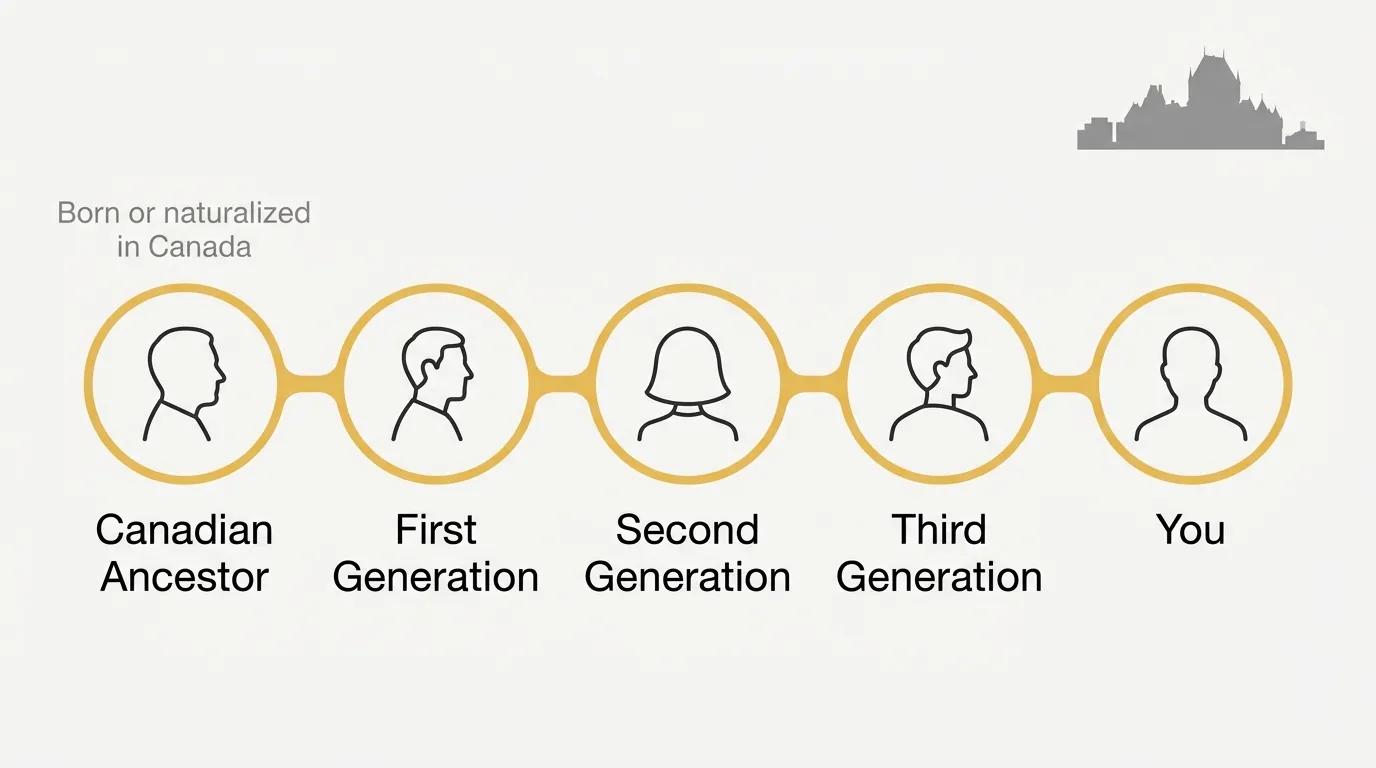
Start by naming the ancestor who was born or naturalized in Canada, then map every parent and child link down to you. Counting generations correctly matters, because the first generation is the first person born outside Canada to a Canadian citizen, not the ancestor who left. Check your own date of birth against December 15, 2025 to confirm which test applies.
Download the Current Version of Form CIT 0001
IRCC revised the proof of citizenship package more than once during the last week of August 2026, including the form, the document checklist, the physical presence form and the instruction guide, and in at least one case the revision code in the footer did not change between versions. A copy saved even a few days earlier may not match the current package. Download the whole set fresh from the IRCC citizenship certificate application page on the day you assemble the application.
Assemble Records for Every Link in the Chain
Order vital records early, because registries in some jurisdictions take months and several of them may be involved in one family. Where a record cannot be obtained, keep the correspondence. IRCC accepts a written explanation for a missing document provided you can show the attempt was made, and letters from the registry are what demonstrate that.
Pay the Fee and Submit the Application
Pay the CAD 75 fee through your IRCC account and keep the receipt, which forms part of the submission. Do not file the same request both online and on paper, since the duplicate will not be processed. Applications from outside Canada and the United States pass a lighter completeness check, with supporting documents requested later at an officer's discretion.
Respond to Officer Requests Without Delay
Officers can ask for further evidence at any point under the Citizenship Act and its regulations, and an unanswered request adds months to a file that is already slow. Keep your address, email and phone number current with IRCC for the entire time your application is open. The declaration you sign commits you to reporting any change to the information on the form before processing ends.
Processing Times and Costs for a Citizenship Certificate
Volumes have risen sharply since the law changed. IRCC published an estimate of roughly 25 months in August 2026, having quoted about 12 months in May and 19 in July of the same year, with well over one hundred thousand people awaiting a decision. A document review during June 2026, which paused finalization of descent applications for about a month, sat on top of an already growing caseload. The estimate is recalculated monthly, so treat any published figure, including this one, as a snapshot and check the government's processing times tool before planning around it. The department's page on the 2025 change to citizenship rules sets out the position it is applying.
Waiting for the queue to shorten rarely helps. The estimate is built from the number of files already ahead of yours at the moment you submit, and intake has climbed every month since December 2025, so a later filing usually means a longer wait rather than a shorter one. Urgent processing exists but is limited to narrow circumstances and is not a general remedy for the backlog.
Common Reasons Citizenship by Descent Claims Stall
- A name that changes between documents without a marriage or name change record to explain it, most often through a female ancestor.
- Short-form birth certificates that confirm the birth but omit the parentage detail the officer needs to establish the link.
- Genealogy research submitted as evidence in place of vital records, which identifies where to look but proves nothing on its own.
- An outdated version of the form or checklist, downloaded before one of the recent revisions.
- Unsworn letters offered as physical presence evidence where a sworn affidavit is now required.
- A gap left unexplained rather than addressed with a letter setting out what was sought and why it could not be obtained.
- A break in the chain before 1947 caused by the British subject rules, missed because the applicant assumed modern law applied throughout.
How SEP Immigration Helps With Citizenship by Descent Claims
We assess whether Bill C-3 reaches your family, identify which records each generation needs, and prepare the proof of citizenship application so that it goes in complete. Sepehr Falahati is a Regulated Canadian Immigration Consultant in good standing with the CICC, and SEP Immigration works with applicants in the United States and elsewhere.
Stay informed
Get our immigration updates first on Google
Add SEP Immigration as a preferred source and our latest news and guides appear more often in your Google results.
About the Author

Sepehr Falahati
CEO of SEP Immigration
- CICC Licensed
- RCIC #R533959
- IRB Member
Sepehr Falahati is a Regulated Canadian Immigration Consultant (RCIC #R533959), licensed by the College of Immigration and Citizenship Consultants (CICC).
Read more about Sepehr FalahatiReviewed By


Continue Reading