
Easiest English Test for Canada Immigration and PR
Reviewed by Mohsen Khorvash and Mahsa Barati

No English test for Canada is graded more generously than the others. Immigration, Refugees and Citizenship Canada converts every result to the same benchmark scale, so a CLB 7 earned on IELTS counts exactly the same as a CLB 7 earned on CELPIP or PTE Core when your Express Entry profile is scored. What changes from test to test is the experience of sitting it: who scores your speaking, how long your written answers must be, how quickly results come back and what a second attempt costs. Those differences decide which test is easiest for you.
This guide compares the three approved tests on the points that move real scores, then matches each one to the candidates it tends to suit. If you have already settled on IELTS, our guide to IELTS for Canada covers that test in depth, and our language converter turns any result into CLB levels one ability at a time.
IRCC-Approved English Tests for Canada PR and Express Entry
Three English tests are approved for Canadian permanent residence, and each one has a near-identical version that cannot be used.
IELTS General Training, CELPIP-General and PTE Core
For English, IRCC accepts IELTS General Training, CELPIP-General and PTE Core, with TEF Canada and TCF Canada on the French side. The same list applies to the Federal Skilled Worker Program, the Canadian Experience Class and the Federal Skilled Trades Program. Most provincial nominee programs follow it too, but some provincial streams still name only IELTS and CELPIP, so confirm the stream before you book PTE Core. Every approved test reports listening, reading, writing and speaking separately, and each score is converted to a Canadian Language Benchmark level on its own.
Test Versions IRCC Does Not Accept for Permanent Residence
Booking the wrong version is the costliest mistake in this decision, because the result cannot be converted or upgraded. IELTS Academic is not accepted for Express Entry, and neither is IELTS One Skill Retake. PTE Academic cannot replace PTE Core. CELPIP-General LS, which tests only listening and speaking, works for a Canadian citizenship application but not for permanent residence. The Duolingo English Test and TOEFL are not approved for any economic immigration program, so a score from either has no value in a PR file.
English Test for Canada Compared: Length, Fees and Result Times
Before format and difficulty, three practical questions narrow the choice for most people: which tests you can book nearby, how fast you need results and what a second attempt would cost.
| Feature | IELTS General Training | CELPIP-General | PTE Core |
|---|---|---|---|
| Delivery | Computer at a test centre (paper testing ended in 2026) | Computer at a test centre | Computer at a test centre |
| Speaking scored by | Live examiner, face to face | Recorded, rated by trained human raters | Recorded, scored by an automated system |
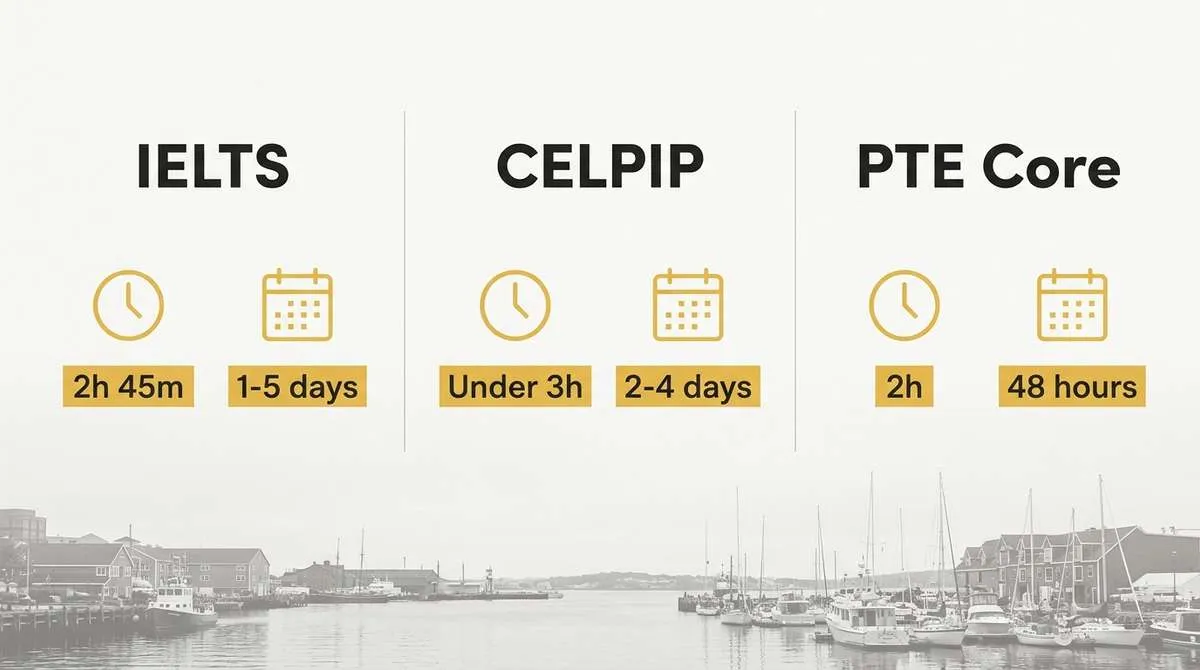
| Total test time | About 2 hours 45 minutes, speaking may be on another day | Just under 3 hours, one sitting | About 2 hours, one sitting |
| Score scale | Bands 1 to 9 in half steps | Levels 1 to 12, same numbers as CLB | 10 to 90 per ability |
| Results | Usually 1 to 5 days | 2 to 4 business days | Usually within 48 hours |
| Fee in Canada | About CAD 320 to 360 | $295 plus tax | About CAD 340 to 360 |
| Test centres | Widest network worldwide | 200+ centres in about 40 countries, concentrated in Canada | 500+ centres in over 115 countries |
The Shortest and Fastest English Test for Canada
PTE Core is both the shortest sitting and the quickest to report, with results usually released inside 48 hours. That speed matters when you are working against the 60-day deadline that follows an Express Entry invitation, or when a post-graduation work permit application needs a language result before your study permit runs out. CELPIP runs longest at just under three hours, but it finishes in one sitting, while IELTS can split speaking onto a separate day.
The Cheapest English Test in Canada and the Real Cost of a Retake
CELPIP has the lowest listed fee at $295 plus tax, which comes to roughly $333 in Ontario. The gap to IELTS and PTE Core is real but small next to the cost of a second sitting, because none of the three offers a single-skill retake that IRCC accepts for permanent residence. A retake is always the full test at the full fee. Before paying for one, check what the higher level would add in our CRS score calculator, since a single ability moving up a level can be worth far more than the fee.
Test Centre Availability Inside and Outside Canada
Inside Canada, larger cities usually host all three tests, though smaller centres may offer only one or two. Outside Canada the picture changes. IELTS has by far the widest network, PTE Core sits in the middle, and CELPIP centres abroad are mostly in large cities in a limited set of countries. For many candidates abroad, availability settles the question before format does.
Easiest Canadian English Test Section by Section
Most candidates find one ability clearly harder than the rest, and the three tests handle each ability differently enough that the same person can land a full level apart.
Speaking With an Examiner or Into a Microphone
IELTS is the only test with a live examiner: an 11 to 14 minute conversation in a private room, covering familiar topics, a two-minute talk and a follow-up discussion. An examiner can tell a pause for thought from a loss of words. CELPIP uses eight recorded tasks over about 15 to 20 minutes, such as giving advice, describing a scene and handling a difficult situation, all with set preparation and response times. PTE Core uses short bursts, including reading aloud, repeating sentences and responding to a situation, and a few seconds of silence can end a recording. If you freeze in front of a microphone, IELTS is usually the safer choice. If talking to a stranger makes you nervous, the recorded formats can feel easier.
Writing Long Answers or Short Timed Tasks
IELTS asks for a letter of at least 150 words and an essay of at least 250 words in 60 minutes, with the essay carrying more weight. CELPIP asks for an email and a survey response of 150 to 200 words each in about 53 minutes, both typed. PTE Core asks for a 25 to 50 word summary and a 50 to 120 word email, and writing is also scored inside some listening and reading tasks. Short answers look easier, but they leave little room to show range, and the PTE Core threshold for CLB 7 in writing is 69, the highest of its four abilities.
Listening and Reading Under Different Time Pressures
IELTS listening uses four longer recordings with 40 questions, so missing one passage can cost several marks at once. CELPIP spreads listening across six parts built on everyday Canadian situations, with Canadian and North American voices. PTE Core uses many short clips and runs listening and reading in about 30 minutes each. Candidates who read carefully and steadily tend to do better on IELTS and CELPIP. Quick readers who work well under a clock often prefer PTE Core.
Best English Test for Canada PR by Candidate Profile
Taking the logistics and the section formats together, most candidates fall into one of three groups.
PTE vs CELPIP for Candidates Already in Canada
Candidates in Canada on a work or study permit usually choose between these two. CELPIP is built around Canadian workplace and community settings, and its scores read straight across to CLB, so there is no conversion table to misread. It was developed in Canada by Paragon Testing Enterprises, originally a University of British Columbia spin-off, and not by IRCC itself. PTE Core suits candidates who type fast and want the result within two days. If your typing is slow or you need time to plan a long answer, CELPIP is usually the more forgiving of the two.
IELTS for Candidates Testing Outside Canada
Abroad, IELTS is often the only test with a centre within reach, and it is the one most preparation material is written for. It also suits anyone who reads more accurately at a steady pace and speaks better in conversation than into a headset. Since the move to computer delivery in 2026, the content is unchanged, but practising reading and typing on screen now matters for IELTS as much as for the other two.
Fast-Result Options for Tight Express Entry Deadlines
When an invitation is already in hand, or results are about to expire, speed outweighs format. PTE Core is the fastest route to a usable report, and CELPIP is a close second for candidates inside Canada. Whatever the deadline, sit a full timed practice test before you pay, because a fast result one level short of the requirement helps no one.
Score Thresholds That Make One Test Harder Than Another
The tests are equal in principle, but each reaches a CLB level through its own cut-offs, and where those cut-offs sit can make a target easier or harder for you on a particular test.
CLB 7 Minimums on IELTS, CELPIP and PTE Core
CLB 7 in all four abilities is the minimum for the Federal Skilled Worker Program and for Canadian Experience Class jobs in TEER 0 or 1. CEC jobs in TEER 2 or 3 need CLB 5, and the Federal Skilled Trades Program needs CLB 5 in speaking and listening and CLB 4 in reading and writing. On IELTS, CLB 7 means 6.0 in every ability. On CELPIP it means 7 in every ability. On PTE Core it means 68 in speaking, 60 in listening, 60 in reading and 69 in writing. There is no averaging on any test, so your lowest ability sets your level.
Where CLB 9 Is Hardest to Reach on Each Test
CLB 9 is where language starts to lift a ranking score sharply, and each test has a different pinch point. On IELTS, listening needs 8.0 while the other three abilities need 7.0. On PTE Core, writing needs 88 and speaking needs 84. CELPIP asks for a flat 9 in every ability. A candidate whose listening is their weakest skill may find CLB 9 more reachable on CELPIP, while a strong listener with weaker writing may do better on IELTS. The official equivalency tables are on IRCC's Express Entry language test results page. Results must be under two years old both when you create your profile and when you submit your permanent residence application.
Language is usually the one factor you can still move once your education and work history are fixed. SEP Immigration, led by Sepehr Falahati (RCIC #R533959, licensed by the CICC), reviews your scores against the program you are targeting and identifies which test, and which ability, is worth your next attempt.
This article is general information, not legal advice, and test fees, formats and program requirements change. Verify current details with IRCC and the test provider before you book; information is current as of October 2026.
Frequently asked questions
01Which English test is the easiest for Canadian immigration?
None of the three is graded more generously. IRCC converts IELTS General Training, CELPIP-General and PTE Core results to the same CLB scale, so the easiest test is the one whose format suits you. Candidates who speak better to a person often prefer IELTS, those comfortable on a computer with North American accents often prefer CELPIP, and fast typists who handle strict timers well often prefer PTE Core.
02Is CELPIP or IELTS better for Canada immigration?
Neither carries an advantage with IRCC. CELPIP usually suits candidates already in Canada, because it uses Canadian settings and its scores match CLB levels directly. IELTS usually suits candidates testing abroad, where its centre network is far wider, and anyone who performs better in a face-to-face speaking interview.
03Is PTE Core easier than CELPIP?
PTE Core is shorter and returns results faster, and its writing tasks ask for far fewer words. It is not easier to score well on, because every task runs on a strict timer and writing needs 69 for CLB 7 and 88 for CLB 9. CELPIP gives more time and longer answers, which suits candidates who need room to develop their ideas.
04How many times can I take an English test for Canada PR?
IRCC sets no limit on attempts and no waiting period between them. Each sitting is a full test at the full fee, and you choose which valid result to enter in your profile, so a weaker later attempt does not cancel a stronger earlier one. The test providers set their own booking rules, so check them before you register a second sitting.
05Do native English speakers need an English test for Canada PR?
Yes. Express Entry candidates must submit results from an approved test whatever their first language, citizenship or education, and a degree taught in English does not replace it. Native speakers often score CLB 9 or higher with little preparation, but the format still rewards a practice run, especially for timed writing.
06Can I switch to a different English test after a low score?
Yes. IRCC does not require you to stay with one test, and you enter whichever valid result you want to rely on in your profile. Switching is worth considering when a format issue cost you a specific ability, such as freezing in a recorded speaking task. If the problem is general English level, more preparation helps more than a new test.
07Which English test is accepted for Canadian citizenship?
Citizenship applicants aged 18 to 54 need CLB 4 in speaking and listening. CELPIP-General, CELPIP-General LS, IELTS General Training and PTE Core are all accepted, and unlike permanent residence, a qualifying result is still accepted after it has expired.
Stay informed
Get our immigration updates first on Google
Add SEP Immigration as a preferred source and our latest news and guides appear more often in your Google results.
About the Author

Sepehr Falahati
CEO of SEP Immigration
- CICC Licensed
- RCIC #R533959
- IRB Member
Sepehr Falahati is a Regulated Canadian Immigration Consultant (RCIC #R533959), licensed by the College of Immigration and Citizenship Consultants (CICC).
Read more about Sepehr FalahatiReviewed By


Continue Reading