
Canadian Language Benchmark (CLB) Guide
Reviewed by Mohsen Khorvash and Mahsa Barati
Your CLB level is the single most important number in most Canadian immigration applications. It decides whether you qualify for Express Entry at all, and it is worth more ranking points than almost any other factor you can realistically change. Understanding what the levels mean, and which ability is holding yours down, is often the fastest route to a competitive profile.
This guide explains what the benchmarks measure, what each level represents in practice, the minimum every program requires, and how a higher level changes your CRS score.
Key Facts About CLB Levels
- CLB for English, NCLC for French. Both run from 1 to 12 and are treated identically.
- There is no CLB test. You take an approved test and your results are converted.
- Each ability is scored separately: listening, reading, writing, and speaking.
- Your lowest ability governs. There is no averaging across the four.
- CLB 7 is the key threshold for most Express Entry applicants.
- Results expire after two years and must be valid at profile and at application.
What Are the Canadian Language Benchmarks?
The Canadian Language Benchmarks (CLB) are Canada's national standard for describing English ability in adult learners. The framework measures listening, speaking, reading, and writing across twelve levels, grouped into three broad stages. Each step up reflects stronger communication and greater independence in daily life or work.
CLB Levels Explained
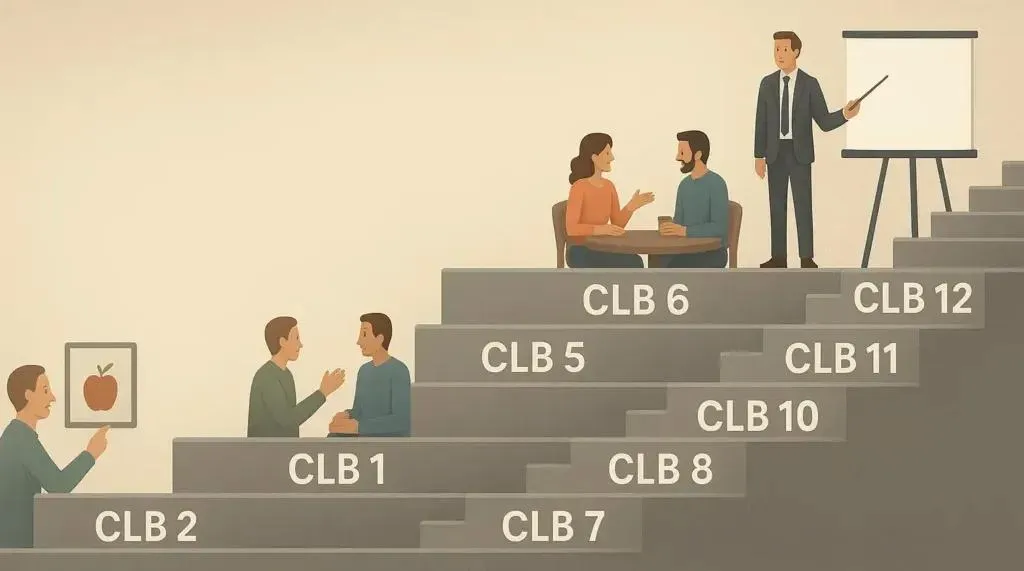
- CLB 1 to 4 (Basic). Communication is limited to simple phrases and everyday expressions. Conversations often need repetition or gestures, and writing stays short and functional.
- CLB 5 to 8 (Intermediate). Conversation flows more easily in work and social settings. Longer texts become readable, and writing is clear though not free of errors. Most immigration thresholds sit in this band.
- CLB 9 to 12 (Advanced). English can be used comfortably in complex or professional situations, including unfamiliar topics, detailed reports, and precise writing.
CLB and NCLC for French
The French equivalent is the Niveaux de compétence linguistique canadiens (NCLC). It uses the same 1 to 12 scale and carries the same weight, so an NCLC 7 in French counts exactly as a CLB 7 in English. Candidates with strong French have a real advantage, because French ability earns additional points and opens French-language category draws that are closed to everyone else.
Why Your Lowest Score Decides Your Level
This is the rule that catches most applicants, and it is worth understanding before you book any test. IRCC assesses each of the four abilities separately, and every one must meet the minimum on its own. There is no averaging.
If three of your abilities sit at CLB 9 and one at CLB 6, you meet CLB 6 for eligibility purposes, not CLB 8. The practical consequence is that a small improvement in one weak skill is usually worth far more than broad improvement across the rest, and identifying that weak skill is the first step before any retest.
Minimum CLB Level by Program
Knowing your level only helps once you compare it against what your program requires. Every ability must meet the minimum on its own.
| Program | Minimum level |
|---|---|
| Federal Skilled Worker Program | CLB or NCLC 7 in all four abilities |
| Canadian Experience Class, TEER 0 or 1 | CLB or NCLC 7 in all four abilities |
| Canadian Experience Class, TEER 2 or 3 | CLB or NCLC 5 in all four abilities |
| Federal Skilled Trades Program | CLB or NCLC 5 in speaking and listening, 4 in reading and writing |
| Second official language (FSW points) | CLB or NCLC 5 in all four abilities |
Provincial streams set their own thresholds, so check the requirements of any Provincial Nominee Program you are targeting rather than assuming the federal minimum applies.
How CLB Affects Your CRS Score
Language is scored twice, which is why it carries so much weight. Under the Federal Skilled Worker selection grid, your first official language earns up to 24 points, and a second official language at CLB or NCLC 5 across all four abilities adds a further 4 points.
Within the Comprehensive Ranking System used to rank candidates in the pool, language counts for considerably more, and points continue rising up to CLB 10. Moving from CLB 7 to CLB 9 often changes an applicant's prospects more than any other single action available to them, which is why a retest is frequently the fastest route to a competitive score.
How to Get Your CLB Level Assessed
You never sit a test called CLB. Instead you take an approved test, and each of your four results is converted into a benchmark level.
Which Tests Canada Accepts
For English, IRCC accepts IELTS General Training, CELPIP-General, and PTE Core. For French, it accepts TEF Canada and TCF Canada. Choosing the wrong version of a test is a common and expensive mistake, since IELTS Academic and PTE Academic cannot be used for Express Entry.
The process itself is straightforward: register at an official test centre well ahead of any deadline, complete all four abilities on test day, then convert each result separately. For the full score-by-score conversion tables covering every accepted test, see our CLB conversion charts.
How Long Results Stay Valid
Test results are valid for two years from the test date, and they must be valid at two separate moments: when you create your Express Entry profile, and when you submit your application for permanent residence. Applying with expired results leads to a refusal. If your results will lapse while you are in the pool, either retest, apply before they expire, or decline an invitation and return to the pool.
How to Improve Your CLB Level
Start by identifying which single ability is holding your level down, because that is where effort pays best. From there, steady practice matters more than intensity:
- Listen actively. Pause and repeat sections, note new words, and check their meanings. Canadian news broadcasts help you adjust to local accents.
- Read slightly above your level. Move up gradually, and use new vocabulary in writing or speech the same day.
- Speak often. Conversation circles at libraries and settlement agencies are usually free. Recording yourself exposes errors you would not otherwise notice.
- Write daily. Summarising a news article in your own words, then comparing structures with the original, builds range quickly.
- Practise under timed conditions. Full sections back to back build the stamina test day demands.
- Get feedback. Many settlement agencies offer free or low-cost classes built directly around the CLB framework.
Progress takes weeks or months, and consistency beats intensity. Thirty minutes daily does more than one long session each week.
A single weak ability can quietly cost you an invitation, and the fix is often smaller than people expect. SEP Immigration, led by Sepehr Falahati (CICC and IRB member R533959), reviews your results against your target programs, identifies which ability is worth retesting, and builds the rest of your profile around it.
This page is general information, not legal advice. Conversion charts and program minimums follow IRCC's official equivalency tables and can change. Confirm your own scores on the Government of Canada's Express Entry language test results page before relying on them.
Frequently asked questions
01How long are CLB scores valid?
Language test results are valid for two years and must still be valid both when you create your profile and when you submit your permanent residence application.
02What is the Canadian Language Benchmarks scale?
A twelve-level system measuring listening, speaking, reading, and writing in English for adults. The French equivalent is the NCLC, and the two are treated identically.
03How do I find my CLB level?
Compare each ability on your test report against the equivalency charts above. Your effective level is your lowest ability, not your average.
04What is CLB 7?
CLB 7 is strong intermediate ability and the most common Express Entry threshold. On IELTS General Training it means 6.0 in each of the four abilities.
05What is CLB 4?
CLB 4 is basic ability. You can handle simple messages but struggle with complex situations. It is the reading and writing minimum for the Federal Skilled Trades Program.
06Is CLB 7 hard to get?
It requires solid preparation, but many test-takers reach it after focused practice across all four abilities. The usual obstacle is one weak skill rather than overall ability.
07Why does CLB 6 matter?
CLB 6 sits just below the main federal threshold, so candidates at this level are often one half-band away from qualifying under a program that requires CLB 7.
08Can I take a CLB test online?
There is no test called CLB. You take IELTS General Training, CELPIP-General, PTE Core, TEF Canada, or TCF Canada, and your results are converted.
09Does my average score count?
No. Every ability is assessed on its own and must meet the minimum. Three abilities at CLB 9 and one at CLB 6 means you meet CLB 6.
10What jobs can I get with CLB 5?
CLB 5 supports basic workplace communication, which suits roles that do not demand advanced technical or professional language. It is also the Canadian Experience Class minimum for TEER 2 and 3 occupations.
Stay informed
Get our immigration updates first on Google
Add SEP Immigration as a preferred source and our latest news and guides appear more often in your Google results.
About the Author

Sepehr Falahati
CEO of SEP Immigration
- CICC Licensed
- RCIC #R533959
- IRB Member
Sepehr Falahati is a Regulated Canadian Immigration Consultant (RCIC #R533959), licensed by the College of Immigration and Citizenship Consultants (CICC).
Read more about Sepehr FalahatiReviewed By


Continue Reading