
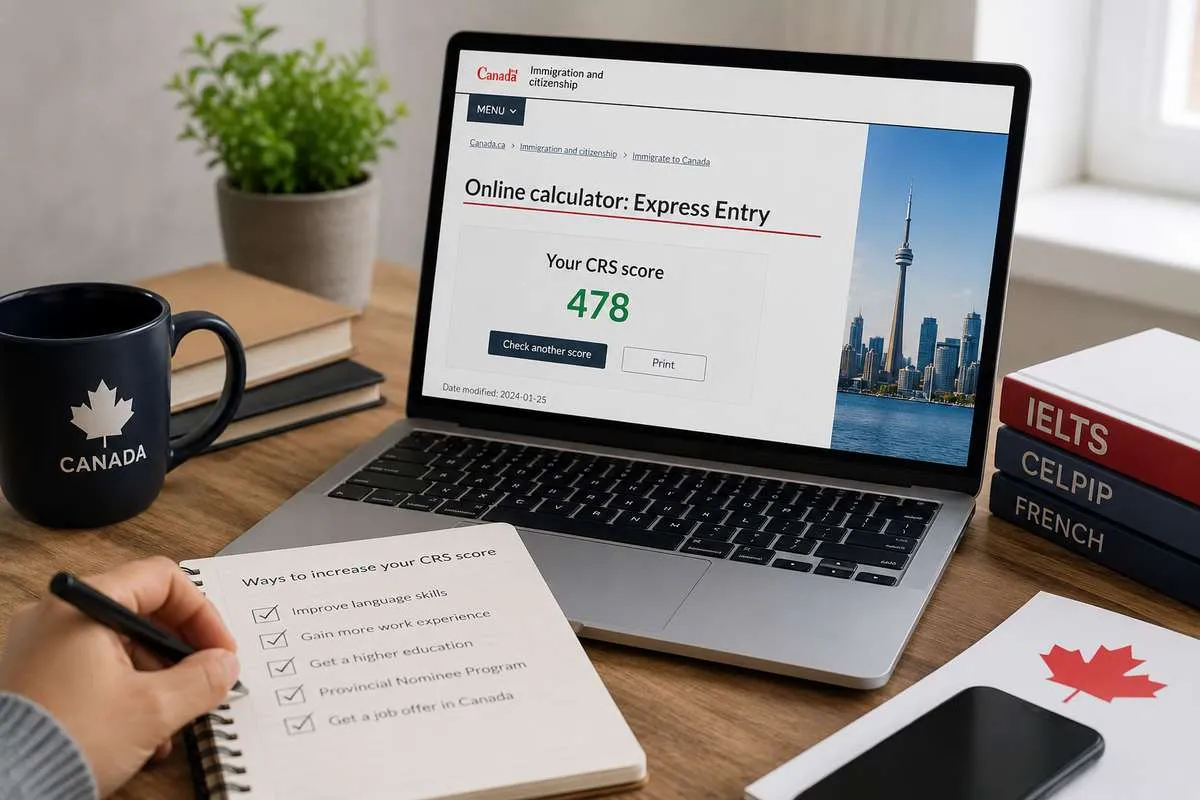
If your Express Entry profile is sitting below recent cut-offs, the question is not how the score works but which lever will actually move it, and how quickly. Some factors are fixed. Age only falls, and you cannot change where you were born. Others are genuinely improvable, and a few are worth far more than most candidates realise.
This guide ranks the realistic ways to raise your score by how many points each is worth and how long each takes. To see where you stand today, start with our CRS score calculator.
Key Facts About Raising Your CRS Score
- A provincial nomination is worth 600 points, more than every other improvement combined.
- Language is the fastest lever. Results arrive in days and count twice.
- French adds up to 50 points and opens lower-cut-off draws.
- Job offer points are gone, removed on March 25, 2025.
- You can update your profile any time before an invitation, and your score recalculates immediately.
- Small gains matter when cut-offs move by single points between draws.
What Is a Good CRS Score?
There is no fixed number to aim at, because the cut-off is set fresh in every round based on how many invitations IRCC issues and who is in the pool that day. General draws through 2026 have largely landed in the 490 to 530 range, so a score above 500 puts most candidates in contention.
Two things complicate that picture in your favour. Category-based draws, which target specific occupations or French ability, frequently invite at lower scores than general rounds. And provincial nomination draws sit far higher only because everyone in them already holds 600 bonus points. Check the current numbers on the Government of Canada's rounds of invitations page rather than relying on a figure you read months ago, and follow recent activity through our Express Entry draws page.
Ways to Increase Your CRS Score, Ranked
The table below compares each realistic lever by value and speed. The right choice depends less on which is biggest than on which is achievable in your situation.
| What you can do | Points | Realistic timeline |
|---|---|---|
| Obtain a provincial nomination | 600 | Several months to over a year |
| Raise your first language scores | Up to roughly 50 to 100 combined | Weeks to a few months |
| Reach NCLC 7 in French | 25 or 50, plus category access | Months to years |
| Gain another year of skilled work experience | Varies, larger for Canadian experience | One year |
| Complete a higher credential | Varies by level | One to two years |
| Claim a sibling in Canada | 15 | Immediate |
| Claim a Canadian credential | 15 or 30 | Immediate if already held |
Get a Provincial Nomination
Nothing else comes close. A nomination through a Provincial Nominee Program adds 600 points, which in practice guarantees an invitation in the next round you are eligible for. This is why candidates in the 400s should treat provincial routes as their primary strategy rather than a fallback.
Each province runs its own streams, criteria, and draw schedule, and many select directly from the Express Entry pool. Some target specific occupations, others prioritise candidates already working in the province. Ontario's Ontario Immigrant Nominee Program is one of the larger programs, and our comparison of Express Entry and the PNP explains how the two systems interact. The trade-off is time and commitment: nomination processes take months, and you generally agree to settle in that province.
Raise Your Language Scores
This is the fastest meaningful gain available to almost everyone. Language is scored twice, once as a core human capital factor and again through skill transferability, where it combines with your education and work experience. That double counting is why a single band improvement can add 20 to 30 points or more, and why moving from CLB 7 to CLB 9 often transforms a profile.
Two practical points decide whether a retest is worth it. Your effective level is set by your weakest ability, so identify which of the four is holding you back rather than preparing across all of them equally. You can check your test results with our Language Converter to see which specific section needs improvement. And points stop increasing above CLB 10, so candidates already at the top of the scale should look elsewhere. Our CLB guide explains how the levels work.
Add French
Reaching NCLC 7 or higher across all four French abilities adds 50 points if your English sits at CLB 5 or above, or 25 points if your English is weaker. That alone is substantial, but the larger prize is access to French-language category draws, which routinely invite candidates at cut-offs well below general rounds. For a candidate with existing French, or the time to reach an intermediate level, this is often the difference between waiting indefinitely and being invited.
Gain More Work Experience
Additional skilled work experience adds points, and Canadian experience is worth considerably more than foreign experience because it also feeds skill transferability. Reaching one year of Canadian skilled work also opens the Canadian Experience Class, which has lower language requirements for some occupations and no proof of funds requirement. If you are already working in Canada, simply staying in your job and updating your profile at each anniversary is a reliable, no-cost gain.
Improve Your Education
A higher credential adds points, and the combination of education with strong language results adds more again through skill transferability. Two smaller opportunities are often missed. If you hold a second completed credential, having it assessed may add points where the combination qualifies. And if you studied in Canada, a Canadian credential adds 15 or 30 points depending on the length of the program, which many candidates simply forget to claim.
Smaller Gains Worth Claiming
When cut-offs move by a handful of points between draws, the small items decide outcomes. These cost nothing but documentation.
- A sibling in Canada adds 15 points. The sibling must be 18 or older, a Canadian citizen or permanent resident living in Canada, and share at least one parent with you or your spouse. Half-siblings and step-siblings can qualify.
- A Canadian credential adds 15 or 30 points, which applies to many former international students who never entered it.
- Switching the principal applicant. If you are applying as a couple, calculate the score both ways. Where your spouse has stronger language results, education, or age, making them the principal applicant can produce a higher total for the same household.
- Your spouse's results count. Their language test and credential assessment add points, so it is often worth them testing even if they were not planning to.
What No Longer Increases Your Score
One change reshaped strategy for many candidates. Since March 25, 2025, a valid job offer adds no CRS points at all, ending the former awards of 50 points for most skilled roles and 200 for senior management. Anyone whose plan depended on securing an LMIA-backed offer purely for points needs a different approach.
A job offer still has real value. It can establish eligibility for a program, and it underpins many provincial nomination streams, which carry 600 points. But the direct points are gone, and treating a job offer as a shortcut to a higher score is now a mistake. IRCC has signalled that limited job offer points may return for certain high-wage and regulated occupations, but that has not taken effect.
How Fast Can You Realistically Raise Your Score?
Set expectations by timeline rather than by ambition. Within days, you can claim a sibling, add a Canadian credential, or correct anything you underreported. Within weeks to a couple of months, a language retest is achievable and usually delivers the largest gain per unit of effort. Within a year, another year of work experience, a nomination, or meaningful French progress becomes realistic.
Your profile stays in the pool for 12 months and can be updated at any time before an invitation, with the score recalculating immediately. If your profile is close to expiring and your score is still short, you can submit a fresh profile and continue improving. Understanding how the pool ranks candidates helps you judge where you sit, and our guide to the Federal Skilled Worker Program covers the eligibility side.
Most candidates focus on the biggest number rather than the one they can actually reach this quarter, and lose months as a result. SEP Immigration, led by Sepehr Falahati (CICC and IRB member R533959), reviews your profile factor by factor, identifies which gains are realistic in your timeframe, and builds the strategy that gets you above the cut-off.
This page is general information, not legal advice. CRS criteria, point values, and draw cut-offs change. Confirm current details on canada.ca, or with a licensed representative, before you act.
Frequently asked questions
01What is a good CRS score?
There is no fixed target, because the cut-off changes with every draw. General draws through 2026 have largely sat between 490 and 530, so a score above 500 is competitive for most candidates. Category-based and French-language draws often invite at lower scores.
02What is the fastest way to increase your CRS score?
Retaking your language test. Results arrive within days on a computer-delivered test, and language is scored twice, so a single band improvement can move your total by 20 to 30 points or more. A provincial nomination is worth far more at 600 points, but takes months.
03Does a job offer still increase your CRS score?
No. IRCC removed job offer points on March 25, 2025, ending the former 50 and 200 point awards. A job offer can still help you qualify for a program or support a provincial nomination, but it no longer adds points on its own.
04How many points does French add to your CRS score?
NCLC 7 or higher in all four French abilities adds 50 points if your English is at CLB 5 or above, or 25 points if your English is weaker. French also opens category draws that often invite at much lower cut-offs.
05Can you increase your CRS score after submitting your profile?
Yes. Your profile stays in the pool for up to 12 months and can be updated at any time before an invitation. New language results, extra work experience, or a nomination recalculate your score immediately.
Stay informed
Get our immigration updates first on Google
Add SEP Immigration as a preferred source and our latest news and guides appear more often in your Google results.
About the Author

Sepehr Falahati
CEO of SEP Immigration
- CICC Licensed
- RCIC #R533959
- IRB Member
Sepehr Falahati is a Regulated Canadian Immigration Consultant (RCIC #R533959), licensed by the College of Immigration and Citizenship Consultants (CICC).
Read more about Sepehr FalahatiReviewed By


Continue Reading