
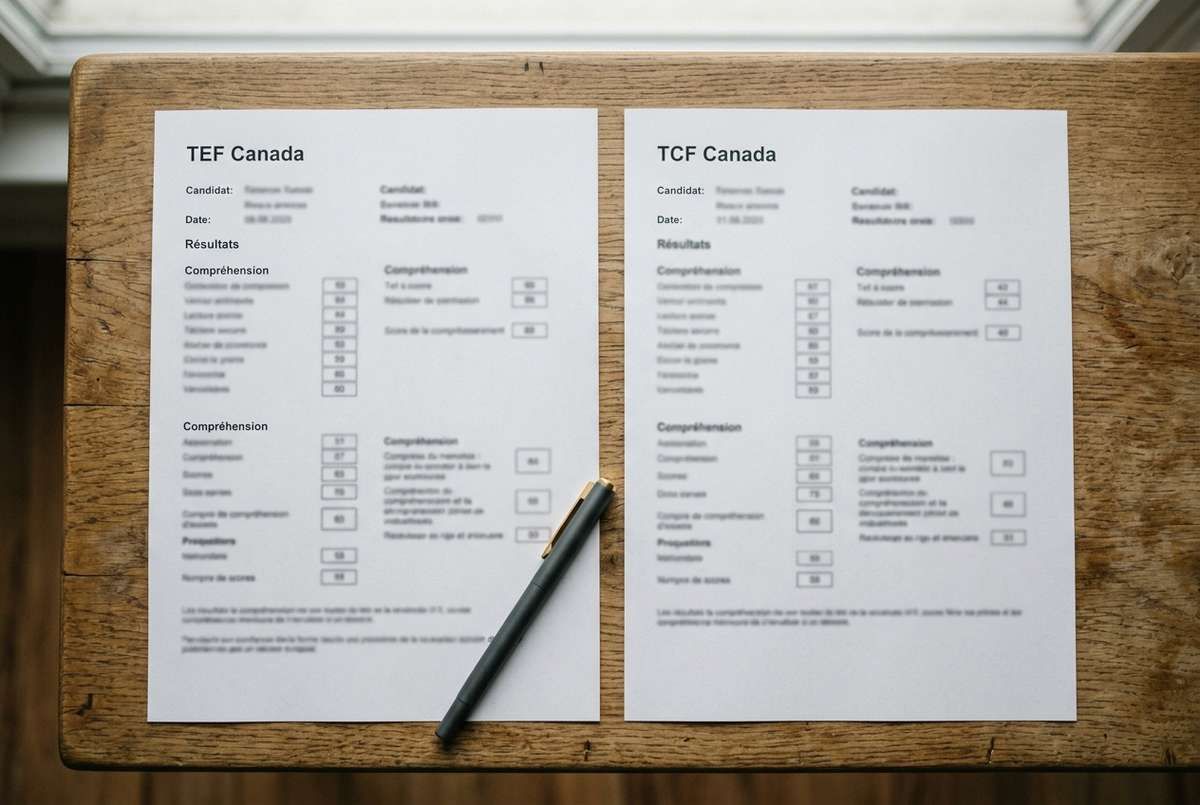
French is the one factor that can lift an Express Entry profile without touching your education or work history, because a strong result earns points twice and opens French-language category draws that are closed to everyone else. To claim any of that, IRCC needs a result from an approved French test, and there are only two: TEF Canada and TCF Canada. Both are accepted equally, both convert to the same benchmark scale, and the choice between them comes down to format and logistics rather than any difference in how IRCC treats the score.
This guide compares the two tests on the things that change a real result: how each section is built, how the speaking task is run, how the scores convert to Canadian Language Benchmark levels, and the one score-entry mistake on TEF Canada that refuses applications every year. If you are weighing French against an English test instead, our guide to the easiest English test for Canada immigration covers that side of the decision.
IRCC-Approved French Tests for Canada PR and Express Entry
Two French tests are approved for Canadian permanent residence, each run by a different organization and each with its own format. A score from any other French exam, including the Quebec-specific versions, cannot be entered in a federal Express Entry profile.
TEF Canada and TCF Canada
IRCC accepts TEF Canada (Test d'evaluation de francais) and TCF Canada (Test de connaissance du francais). TEF Canada is administered by CCI Paris Ile-de-France, and TCF Canada by France Education International, delivered through Alliance Francaise and Campus France centres. Both report listening, reading, writing and speaking separately, and each ability is converted to an NCLC level on its own. The NCLC (Niveaux de competence linguistique canadiens) is the French side of the same 1 to 12 scale used for English, so an NCLC 7 is worth exactly what a CLB 7 is worth. The same two tests apply across the Federal Skilled Worker Program, Canadian Experience Class and Federal Skilled Trades Program.
Test Versions IRCC Does Not Accept
Booking the wrong version wastes the fee entirely, because the result cannot be converted. TEFAQ (TEF pour le Quebec) and TCF Quebec are built for Quebec's own immigration programs and are not accepted for federal Express Entry. The standard TEF and the plain TCF sat for university admission are not the Canada versions either. For a federal PR application, the result must come from the test named with "Canada" after it, and the oral and written sections must both be included, since some formats treat them as optional.
TEF Canada vs TCF Canada Format: Sections, Timing and Speaking
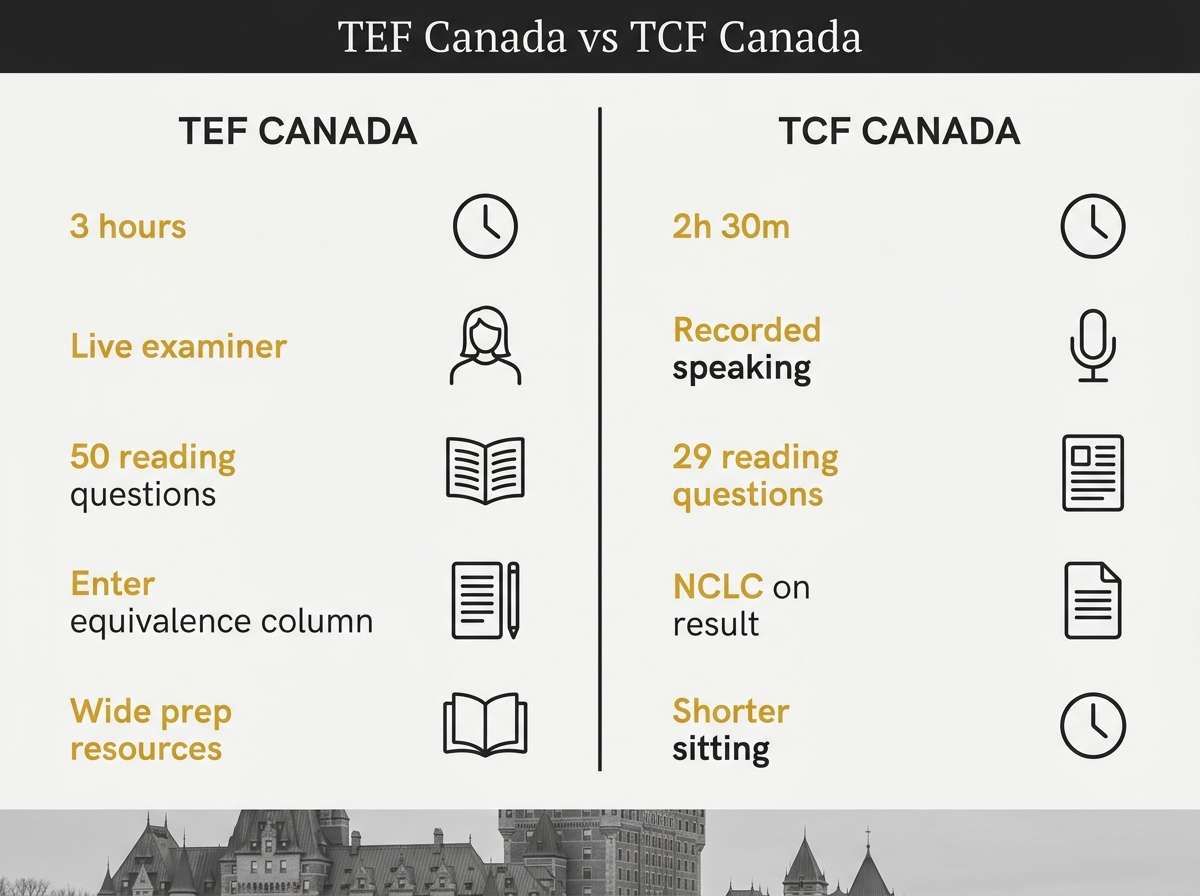
The two tests cover the same four abilities but build them differently, and those differences decide which one plays to your strengths. The table below sets them side by side.
| Component | TEF Canada | TCF Canada |
|---|---|---|
| Listening | About 40 questions, roughly 40 minutes | About 29 questions, roughly 30 minutes |
| Reading | About 50 questions, roughly 60 minutes | About 29 questions, roughly 45 minutes |
| Writing | 2 tasks, about 60 minutes | 2 tasks, about 60 minutes |
| Speaking | 2 tasks with a live examiner, about 15 minutes | 2 tasks, recorded, about 12 minutes |
| Reading and listening format | Fixed, multiple choice | Fixed, multiple choice |
| Total time | About 3 hours | About 2 hours 30 minutes |
| Score validity | 2 years | 2 years |
Live Examiner on TEF Canada, Recorded Speaking on TCF Canada
The clearest split is the speaking section. TEF Canada runs it as a face-to-face conversation with a certified examiner, which rewards candidates who think on their feet and read a listener's reactions. TCF Canada records your answers to prompts and scores them afterward, which removes the pressure of a live person but gives you no feedback to adjust to mid-task. Candidates who freeze in front of an examiner often prefer the recorded format, while those who find a blank microphone harder than a conversation tend to do better on TEF Canada.
The Shorter Test and the Heavier Reading Load
TCF Canada is the shorter sitting by roughly half an hour, with fewer questions in both listening and reading. TEF Canada carries the heavier reading load at around 50 questions, so pacing matters more. The length does not change the NCLC level you need, but fewer items can suit candidates who lose accuracy as fatigue sets in.
NCLC Score Conversion for TEF Canada and TCF Canada
Both tests convert to NCLC levels, and the level you reach, not the raw score, is what feeds your ranking. Every ability is converted on its own, and your lowest ability sets the level that counts, because there is no averaging across the four.
NCLC 7, the First Threshold That Earns French Points
NCLC 7 in all four abilities is the minimum for French as a first official language under the Federal Skilled Worker Program, and it is also where French starts earning Comprehensive Ranking System points. As a second official language alongside English, NCLC 5 across all four abilities adds further points on top. Because French is scored both as a language and as a bonus, a mid-range result can be worth more than a high English score alone. You can check what a given level is worth against your own profile in the CRS score calculator.
Where to Find Your Exact Score Conversions
The two tests use entirely different number ranges, so a TEF listening score tells you nothing about a TCF one until both are converted. Rather than memorize two sets of cut-offs, find your level ability by ability. Our language converter turns a TEF Canada or TCF Canada result into NCLC levels one ability at a time, so you can see where each of your four scores lands before deciding whether a retest is worth it.
The TEF Canada Score-Entry Mistake That Refuses Applications
This detail separates a clean French file from a refused one, and it applies only to TEF Canada. A TEF Canada statement of results shows your scores in more than one column, and only one is the one IRCC reads.
Enter the Equivalence Column, Not the Score Out of 699
TEF Canada reports each ability both as a raw "Score / 699" and in an "Equivalence ancien score" column. IRCC bases your NCLC level on the equivalence column only, and the department states plainly that entering the score out of 699 can lead to a refusal. When you transfer your results into your Express Entry profile, read each ability from the equivalence column and leave the 699 figures out entirely. TCF Canada does not have this trap, because its results come with the NCLC level already stated for each component.
Confirm Your Results Are Still Valid at Both Stages
A French result is valid for less than two years, and it must be valid at two separate moments: when you create your profile, and when you submit your permanent residence application. A result that lapses between those two points leads to a refusal, so if yours will expire while you sit in the pool, plan to retest, apply before it expires, or decline an invitation and return to the pool with a fresh result.
Choosing Between TEF Canada and TCF Canada by Profile
Neither test is easier in IRCC's eyes, so the right one is the one that fits how you perform and what you can access. Most candidates fall into one of these groups.
When TEF Canada Is the Better Fit
TEF Canada suits candidates who speak more confidently in a real conversation than into a microphone, and who want the widest set of preparation materials, since it has the longer track record and more published practice resources. It is also the more commonly recognized of the two for federal bilingual public-sector roles.
When TCF Canada Is the Better Fit
TCF Canada suits candidates who want a shorter sitting, fewer total questions, and a recorded speaking section without a live examiner in the room. Where an Alliance Francaise or Campus France centre is the more accessible option in your city, availability can settle the choice before format does.
French is often the fastest lever left once your education and work history are fixed, but only if the result is entered correctly and still valid on the day you apply. SEP Immigration, led by Sepehr Falahati (RCIC #R533959, licensed by the CICC), reviews your French result against the program you are targeting and confirms which test, and which ability, is worth your next attempt.
This article is general information, not legal advice, and test formats and program requirements change. Verify current details with IRCC and the test provider before you book; information is current as of October 2026.
Frequently asked questions
01Is TEF Canada or TCF Canada easier for immigration?
Neither is easier in IRCC's scoring. Both convert to the same NCLC scale, so the easier test is the one whose format suits you. Candidates who prefer a live speaking conversation often choose TEF Canada, while those who want a shorter test with a recorded speaking section often choose TCF Canada.
02Which French tests does IRCC accept for Express Entry?
Only TEF Canada and TCF Canada are accepted for federal Express Entry. The Quebec versions, TEFAQ and TCF Quebec, are built for Quebec's own programs and are not accepted for federal permanent residence.
03How long are TEF Canada and TCF Canada results valid?
Both are valid for less than two years from the test date. The result must be valid when you create your Express Entry profile and again when you submit your permanent residence application, or the application can be refused.
04What NCLC level do I need for Express Entry with French?
NCLC 7 in all four abilities is the minimum for French as a first official language under the Federal Skilled Worker Program. As a second official language alongside English, NCLC 5 across all four abilities earns additional points.
05Why can entering my TEF Canada score wrong get my application refused?
A TEF Canada result shows scores in more than one column. IRCC reads only the "Equivalence ancien score" column, not the raw score out of 699. Entering the wrong figures can lead to a refusal, so transfer only the equivalence scores into your profile.
06Can I use TEF Canada or TCF Canada for Canadian citizenship?
French ability can be proven for citizenship, but the accepted proof differs from the Express Entry list, so confirm the current citizenship requirement before relying on a test result for that purpose rather than for permanent residence.
Stay informed
Get our immigration updates first on Google
Add SEP Immigration as a preferred source and our latest news and guides appear more often in your Google results.
About the Author

Sepehr Falahati
CEO of SEP Immigration
- CICC Licensed
- RCIC #R533959
- IRB Member
Sepehr Falahati is a Regulated Canadian Immigration Consultant (RCIC #R533959), licensed by the College of Immigration and Citizenship Consultants (CICC).
Read more about Sepehr Falahati
Continue Reading