
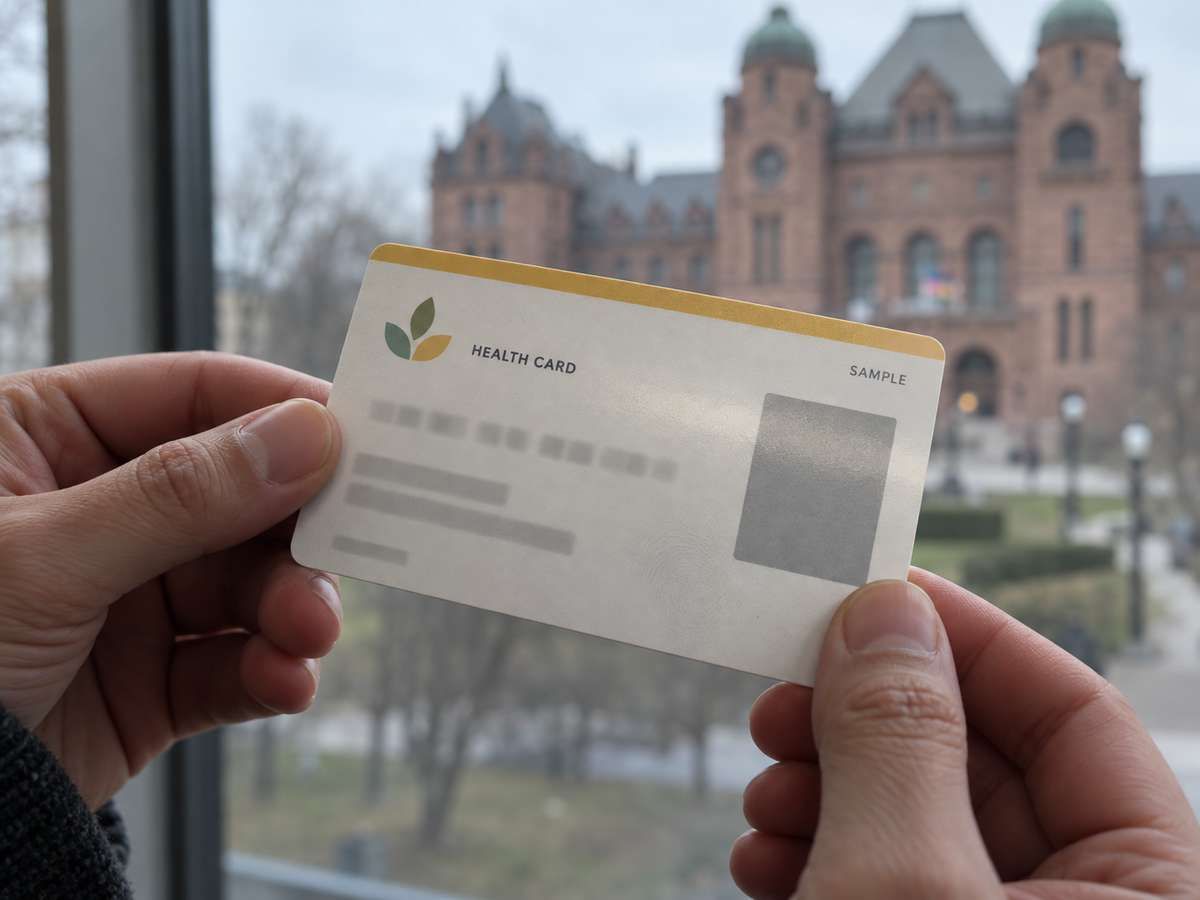
Ontario is where most new permanent residents settle, and the health card is usually the first government document they chase after landing. One rule has changed in a way that still catches people out: the three month wait newcomers were warned about for decades no longer applies, so coverage can begin almost immediately. This guide covers who qualifies for the Ontario Health Insurance Plan, what documents ServiceOntario expects, and how the process differs for permanent residents, workers and students.
If you are still deciding which province to settle in, our guide to healthcare in Canada compares the thirteen provincial and territorial plans. This page deals only with Ontario.
OHIP Is Ontario's Public Health Insurance Plan for Residents
OHIP, the Ontario Health Insurance Plan, is the provincial programme that pays for medically necessary hospital and physician care. It is funded through taxes rather than premiums, so eligible residents pay nothing at the point of service. The Ministry of Health administers it, and registration runs through ServiceOntario.
What the Ontario Health Insurance Plan Pays For
OHIP insurance covers appointments with a family doctor or specialist, walk-in clinic visits, emergency room care, medically necessary surgery, and diagnostic work such as blood tests and imaging. Virtual appointments by video or telephone are covered on the same basis as in-person ones, and medications given to you as an admitted hospital patient are included, though prescriptions filled after discharge are not. The test is always medical necessity, so cosmetic procedures sit outside the plan, as do upgrades such as a private or semi-private room.
Why the Health Card Matters From Day One
The card is proof of coverage, and you present it at every appointment, test and hospital visit. Without one you can be billed directly, and an uninsured emergency department visit runs into the thousands. It also unlocks the rest of the system: registering with Health Care Connect to find a family doctor requires an Ontario health number, and so does filling a prescription under the provincial drug programme.
OHIP Requirements and Ontario Health Card Eligibility for Newcomers
Eligibility has two layers. Every applicant must satisfy three residency conditions and fall into at least one qualifying immigration category. Missing either layer means refusal, which is why newcomers are so often turned away at the counter over paperwork rather than status.
The 153-Day Physical Presence Rules
The residency conditions are specific. You must be physically in Ontario for 153 days in any twelve month period, you must be physically in Ontario for at least 153 days of the first 183 days immediately after you begin living in the province, and Ontario must be your primary residence. The second condition is the one that trips people up, because a long trip abroad shortly after landing can undermine a registration you have already completed. These are commitments about how you will live here, not a queue to join: you do not wait 153 days before applying.
Permanent Residents and Permanent Residence Applicants
Permanent residents qualify straight away, which is why permanent residence is the cleanest route to Ontario health coverage. Applicants still waiting on a decision can also qualify, but only on strict terms: the application must be filed with IRCC, IRCC must have confirmed it reviewed the application and that you meet the requirements to apply, and you must not yet have been refused. A nomination through the Ontario Express Entry stream does not by itself create OHIP eligibility, so applicants there usually qualify through a work permit while their application is processed.
Work Permit Holders Employed Full Time in Ontario
Holding a work permit is not enough on its own. You must be working full time in Ontario, for an Ontario employer, for at least six months. Meet that bar and your spouse and dependants can usually be registered alongside you. Permits under the Live-in Caregiver Program and the Seasonal Agricultural Worker Program qualify in their own right, and if your permit has expired but you hold maintained status you may still be eligible, with ServiceOntario deciding those cases individually.
The six month rule is also why graduates matter here. Someone moving onto a Post-Graduation Work Permit and starting full-time work with an Ontario employer typically becomes OHIP eligible for the first time, having been outside the plan throughout their studies.
Study Permit Holders Are Covered by UHIP, Not OHIP
Ontario removed international students from OHIP in 1994, and that exclusion still stands, so a study permit does not qualify you for an Ontario health card. Students at Ontario universities are enrolled instead in the University Health Insurance Plan, usually automatically as a condition of registration, with colleges running comparable private plans. UHIP mirrors much of what OHIP covers, including doctor visits, hospital care and emergency treatment, but it is private insurance with its own premiums, claim rules and enrolment dates. Students who also work full time in Ontario for six months or more may qualify for OHIP through the work permit route.
Refugees, Protected Persons and Humanitarian Arrivals
Convention refugees and other protected persons qualify, as do holders of a Temporary Resident Permit in certain case types. People admitted under an emergency humanitarian authorization are covered for its duration, and for them the primary residence requirement is set aside. Clergy ministering full time in Ontario for at least six months also qualify, along with their families.
| Status in Ontario | OHIP eligible | Main proof required |
|---|---|---|
| Permanent resident | Yes | PR Card or Confirmation of Permanent Residence |
| Permanent residence applicant in Canada | Yes, on conditions | IRCC letter confirming eligibility to apply and no refusal |
| Work permit holder, full time, 6 months or more | Yes | Work permit plus signed employer letter |
| Spouse or dependant of an eligible worker | Yes | Own immigration document plus the worker's proof |
| Study permit holder | No | Enrols in UHIP or an institutional plan instead |
| Convention refugee or protected person | Yes | IRB letter or Protected Person Status document |
| Visitor, tourist or Super Visa holder | No | Private medical insurance required |
The OHIP Waiting Period No Longer Applies to New Immigrants
For years Ontario applied a three month wait before coverage started, and newcomers were told to buy private insurance to bridge it. That wait has been removed, and Ontario now states plainly that eligible applicants have immediate coverage. Much of the advice online has not caught up, including settlement pages and insurance comparison sites that still describe the old rule, so check the date on anything you read about an OHIP waiting period being waived or extended.
Health Insurance While Waiting for OHIP to Be Approved
The remaining gap is administrative rather than regulatory. You can register as soon as you arrive, but you still have to assemble three documents and attend a ServiceOntario centre in person, and few new arrivals have an Ontario utility bill or lease on day one. That gap is usually days or weeks, and short-term newcomer insurance is worth holding until your registration is approved.
Interim Federal Health Program Coverage for Refugees
Resettled refugees, claimants and certain other protected groups are covered federally by the Interim Federal Health Program until provincial coverage begins. It covers basic and emergency care, and in some cases prescription drugs and limited dental and vision services OHIP does not fund. It is a bridge, so register for OHIP as soon as you qualify.
How to Get OHIP for New Immigrants at ServiceOntario
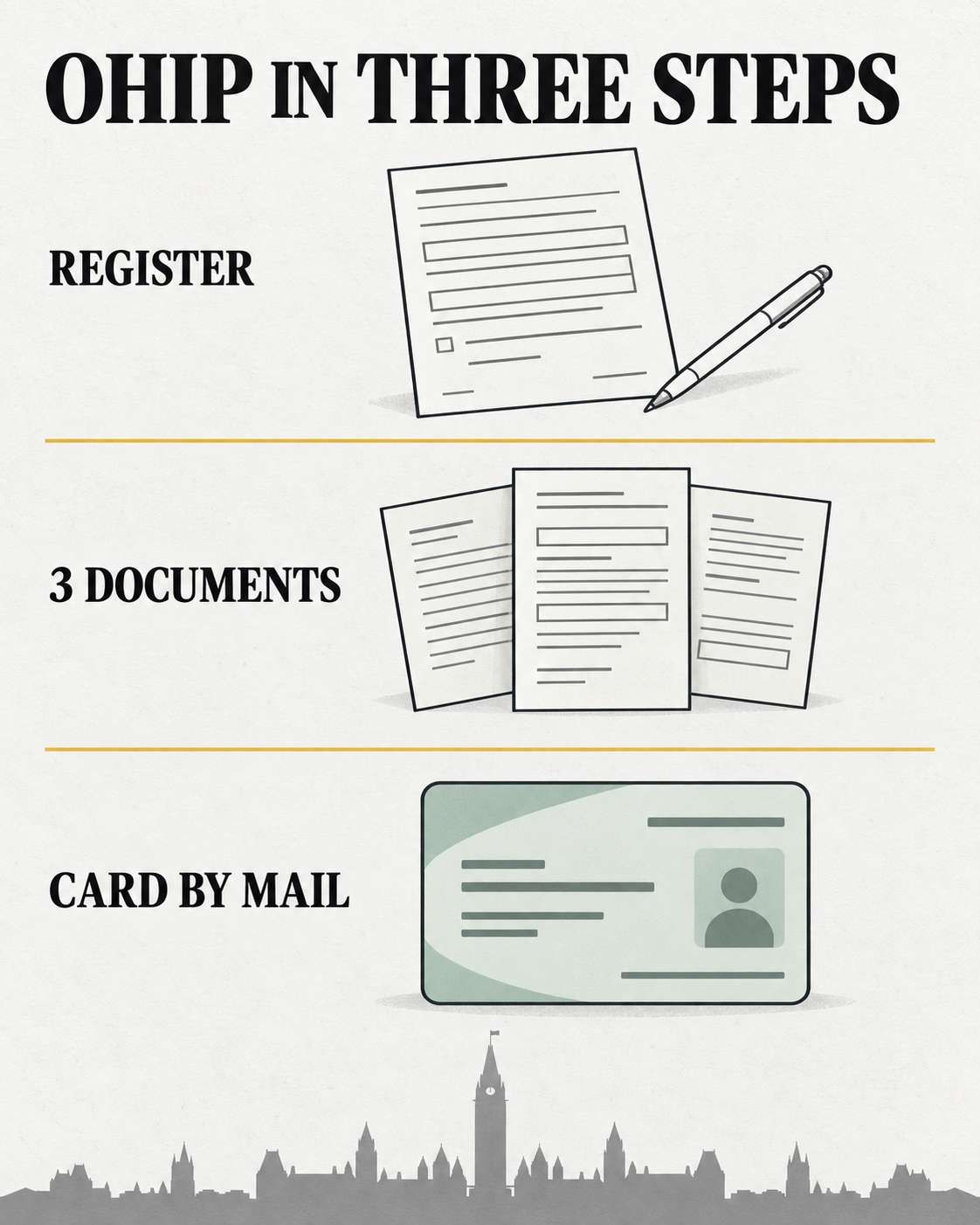
Registration cannot be done online, by mail or through a representative. Every new applicant attends in person, and the visit succeeds or fails almost entirely on the documents in the folder.
Step 1: Complete the Registration Form Before You Go
Download the Registration for Ontario Health Insurance Coverage form from the Ontario government site and fill it in beforehand. Completing it at the counter burns your appointment slot, and errors on it send people away to return another day.
Step 2: Gather Three Separate Original Documents
You need three different documents: one proving Canadian citizenship or OHIP-eligible immigration status, one proving you live in Ontario, and one supporting your identity. Photocopies are not accepted, and no document counts twice, so a Permanent Resident Card cannot serve as both status and identity. The status document must be an original, but the residency document may be an original, a printout or a digital version, which helps when all you have is an emailed bank statement. The accepted list is broader than most people expect, running from insurance policies and property tax bills to employer letters and school transcripts: review the official list of qualifying identification documents first.
Step 3: Get an Employer Letter if You Hold a Work Permit
Work permit holders face an extra requirement, and it is the most common reason a registration fails. Alongside the permit you need a contract or letter on company letterhead, signed and dated by the employer, stating that you work full time, your job title or occupation, your start date, and that the employer intends to employ you for at least six months. A letter confirming permanent employment still has to address the full-time point separately, so read yours against all four.
Step 4: Apply in Person at a ServiceOntario Centre
Take the completed form and your three documents to a ServiceOntario centre. Appointments can be booked in advance and are worth it, since walk-in waits at busy Toronto and Mississauga locations run long. Coverage begins once your registration is approved, and the card follows by mail.
Step 5: Register Each Family Member Separately
There is no family card. Everyone in the household gets their own health number and card, and each needs their own immigration document from IRCC. Requirements for children differ from those for adults, so confirm with ServiceOntario what each child needs beforehand. Babies born in an Ontario birthing hospital or with a registered midwife are registered on a form the hospital or midwife provides, and their card arrives within eight weeks.
Ontario Health Insurance Gaps and Keeping Your Card Valid
OHIP is broad but far from complete, and the gaps are exactly the costs most households meet in an ordinary year. Budgeting for them, or finding an employer plan that covers them, is part of settling in.
Prescription Drugs, OHIP+ and the Trillium Drug Program
Prescriptions filled outside hospital are not covered for most adults. The exception is OHIP+, which pays for more than 5,900 medications for anyone aged 24 or under who has OHIP and is not on a private plan. There is nothing to enrol in: the pharmacy needs only the health card number and an eligible prescription. Coverage ends on the twenty-fifth birthday or when a private plan starts, and households with high drug costs relative to income can apply to the Trillium Drug Program.
Dental, Vision and Paramedical Care Gaps
Dental work in a dentist's office is not covered, although complex dental surgery performed in hospital can be, and eyeglasses and contact lenses are excluded. Eye exams are covered once every twelve months for anyone 19 or younger and for adults with a qualifying condition such as diabetes or glaucoma, and once every eighteen months for adults 65 and over without one, so most adults between 20 and 64 pay for their own. Physiotherapy, chiropractic, massage and naturopathic care outside hospital generally fall outside the plan, and individual services can be checked against the Ontario government's coverage list. One protection worth knowing: it is illegal in Ontario for a clinic to charge you for an insured service or to require a block fee to receive one.
Staying Eligible After You Get Your Card
Coverage is tied to continued residency, not to the card in your wallet. If you are outside Ontario for more than 212 days in any twelve month period you may have to reapply in person, which matters for newcomers who go home for long family visits in their first years. Keep your address current with ServiceOntario too, since renewal notices go to the address on file.
Your access to Ontario healthcare follows from your immigration status, so the status comes first and the health card follows. SEP Immigration, led by Sepehr Falahati, a Regulated Canadian Immigration Consultant (RCIC #R533959) licensed by the College of Immigration and Citizenship Consultants, helps newcomers secure the permanent residence or work status that makes OHIP coverage possible.
This page is general information, not legal or medical advice, and OHIP eligibility rules and coverage change over time. Verify current requirements against the Ontario Ministry of Health and ServiceOntario before you apply. Information current as of October 2026.
Frequently asked questions
01Can I apply for an Ontario health card before I have permanent housing?
You still need a document that shows you live in Ontario, but the accepted list is broader than a lease. A utility bill, a bank statement, a pay stub, an employer letter on company letterhead, a credit card statement or an insurance policy all qualify. Many newcomers staying temporarily with family use an employer record or a bank statement sent to that address.
02What happens if ServiceOntario decides I do not qualify for OHIP?
You can ask the OHIP Eligibility Review Committee at the Ministry of Health to review the decision. You need a copy of the eligibility assessment from ServiceOntario, an explanation of why you believe you qualify and any supporting documents. If that review also finds you ineligible, you have 30 days to appeal to the Health Services Appeal and Review Board.
03Do parents visiting on a Super Visa qualify for OHIP?
No. Visitors to Ontario do not qualify for OHIP, whatever their length of stay. Super Visa applicants must hold private Canadian medical insurance as a condition of the visa itself, and that private policy is what covers them while they are here.
04Does OHIP cover medical care when I travel outside Canada?
No. OHIP does not pay for routine medical care received outside Canada, so private travel insurance is necessary for any trip abroad, including a visit home. Coverage inside Canada works differently, because most other provinces bill Ontario directly for hospital and physician services.
05How often does an Ontario health card need to be renewed?
Photo health cards carry an expiry date and must be renewed before they lapse. ServiceOntario sends a renewal notice to the address on file, which is one of the reasons keeping your address current matters. Older red and white cards do not expire, but they are being phased out in favour of photo cards.
Stay informed
Get our immigration updates first on Google
Add SEP Immigration as a preferred source and our latest news and guides appear more often in your Google results.
About the Author

Sepehr Falahati
CEO of SEP Immigration
- CICC Licensed
- RCIC #R533959
- IRB Member
Sepehr Falahati is a Regulated Canadian Immigration Consultant (RCIC #R533959), licensed by the College of Immigration and Citizenship Consultants (CICC).
Read more about Sepehr Falahati
Continue Reading