
CELPIP Test for Canada Immigration
Reviewed by Mohsen Khorvash and Mahsa Barati

The CELPIP is one of three English tests Immigration, Refugees and Citizenship Canada accepts as proof of language ability, alongside IELTS General Training and PTE Core. It is the only one built around Canadian English, and the only one whose score numbers match the Canadian Language Benchmark scale one for one, so a CELPIP 8 in speaking is a CLB 8 in speaking with no conversion involved. For anyone preparing an Express Entry profile, that makes it the easiest result to read against a program requirement. If you need to compare these scores against IELTS or PTE Core, our Language Converter shows the equivalent benchmarks.
What the test will not forgive is a booking error or a timing error. There are two CELPIP tests and only one counts for permanent residence, and a result that has expired by the day you submit is treated as no result at all. Below is which version to sit, the level each program expects, what the test looks like inside, and what it costs. If you are weighing a retake under the Federal Skilled Worker Program, start with the scoring section.
CELPIP Test Basics for Canadian Immigration
CELPIP stands for Canadian English Language Proficiency Index Program. It is developed by Paragon Testing Enterprises, a University of British Columbia spin-off that has been part of Prometric Canada since 2021, and it has been accepted for Canadian immigration since 2012. Everything is delivered by computer, including speaking.
CELPIP-General and CELPIP-General LS Are Not Interchangeable
CELPIP-General tests all four abilities: listening, reading, writing and speaking. This is the version IRCC names for permanent residence, and the one professional regulators and some colleges ask for. CELPIP-General LS covers listening and speaking only, takes about 70 minutes, and exists for the Canadian citizenship application language requirement.
The two are not substitutes in either direction. An LS result cannot be used for permanent residence and there is no upgrade path, so a wrong booking means paying for a second sitting. Registration also asks you to select the purpose of your test, and the choice appears on your file: applicants testing for a post-graduation work permit are directed to select Canadian permanent residency or temporary residency rather than a study-related purpose.
Programs and Permits That Accept CELPIP Results
CELPIP-General is accepted across all three Express Entry programs: the Federal Skilled Worker Program, the Canadian Experience Class and the Federal Skilled Trades Program. Provincial nominee streams accept it too, including those under the Ontario Immigrant Nominee Program, where language results carry points rather than only clearing a threshold.
Its reach now goes beyond permanent residence. Since November 2024, most applicants for a post-graduation work permit must submit language results, and CELPIP-General is accepted. Australia's Department of Home Affairs also began accepting it for visa applications in August 2025.
CELPIP Test Format and Timing
The whole test runs in a single sitting of under two hours and fifty minutes, with no separate speaking appointment on another day. The listening and reading sections may include unscored trial questions that look exactly like the scored ones, so treat every item as if it counts.
Listening and Reading Sections
Listening takes 46 to 55 minutes across six parts: problem solving, a daily life conversation, information, a news item, a discussion and viewpoints. Reading takes 43 to 56 minutes across four parts, including correspondence and an unusual task that asks you to apply information from a diagram. Both are multiple choice and machine scored, and a blank answer counts as wrong, so guessing costs nothing.
Writing and Speaking Tasks
Writing gives you 53 minutes for two tasks: an email and a response to survey questions. Speaking gives you 15 minutes for eight short recorded answers to on-screen prompts, covering giving advice, describing a scene, making predictions and dealing with a difficult situation. There is no examiner in the room and no conversation, which is the biggest structural difference between CELPIP and IELTS.
How CELPIP Levels Are Scored
Each ability is reported as a level from 1 to 12 that maps directly onto the CLB scale, and the same levels are mapped to the CEFR framework and to Australia's English proficiency bands. Listening and reading are machine scored and then equated, so a harder test form does not penalise you. Speaking and writing are rated by multiple trained human raters working independently, with a benchmark rater brought in when they disagree.
CELPIP Scores Required for Canadian Immigration Programs
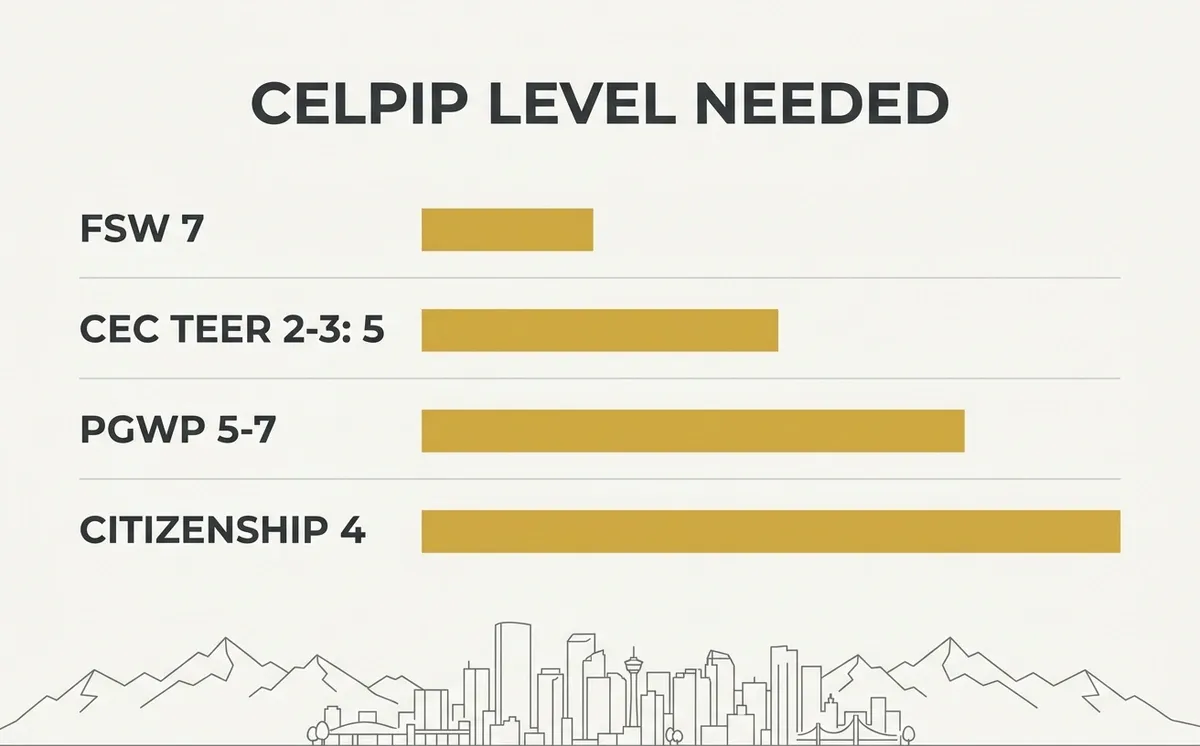
Because CELPIP levels and CLB levels use the same numbers, program requirements read straight off your score report. The table below sets out the minimum CELPIP level needed in each ability for the most common routes.
| Program or permit | Minimum CELPIP level |
|---|---|
| Federal Skilled Worker Program, first official language | 7 in all four abilities |
| Federal Skilled Worker Program, second official language | 5 in all four abilities |
| Canadian Experience Class, job in TEER 0 or 1 | 7 in all four abilities |
| Canadian Experience Class, job in TEER 2 or 3 | 5 in all four abilities |
| Federal Skilled Trades Program | 5 in speaking and listening, 4 in reading and writing |
| Post-graduation work permit, bachelor's degree or higher | 7 in all four abilities |
| Post-graduation work permit, college-level credential | 5 in all four abilities |
| Canadian citizenship, applicants aged 18 to 54 | 4 in listening and speaking |
Express Entry Minimums Versus Competitive Scores
Clearing the minimum only gets you into the pool. On the Federal Skilled Worker selection grid, a 7 in every ability earns 4 points per ability, an 8 earns 5 and a 9 or above earns 6, to a maximum of 24. The larger effect sits in the Comprehensive Ranking System, where moving from 7 to 9 also unlocks the skill transferability combinations that pair language with education and foreign work experience.
Two-Year Validity and When It Is Measured
Results must be less than two years old at two separate moments: when you complete your Express Entry profile, and when you submit your permanent residence application. Candidates who sit in the pool for months get caught, because an invitation can arrive with weeks left on the clock. If your report will expire first, you can retest, apply before it lapses, or decline the invitation and return to the pool. Applying with an expired result leads to refusal.
Citizenship works differently. A CELPIP report showing 4 or higher in listening and speaking is accepted as proof even after it has expired, so an old result from a permanent residence application can often be reused years later.
CELPIP Test Cost, Booking and Results Timeline
Fees are set by the test provider rather than by IRCC, and the Canadian price is not the international price. Budget for tax on top of the listed fee, and for the possibility of a second sitting.
Fees, Transfers and Cancellations
In Canada, CELPIP-General costs $295 plus tax and CELPIP-General LS costs $199 plus tax, which brings the General test to roughly $333 in Ontario and about $310 where only GST applies. Outside Canada, fees are set in local currency and vary by country, with the exact amount shown before you pay. Test dates can be transferred through your CELPIP account, the first change usually free and later changes charged, and any transfer has to be requested well before your test date. A retake is a new test at full price.
Booking a Test Date and Test Day Requirements
Registration happens only through a CELPIP account, and there are more than 200 test centres in over 40 countries, including centres across the Greater Toronto Area and most Canadian cities. Seats in major cities are commonly available within about two weeks, though demand spikes around provincial intake windows. Availability and current pricing are on the official CELPIP test date finder. On test day, bring the original government-issued photo identification you registered with, and make sure the name on your registration matches it exactly, since a mismatch can cost you the sitting.
Result Release, Re-evaluation and Retakes
Scores post to your CELPIP account in 2 to 4 business days and you get an email when they are ready. Paper reports no longer exist: you download the official score report as a PDF and submit that copy yourself. It stays in your account for two years from the test date.
If a score looks wrong, you can request a re-evaluation within six months of the test date. There is a fee per component, refunded if the level changes, a limit of one re-evaluation per component, and a turnaround of roughly one to two weeks. It is worth considering for speaking or writing, which are human rated, and rarely changes listening or reading. CELPIP has no single-skill retake either: you resit the full test, and while IELTS offers a One Skill Retake, IRCC does not accept it for Express Entry.
CELPIP Compared With IELTS General Training and PTE Core
All three English tests are accepted equally by IRCC, and no version carries an advantage with an officer. The differences are practical: they affect how you perform, not how you are judged.
| Feature | CELPIP-General | IELTS General Training | PTE Core |
|---|---|---|---|
| Delivery | Fully computer based, speaking recorded | Computer or paper, speaking with a live examiner | Fully computer based |
| Total time | Under 2 hours 50 minutes, one sitting | About 2 hours 45 minutes, speaking may be scheduled separately | About 2 hours |
| Score scale | 1 to 12, identical numbering to CLB | 0 to 9 bands, conversion required | 10 to 90, conversion required |
| Result timing | 2 to 4 business days | Usually 3 to 5 days for computer-delivered tests | Often within 2 days |
| Re-evaluation window | Six months from the test date | Commonly six weeks from the test date | Varies by centre |
| Single-skill retake | Not offered | Offered, but not accepted for Express Entry | Not offered |
Practical Differences That Change Scores
Three things decide it. Speaking to a screen suits some people and unsettles others, and no examiner is there to read your hesitation charitably. Writing is typed, so keyboard speed is part of what gets measured. Listening uses North American speakers and everyday Canadian settings, which favours candidates already in Canada over those preparing abroad on British English materials.
Choosing Between CELPIP and IELTS for Your Profile
Candidates already in Canada on a work or study permit often find CELPIP the more natural fit, both for the accents and because the score numbers match the requirement they are aiming at. Those testing where CELPIP centres are thin on the ground, or who prefer a live speaking interview, usually do better with IELTS General Training. PTE Core has been accepted since January 2024 and returns results fastest. The Duolingo English Test is not accepted for Express Entry, provincial nominee programs or citizenship. Whichever way you lean, sit the free official sample test before paying for a seat.
Language is the one factor most candidates can still change after their education and work history are fixed. SEP Immigration, led by Sepehr Falahati (RCIC #R533959, licensed by the CICC), reviews your score report to identify which ability is worth a retest.
This page is general information, not legal advice, and test fees, formats and program requirements change. Confirm current minimum levels against the Government of Canada's Express Entry language test results page, or with a licensed representative, before you rely on them. Information current as of September 2026.
Frequently asked questions
01Is CELPIP easier than IELTS for Canadian immigration?
Neither test is graded more generously, and IRCC treats the results as equivalent once they are converted. CELPIP suits candidates who type quickly, are comfortable speaking to a computer and prefer North American accents. IELTS suits candidates who perform better talking to a person and who read more accurately on paper. The honest way to choose is to sit a free sample of each and compare how you perform.
02Can I use a CELPIP-General LS result for permanent residence?
No. IRCC requires the four-skill CELPIP-General test for Express Entry and other permanent residence programs. CELPIP-General LS covers only listening and speaking and is accepted for citizenship applications. If you book LS by mistake, there is no way to convert it, and you have to register and pay for a full CELPIP-General sitting.
03What happens if one CELPIP ability falls below the program minimum?
You do not meet the requirement. IRCC assesses each of the four abilities separately and there is no averaging, so your effective level is your lowest score. A candidate with 9 in listening, reading and speaking and 6 in writing meets CLB 6, not CLB 9, and does not qualify for a program that requires CLB 7 in all four abilities.
04How many times can I retake the CELPIP test?
There is no limit on the number of sittings, but you cannot retake a single section. Each attempt is a full registration at the full price, and the score report from each sitting stands on its own. In practice the limiting factors are seat availability at your test centre and how much time you have to prepare before your next attempt.
05Does IRCC receive my CELPIP results directly from the test centre?
You are responsible for submitting them. Download the PDF official score report from your CELPIP account and include it with your application, and enter the scores yourself when you build an Express Entry profile. Entering a score that does not match your report can lead to a refusal or a finding of misrepresentation, so check each ability against the PDF before you submit.
06Do I still need CELPIP if I studied in English?
For permanent residence, yes. An approved test result is mandatory for Express Entry regardless of where you studied or what language your degree was taught in. Citizenship is different: applicants aged 18 to 54 can prove language ability with a secondary or post-secondary transcript or diploma showing instruction in English or French instead of a test.
07How far in advance should I take the CELPIP test?
Early enough to leave room for a retake. Seats in major cities are often available within about two weeks and scores post in 2 to 4 business days, so a first attempt roughly two months before you plan to submit a profile leaves time for a second sitting if one ability falls short. Remember that the two-year clock starts when the report is issued, not when you apply.
Stay informed
Get our immigration updates first on Google
Add SEP Immigration as a preferred source and our latest news and guides appear more often in your Google results.
About the Author

Sepehr Falahati
CEO of SEP Immigration
- CICC Licensed
- RCIC #R533959
- IRB Member
Sepehr Falahati is a Regulated Canadian Immigration Consultant (RCIC #R533959), licensed by the College of Immigration and Citizenship Consultants (CICC).
Read more about Sepehr FalahatiReviewed By


Continue Reading