
The First 90 Days in Canada: A Timeline Checklist for New Arrivals
Reviewed by Mohsen Khorvash and Mahsa Barati
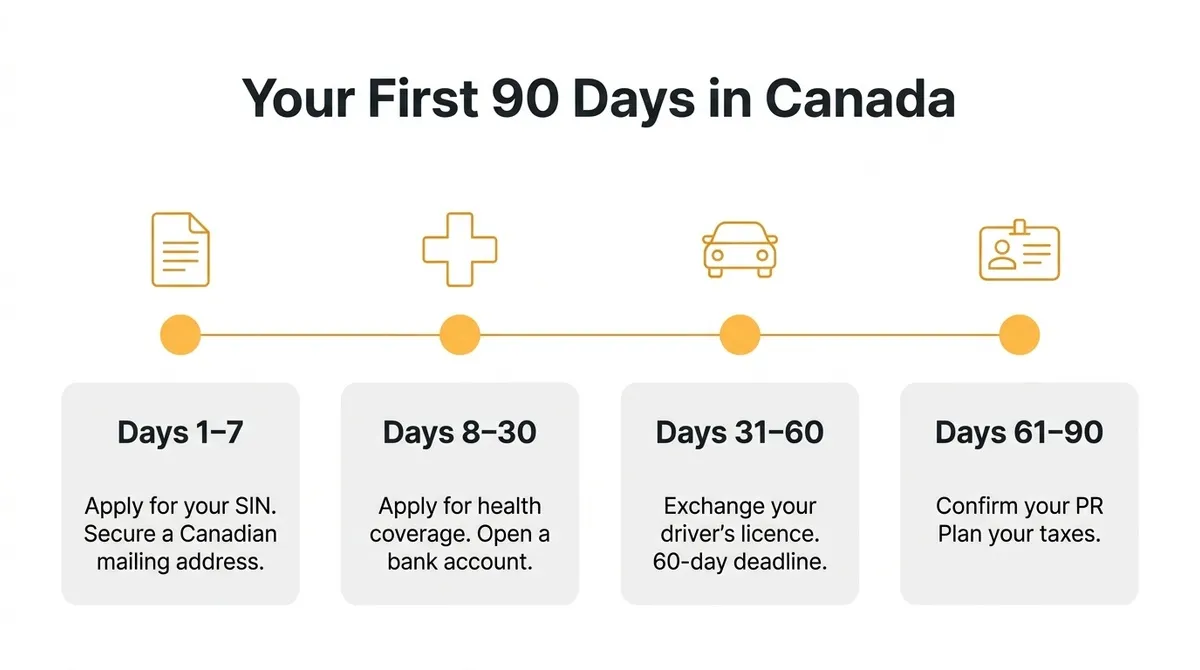
Most newcomer checklists give you a list of tasks. What they rarely give you is the order, and the order is what decides whether your first three months go smoothly. You cannot be paid until you have a Social Insurance Number. You cannot get a health card without proof of an Ontario address. Your first permanent resident card is only mailed to you if Immigration, Refugees and Citizenship Canada (IRCC) has your address in time. This guide sets out what to do in each stretch of your first 90 days, which deadlines carry real consequences, and the two residency clocks that started counting the day you landed.
Key Facts About Your First 90 Days
- Day 1–7: apply for your Social Insurance Number (SIN) and secure a Canadian mailing address.
- 180-day deadline: new permanent residents must give IRCC a Canadian address within 180 days of landing, or the free first PR card is no longer automatic.
- Health coverage: Ontario has removed the three-month OHIP waiting period. Eligible applicants are covered as soon as they are approved.
- 60-day deadline: once you become an Ontario resident, your foreign driver's licence is valid for 60 days only.
- 730 days: the physical presence you must maintain in every five-year period to keep your permanent resident status.
- 1,095 days: the physical presence you need before you can apply for Canadian citizenship.
Days 1–7: Documents, SIN, and a Mailing Address
Keep your landing documents accessible
If you arrived as a permanent resident, your Confirmation of Permanent Residence (COPR or eCOPR) is your legal proof of status until your PR card arrives. It is not paperwork to file away. If you arrived on a study or work permit, your permit and your Port of Entry letter serve the same purpose.
Apply for your Social Insurance Number
Everything downstream waits on this. Your SIN is a nine-digit number required to work legally, be paid, file taxes, and access most government benefits. It is free, you must be physically in Canada to apply, and you can apply online, by mail, or in person at a Service Canada centre. In-person applications are usually fastest if your documents are in order. There is no reason to push this past your first week.
Secure a Canadian mailing address
This is the step newcomers most often underestimate. IRCC needs a Canadian mailing address to send your first PR card, and you have 180 days from landing to provide one. Miss that window and the free first card is no longer automatic — you must submit a PR card application yourself and pay for it. A friend's address or a temporary rental is acceptable, and you can update it later.
If your family did not land with you
If your spouse or children stayed behind, start the sponsorship conversation now rather than after you have settled. Spousal sponsorship and dependent sponsorship both take many months, and the clock only starts when you file. If your parents want to visit for extended periods rather than immigrate, a Super Visa is usually faster than parents sponsorship, which opens only in limited intake windows and requires proof of income over the preceding three tax years.
Days 8–30: Health Coverage, Banking, and Work Authorization
Apply for provincial health coverage immediately
In Ontario this is the most misunderstood step, because most advice online is out of date. The Government of Ontario's own application page now states there is no longer a waiting period for OHIP coverage: if you are eligible, coverage is immediate once you are approved. If someone tells you to budget for three months of private insurance before OHIP begins, that advice is several years old.
Two things still catch people out. First, you must apply in person at a ServiceOntario centre — there is no online application for a first health card — and you need three separate documents: proof of immigration status, proof of Ontario residency, and proof of identity. Every family member needs their own application and their own IRCC document. Second, no waiting period does not mean instant card. Approval is immediate if you qualify, but the physical card takes time to arrive, so keep any private newcomer coverage active until yours is confirmed.
You will also see a rule about being physically present in Ontario for 153 of your first 183 days. That is an eligibility test you satisfy over your first months, not a delay before you are allowed to apply. If you are settling outside Ontario, check your province specifically — coverage begins on arrival in some provinces and after a two- to three-month wait in others. Our guide to healthcare in Canada for newcomers covers the provincial differences.
Sort out work authorization for the whole household
If you landed as a permanent resident, you and your spouse can both work immediately. If you are here on a work permit, check whether your spouse qualifies for a spouse open work permit, which lets them work for any employer rather than waiting on a job-specific permit. If you arrived as a student, plan your post-graduation work permit well before your studies end — it is the most common bridge from a study permit to permanent residence, and applying late can cost you the option entirely.
Open a bank account and start building credit
Bring your passport and your status document. Beyond day-to-day banking, the reason to do this early is credit: your credit history from your home country does not transfer to Canada, and you begin at zero. A secured credit card used carefully from month one puts you months ahead when you apply to rent an apartment or finance a car. Read our full guide to opening a bank account in Canada as an immigrant.
Register children for school
Public school registration requires proof of address and your child's immigration documents. Children have the right to attend school regardless of their own or their parents' immigration status.
Days 31–60: The Driver's Licence Deadline
Once you become an Ontario resident, your foreign licence is valid for 60 days only. After that, driving on it is not permitted. What happens next depends on where your licence is from.
If your country has an exchange agreement with Ontario
Ontario has reciprocal agreements with a number of jurisdictions, including the United States, Great Britain, Ireland, Australia, New Zealand, Japan, South Korea, Taiwan, and several European countries. If you hold a valid licence from one of them and have enough verified experience, you may be able to exchange directly for a full Class G licence with only a vision test.
If your country does not have an agreement
You enter the graduated licensing system, but you are not starting from zero. As of July 1, 2026, drivers from non-agreement jurisdictions can receive credit for up to 12 months of verified foreign driving experience, then complete the G2 road test and attempt the G road test at least 12 months later. This affects applicants from countries such as Iran, India, Pakistan, and the Philippines, none of which hold an exchange agreement with Ontario. If you are still preparing your move, our country guides for Iran, India, Pakistan, and the Philippines cover what to gather before you leave.
Two practical notes. Ontario now requires licence applicants to declare that Ontario is their primary residence and that they are legally present in Canada. And if you are claiming previous driving experience, you need an official letter or abstract from your home country's licensing authority. Arrange this before you leave if you can, because obtaining it remotely is slow and sometimes impossible.
Days 61–90: PR Card, Taxes, and Your Job Search
Confirm your PR card has arrived
Your PR card is what allows you to re-enter Canada by commercial carrier after travelling abroad. Do not book international travel until you have it. If your card has not arrived, contact IRCC. Your status is unaffected by a missing card, but returning from abroad without one requires a Permanent Resident Travel Document instead.
Understand your tax position
You generally become a resident for Canadian tax purposes on the day you establish residential ties here. File your first return even if you earned nothing that year. Filing is how you access benefits such as the GST/HST credit and the Canada Child Benefit, and it also builds the tax-filing record you will need later when you apply for citizenship.
Start your job search properly
Have your resume reformatted to Canadian conventions, and if your profession is regulated, begin credential recognition now rather than after you have been turned down for a role. Canadian employers also expect reference letters in a particular format, and the same structure is what IRCC looks for later, so it is worth getting right the first time. Our guide to reference letters sets out what a compliant letter contains.
The Two Residency Clocks That Started When You Landed
This is where a settlement checklist stops being about errands and becomes about your legal status.
Clock one: keeping your permanent resident status
As a permanent resident, you must be physically present in Canada for at least 730 days in every five-year period. The days do not need to be consecutive, and certain time abroad can count, such as accompanying a Canadian citizen spouse. Fall short and your status can be challenged at a port of entry or when you renew your card.
Clock two: becoming a Canadian citizen
To apply for citizenship you need 1,095 days of physical presence within the five years before you apply. Time spent in Canada before becoming a permanent resident — as a student, worker, or visitor — counts as half a day each, up to a maximum of 365 days. That is a genuine head start for many applicants, and it is also the calculation most people get wrong. See our breakdown of the 1,095-day rule, and if you hold another nationality, read about dual citizenship before you take the oath.
Both clocks depend on the same thing: an accurate record of every day you spend outside Canada. Start a simple travel log now — date out, date back, destination. In five years you will otherwise be reconstructing it from passport stamps and boarding passes.
Common Mistakes to Avoid
- Waiting on the SIN. It gates employment and it is the easiest task on this list.
- Missing the 180-day address deadline. The first PR card is free and automatic only if IRCC can reach you.
- Believing the OHIP three-month myth and paying out of pocket for coverage that was available on day one.
- Letting the 60-day driving window lapse, then discovering the exchange requires a document only obtainable from your home country.
- Not tracking travel from day one. Both residency clocks depend on a record you can only build as you go.
Your first 90 days set up everything that follows: your ability to work, your health coverage, your credit, and the record that will eventually support your citizenship application. SEP Immigration, led by Sepehr Falahati (CICC and IRB member R533959), is a Toronto-based firm that works with newcomers from landing through to citizenship.
This page is general information, not legal advice. Rules, fees, and provincial requirements change. For official guidance, see the Government of Canada's page on applying for a Social Insurance Number and Ontario's page on applying for OHIP, or speak with a licensed representative.
Stay informed
Get our immigration updates first on Google
Add SEP Immigration as a preferred source and our latest news and guides appear more often in your Google results.
About the Author

Sepehr Falahati
CEO of SEP Immigration
- CICC Licensed
- RCIC #R533959
- IRB Member
Sepehr Falahati is a Regulated Canadian Immigration Consultant (RCIC #R533959), licensed by the College of Immigration and Citizenship Consultants (CICC).
Read more about Sepehr FalahatiReviewed By


Continue Reading