
Confirmation of Permanent Residence (COPR)
Reviewed by Mohsen Khorvash and Mahsa Barati
The Confirmation of Permanent Residence, or COPR, is one of the most important documents in the Canadian immigration process. It's the paper or electronic proof that your application for permanent residence has been approved. For many newcomers, this moment represents the official start of their new life in Canada.
Understanding how the COPR works, when you'll receive it, and the common mistakes that sometimes appear can help you avoid stress and move forward with confidence.
Why the COPR Matters
The COPR is more than a formality — it is the legal proof of your permanent resident status the moment IRCC issues it. It gives you the right to work for any employer, access provincial health coverage, apply for a Social Insurance Number, and travel in and out of Canada while your PR card is being produced. Until your PR card arrives, the COPR (or eCOPR) is your only proof of status, so treat it as an essential document, not paperwork to file away.
What the Confirmation of Permanent Residence Is
The Confirmation of Permanent Residence (COPR) is the document that marks the finish line of the immigration process. Issued by Immigration, Refugees and Citizenship Canada (IRCC), it states that your permanent residence has been approved.
If you're outside Canada, it usually arrives in paper form and is presented when you enter the country. If you're already inside, the COPR comes electronically through the Permanent Residence Portal. This electronic version is called eCOPR.
COPR itself is not a travel document. You may still need a visa or an electronic travel authorization (eTA) to board a plane, but the COPR is what finalizes your permanent resident status.
When and How You Receive COPR
Getting your Confirmation of Permanent Residence depends on where you are when IRCC approves your application. The steps are not complicated, but timing and details matter.
- After approval: Once IRCC accepts your application under Express Entry, the Provincial Nominee Program, or another stream, they’ll send a message with instructions. If you’re abroad, you’ll receive a paper COPR (sometimes called a landing paper). If you’re already in Canada, it arrives as an electronic version through the Permanent Residence Portal.
- Passport, photo, and address checks: For individuals outside Canada, IRCC may request that you mail your passport for visa stamping. They double-check your passport information, photo, and personal details before releasing your COPR. If something doesn’t line up — say, a typo in your name — errors can creep in.
- Expiry dates: Every COPR has an expiry date. You must land in Canada or complete your virtual landing before that date. IRCC won’t extend it, so watching that date is critical.
- Virtual vs. physical landing: Applicants already in Canada confirm their details in the PR Portal: they declare they’re physically here, add a Canadian address, and upload a photo. That confirmation leads to the eCOPR being issued. Applicants abroad must present their paper COPR at the border, along with their passport and, if needed, a visa.
- Timelines: For many, COPR or eCOPR arrives within a few weeks. Some see it faster, while others wait longer — especially if a passport is required for submission.
- Double-check everything: As soon as your COPR arrives, review your personal details carefully. Names, dates of birth, and passport numbers — all must match your documents. Errors caught early are easier to correct.
How Long Is a COPR Valid?
Your COPR has a "Valid to" date printed on it, and this date is set by whichever document expires first — your passport or your Immigration Medical Examination (IME) results.
In most cases, this gives you a window of 6 to 12 months from the date your COPR was issued.
If you are outside Canada, you must arrive and complete your landing before this date — no exceptions. If you miss it, your COPR cannot simply be renewed, and you may need to restart the permanent residence process.
If you are already in Canada completing your landing through the PR Confirmation Portal, the travel deadline does not apply to you — but you should still confirm your status promptly and not leave Canada before IRCC grants you PR status.
Close-up of hands holding an open passport and official documents next to a desk calendar on a professional office desk.
Tip: Check your passport and medical exam validity early in the PR application process. If either is close to expiring, renew them before your application reaches the final stages — otherwise your COPR window could be shorter than expected.
Common Errors on COPR & How to Fix Them
Even official documents can have mistakes. Here are seven problems that appear on COPRs and what you can do if they show up on yours:
Name misspelled
A missing letter or names flipped in the wrong order can cause major issues later. This usually happens when information was copied incorrectly from your passport.
Fix: Use IRCC’s amendment form, attaching a copy of your passport. Expect to wait a few weeks for the correction.
Wrong date or place of birth
A single wrong digit in your birth date or an incorrect city of birth can show up. These errors may cause confusion with visas or future renewals.
Fix: Submit proof such as a birth certificate. Corrections must show the error came from IRCC’s side, not from your own application.
Incorrect citizenship or passport number
If the citizenship listed doesn’t match your passport, or the passport number is wrong, border officers may question your documents.
Fix: Provide a clear copy of your passport and citizenship papers. Ask IRCC for an amendment before you travel.
Marital status or gender mistake
Being listed as single when you are married, or errors in gender information, can create problems with family sponsorships or official records.
Fix: Send supporting documents — marriage certificate, divorce order, or government ID — through the amendment process.
Wrong immigration category
Sometimes the COPR shows the wrong stream, such as Provincial Nominee, when you were approved through Express Entry. This mistake can affect how your file is recorded.
Fix: Submit a request to IRCC to amend. This may take longer, as it involves internal checks.
Passport expiry or photo mismatch
If the COPR shows the wrong passport expiry date, or the photo linked to your file doesn’t meet requirements, problems can arise when travelling.
Fix: Send the correct passport information or a new photo that meets IRCC’s standards. Carry backup documents with you when you land.
Incorrect landing date
The landing date is key — it marks the start of your permanent resident status. If it’s wrong, it may complicate future renewals or citizenship applications.
Fix: Request an amendment and provide evidence, such as entry stamps or the official portal record for your virtual landing.
Understanding the COPR Document
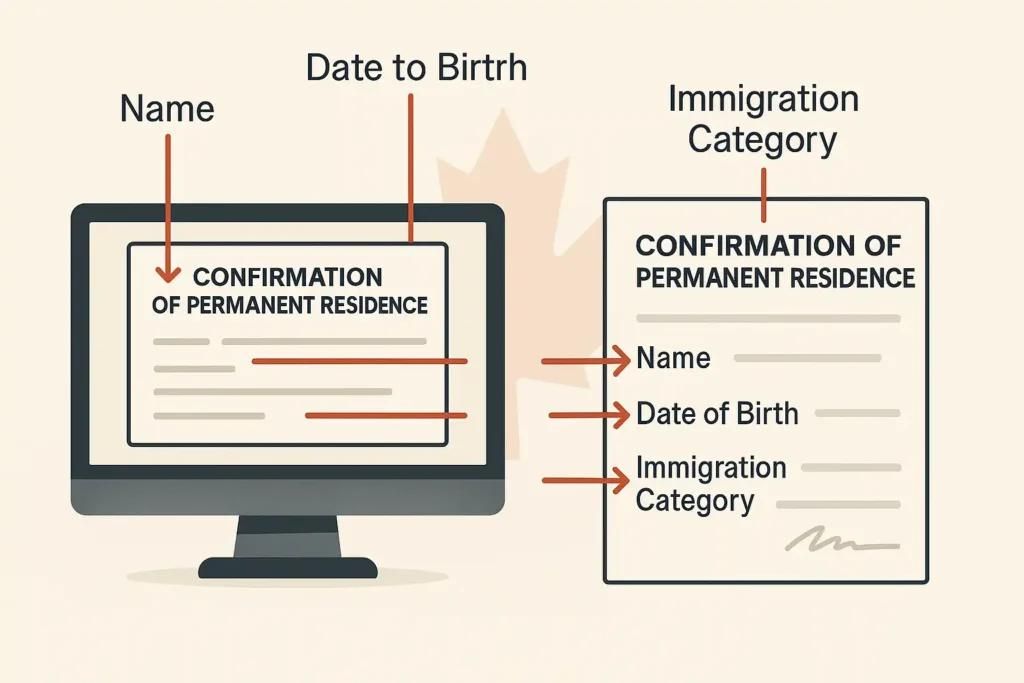
Every COPR document, paper or electronic, contains key details. Among them are:
- Your full legal name, along with any aliases;
- Date and place of birth, and your citizenship at the time of landing;
- Gender and marital status when permanent residence was granted;
- Passport information, including number, country of issue, and validity dates;
- Immigration category (for example, Express Entry, Provincial Nominee Program);
- The date and place of landing, or the date of your virtual landing;
- Conditions tied to your permanent residence, if any, apply.
- Your COPR also shows a short category code next to your immigration stream, for example CEC (Canadian Experience Class), SW1-FED (Federal Skilled Worker), or FC1/FC3 (Family Class sponsorship categories). These codes are for IRCC's internal reference and don't affect your status; if the code doesn't match the stream you applied under, treat it the same as any other COPR error and request an amendment.
The document also shows an expiry date. If you’re outside Canada, this is the last date you can use it to enter and become a permanent resident. Once you land, that expiry date no longer matters for your status. The COPR may also have signatures or stamps from officers confirming your landing.
Before Your eCOPR: The Passport Request (PPR) Stage
Before IRCC issues your eCOPR, many applicants — especially those approved through Express Entry — first receive a Passport Request (PPR). This is IRCC's instruction to submit your passport (or confirm passport details online) for final processing before your permanent residence is finalized. Receiving a PPR is a strong signal that your application has been approved; the eCOPR follows once IRCC processes it.
If you're already inside Canada, you may instead receive an email referred to informally as the "P2" notification, asking you to log into the PR Confirmation Portal and confirm your physical presence, address, and photo. Respond to either request promptly and exactly as instructed — delays here push back everything that follows, including your eCOPR and PR card.
COPR Document Numbers: IMM 5292 and IMM 5688
When IRCC issues your Confirmation of Permanent Residence, it comes in one of two official formats, each with its own form number:
- IMM 5292 — the paper COPR issued to applicants outside Canada
- IMM 5688 — the electronic COPR (eCOPR) issued to applicants already inside Canada through the PR Confirmation Portal
Knowing which form you're looking for helps you verify you've received the right document and makes it easier to reference when contacting IRCC or applying for services like your Social Insurance Number.
Differences between COPR and PR Card
People often confuse the two, but they serve very different purposes:
| Feature | COPR / eCOPR | PR Card |
| Main role | Confirms approval of permanent residence and the date of landing. | Acts as an identification card for permanent residents and is used for travel back to Canada. |
| Issued | Immediately after IRCC approves your PR application. | A few weeks later, once your details and photo are processed. |
| Travel use | Not valid for re-entry to Canada on its own. | Required for re-entry to Canada by air, train, bus, or boat. |
| Proof of PR status | Yes, especially at the time of landing. | Yes, more convenient for everyday proof after landing. |
What to Do After Receiving Your COPR
Receiving your COPR is a big moment, but there are a few steps you need to take right away. Here's what the process looks like from start to finish:
Step 1 — Check every detail immediately
As soon as your COPR arrives, compare every field against your passport. Name spelling, date of birth, immigration category, and passport number all need to match exactly. If you spot an error, contact IRCC before taking any further steps — corrections are easier to make before you land.
Step 2 — Complete your landing
If you're outside Canada, travel before your COPR's "Valid to" date and present it to the Canada Border Services Agency (CBSA) officer at the port of entry. The officer will sign and date the document, officially confirming your PR status.
If you're already inside Canada, log in to the IRCC PR Confirmation Portal using the link sent to you by email. Confirm your physical presence in Canada, and IRCC will issue your eCOPR through the portal. Note that the PR Confirmation Portal is separate from your regular IRCC secure account — do not create your own account in the portal, as this can cause delays. Follow the instructions in the email you receive from IRCC and an account will be set up for you.
Step 3 — Submit your photo and Canadian address within 180 days
This is the step most people don't know about. After landing, you have 180 days to provide IRCC with a photo and your Canadian mailing address. Your first PR card is then mailed to you automatically — there is no separate application needed if you complete this step on time.
If you miss the 180-day window, you will need to apply for your PR card manually, which adds weeks or months to the process.
Step 4 — Use your COPR while your PR card is processed
Your PR card typically arrives within a few weeks of submitting your photo and address. In the meantime, your COPR (paper or eCOPR) is legally valid proof of your permanent resident status. Keep it handy.
Step 5 — Store your COPR permanently
Even after your PR card arrives, keep your COPR in a safe place. You may need it for future citizenship applications, sponsorship files, or to resolve any status questions with IRCC.
What You Can Do with Your COPR Before Your PR Card Arrives
Hands reviewing an official immigration document on a modern desk next to a laptop, representing the COPR process.
While you wait for your PR card, your COPR is not just a piece of paper to file away — it's an active document you can use right away. Here's what you can do with it:
- Apply for your Social Insurance Number (SIN) at a Service Canada location. Your SIN is what allows you to work legally and pay taxes in Canada.
- Register for provincial health coverage. Each province has its own process and waiting period, so it's worth applying as soon as you land.
- Update your status with your employer. If you were previously on a work permit, your COPR confirms that your work authorization is no longer tied to a specific employer or permit — you are now a permanent resident.
- Access federal and provincial government services for which permanent residents are eligible, including certain settlement programs and benefits.
You do not need your physical PR card to do any of the above. The eCOPR or signed paper COPR is accepted as proof of status in all of these situations.
Frequently Asked Questions
01What is a Confirmation of Permanent Residence?
It’s the document issued by IRCC confirming that your permanent residence has been approved.
02What is the difference between COPR and eCOPR?
The main difference is format. Paper COPR is given when you’re outside Canada, while eCOPR is issued through the portal if you’re already inside.
03How long after COPR to get a PR card?
After receiving your eCOPR and submitting your photo and Canadian address in the PR Portal, IRCC's own processing data (updated weekly) shows new PR cards are currently taking roughly 6 to 8 weeks on average, though this has been improving through 2026.
04Is COPR the same as landing paper?
Yes. “Landing paper” is just another name for the COPR.
05What is the next step after COPR?
If outside Canada, you travel and present it at the border. If inside, you use the portal to confirm your details and wait for the PR card.
06What is the meaning of confirmation of residence?
It simply means proof that you have been granted permanent resident status.
07How long is the wait for eCOPR?
Most applicants receive their eCOPR within 1 to 2 weeks of submitting their photo and Canadian address in the PR Confirmation Portal. However, timelines vary — common causes of delay include a rejected photo (wrong dimensions, background, or quality), a missing or incorrect address, IRCC processing backlogs, or additional background check requirements. If you haven't received your eCOPR after 6–8 weeks, you can contact IRCC or reach out to your local Member of Parliament for follow-up.
08How to get proof of permanent residence?
Your COPR serves as proof when you first land. Later, your PR card is used as ongoing proof.
09How long is eCOPR valid?
It has an expiry date for landing if you are outside Canada. Once you land, the document itself does not expire, but your PR card will eventually need renewal.
10How many times can you take COPR?
Only once per approved application. If it expires before you land, you may need a new document through IRCC, but you don’t get unlimited tries.
11Can you buy a house with eCOPR?
Yes. With permanent residence confirmed, you can purchase property, though banks may ask for your PR card as extra proof.
12How many days from Portal 2 to eCOPR?
There isn’t a fixed rule. Some receive it in days, others in weeks.
13Can eCOPR be cancelled?
It can be revoked if the information was false or if conditions are violated.
14How will I get my eCOPR?
Through IRCC’s Permanent Residence Portal. You’ll get email instructions, confirm your information, then download the eCOPR once issued.
15What is a Passport Request (PPR)?
A PPR is IRCC's request to submit your passport, or confirm its details online, as the final step before your eCOPR or paper COPR is issued. It usually means your application has been approved.
16What if I lose my COPR after landing?
You cannot get a replacement copy of a COPR once it has served its purpose at landing. Instead, you can apply to IRCC for a Verification of Status (VOS), which confirms the same landing details for situations like lost records or service applications.
1718 What do the codes on my COPR mean (like CEC or SW1-FED)?
These are IRCC's internal codes identifying your immigration category, such as Canadian Experience Class (CEC) or Federal Skilled Worker (SW1-FED). They're for administrative reference only and don't change your rights as a permanent resident.
Stay informed
Get our immigration updates first on Google
Add SEP Immigration as a preferred source and our latest news and guides appear more often in your Google results.
About the Author

Sepehr Falahati
CEO of SEP Immigration
- CICC Licensed
- RCIC #R533959
- IRB Member
Sepehr Falahati is a Regulated Canadian Immigration Consultant (RCIC #R533959), licensed by the College of Immigration and Citizenship Consultants (CICC).
Read more about Sepehr FalahatiReviewed By


Continue Reading