
Work Without a Work Permit in Canada: R186 Exemptions and Business Visitors
Reviewed by Mohsen Khorvash and Mahsa Barati

Not every job performed in Canada requires a Canadian work permit. Section 186 of the Immigration and Refugee Protection Regulations lists two dozen categories of foreign nationals who may work here without one, and two public policies add short-term exemptions on top of that list.
The exemption is narrower than most people assume, and the largest category, the business visitor, turns on where the money comes from rather than what the job is called. Getting it wrong means refusal at the border, not a request for more paperwork. For employers, it also means skipping the Labour Market Impact Assessment or employer portal steps that should have applied, which is a compliance problem. Companies bringing in engineers, trainers or service technicians as part of business immigration to Canada need this settled before anyone books a flight.
One point to clear up first: being exempt from the permit requirement says nothing about the document needed to enter the country. Depending on nationality, an exempt worker may still need a visitor visa or an electronic travel authorization.
Work Permit Exemptions Under Section R186 of the Immigration Regulations
Canadian immigration law defines work broadly. Activity that competes in the Canadian labour market, or that generates wages or commission, counts as work whether or not it resembles a job. Business visitors are performing work under that definition and are simply relieved of the permit requirement. Section 186 sets out where that relief applies, lettered from (a) to (x). Some paragraphs are occupational, some situational, and they share nothing but the exemption itself, so the question is never whether an occupation sounds exempt but whether the person fits one specific paragraph and its conditions.
Full List of R186 Work Permit Exemption Categories
Each paragraph carries its own conditions, several of which are set out in separate IRCC guidance.
| Paragraph | Who it covers |
|---|---|
| R186(a) | Business visitors, assessed against the criteria in section R187 |
| R186(b) and (c) | Foreign representatives and their family members |
| R186(d) | Military personnel |
| R186(e) | Foreign government officers |
| R186(f) | On-campus employment for eligible study permit holders |
| R186(g) | Performing artists |
| R186(h) | Athletes and team members |
| R186(i) | News reporters and media crews |
| R186(j) | Public speakers, including seminar leaders where the seminar runs no longer than five days |
| R186(k) | Convention organizers, excluding hands-on service providers and Canadian events |
| R186(l) | Religious leaders |
| R186(m) | Judges, referees and similar officials |
| R186(n) | Examiners and evaluators |
| R186(o) | Expert witnesses and investigators |
| R186(p) | Short-term students in a foreign health care program |
| R186(q) | Civil aviation inspectors |
| R186(r) | Aviation accident and incident inspectors |
| R186(s) | Crew |
| R186(t) | Emergency service providers |
| R186(u) | Permit holders working while a renewal decision is pending |
| R186(v) | Off-campus work for eligible study permit holders |
| R186(w) | Study permit holders who have completed their program |
| R186(x) | Registered Indians as defined under the Indian Act |
Business Visitor Requirements Under Section R187
Business visitors generate most of the questions, and section R187 holds the answer. Two conditions have to hold together.
The Three Tests That Keep You Out of the Canadian Labour Market
A foreign national stays outside the Canadian labour market when all three of the following are true: the primary source of remuneration for the activity remains outside Canada, the principal place of business remains outside Canada, and the accrual of profits remains outside Canada.
These are financial tests, not occupational ones. The same job title can be exempt in one arrangement and permit-required in another, purely because of who pays and where the business sits.
Business Activities That Qualify Without a Work Permit
The activity must also be international in scope, meaning the person is not engaging with the general public. IRCC guidance covers attendance at business meetings, trade conventions and exhibitions where nothing is sold to the public, procurement of Canadian goods and services, after-sales service under a warranty, and attendance at a board of directors meeting. A board member may be well paid for their expertise and still qualify, though taking on other business duties in Canada can change that.
Exhibitors sit on a fine line. Displaying goods, or selling to wholesalers, retailers and institutions, falls inside the exemption. Selling foreign-made goods to the general public and handing them over at the point of sale does not.
After-Sales Service and Warranty Work Permit Exemption Rules
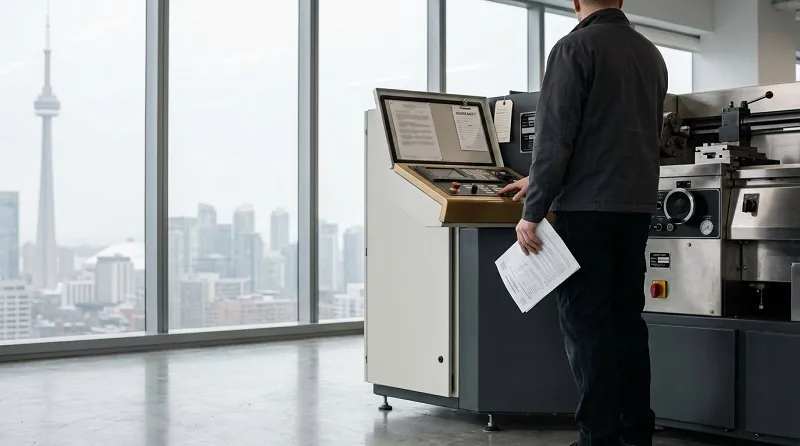
This is the busiest part of the category and the part most often misapplied. It covers entry to repair, service, set up, test or supervise work on specialized commercial or industrial equipment purchased or leased outside Canada.
The contract decides it. The service must be provided under the original sales, lease or rental agreement, or an extension of it. A service contract negotiated with a third party after the original agreement was signed is not covered, with one exception: where the original agreement names a third company as the servicer, the exemption still applies.
Supervision, Training and Installation Limits
Set-up does not extend to hands-on activities normally performed by construction or building tradespeople such as electricians or pipe fitters. Prefabricated structures and equipment needing proprietary knowledge to assemble can be exceptions, but the default is that trade work needs a permit.
Supervisors may oversee the installation of specialized machinery bought or leased abroad, or the dismantling of equipment bought in Canada for relocation outside the country, without doing the work themselves. Trainers may train the Canadian purchaser's users or maintenance staff after installation is complete, provided they keep their position in their home branch and receive nothing from the Canadian branch beyond expenses.
Software Upgrades Treated as a New Contract
A sales or lease agreement for a software upgrade to previously purchased equipment counts as a new contract for a new product. Someone entering to install, configure or train on that upgrade may qualify, provided the service activity is set out clearly in the new agreement or purchase order.
Out-of-Warranty Repair Work Requires a Different Route
Once equipment is no longer under warranty or a service agreement, the exemption stops applying. That work is assessed under the significant benefit provisions in section R205, which cover emergency and out-of-warranty repair personnel. A permit is required, an LMIA is not. Sending a technician on the assumption that all repair work is exempt is a common and avoidable error.
Contracted Services That Do Not Qualify as Business Visitor Activity
Where a Canadian company directly contracts services from a foreign company, and that company sends an employee to perform the work, the employee needs a permit. The reasoning is not about who signs the cheque: because the Canadian entity contracted for the service, there is entry into the labour market, and payment from abroad does not change that. IRCC's guidance on the business visitor category illustrates this with architects sent by a United States firm to work on a Canadian airport expansion.
The reverse arrangement is treated differently. Where a foreign company contracts a Canadian company to do work for it abroad and sends employees here for quality assurance or inspection, those employees remain business visitors, because the foreign company stays their employer, keeps them on payroll, remains the beneficiary of their work and keeps its principal place of business outside Canada.
Tour Guides, Bus Operators and Other Occupations Assessed by Employer
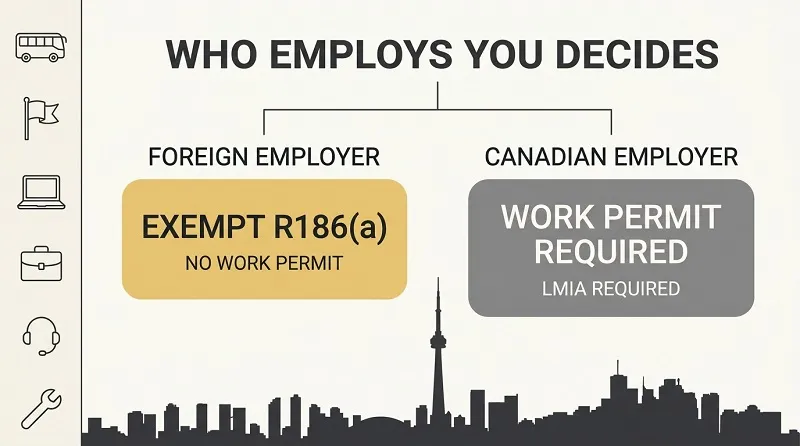
Several occupations appear on both sides of the line depending only on who employs the person. IRCC's officer reference guide lists them twice, with the employer as the deciding factor.
| Occupation | Working for a foreign employer | Hired by a Canadian employer |
|---|---|---|
| Tour guides and bus operators | Exempt under R186(a) | Work permit and LMIA required |
| Buyers and procurement staff | Exempt under R186(a) | Work permit and LMIA required |
| Computer specialists and systems analysts | Exempt under R186(a) | Work permit and LMIA required |
| Financial services personnel | Exempt under R186(a) | Work permit and LMIA required |
| Public relations and advertising personnel | Exempt under R186(a) | Work permit and LMIA required |
| Trainers, trainees, translators and interpreters | Exempt under R186(a) | Work permit and LMIA required |
For a tour guide or coach operator, then, the question is not how interactive the role is or where the itinerary begins and ends. It is whether the guide works for a foreign operator whose remuneration and principal place of business stay outside Canada. A guide employed by a Canadian tour company needs a permit regardless of the route. Free trade agreements can narrow this further: the Canada-Korea agreement, unlike CUSMA, does not include tour bus operators in its business visitor coverage.
Short-Term Work Permit Exemptions for 15, 30 and 120 Days
Separately from section R186, two public policies introduced under the Global Skills Strategy exempt certain high-skilled work from the permit requirement. The main one covers work in a TEER 0 or TEER 1 occupation for 15 consecutive days where no exemption has been granted in the previous six months, or 30 consecutive days where none has been granted in the previous 12 months. A separate policy provides a 120-day exemption for researchers.
Three details decide most cases. The exemption attaches to the person rather than the employer, so someone working for two Canadian companies in the same window needs both roles to sit in TEER 0 or 1. The clock runs consecutively from the day it is granted, and leaving Canada partway through does not extend it. An initial request cannot be made from inside Canada, which rules the policy out for anyone already here. Current categories are listed on IRCC's page covering who can work without a work permit.
Documents Business Visitors Should Carry to the Port of Entry
There is no application to file and no fee to pay, so the whole assessment happens at the border with whatever the traveller has in hand. The onus sits on the applicant.
A support letter from the foreign employer and an invitation letter from the Canadian host business are the two documents officers expect. Contracts matter for service work, since the exemption depends on the agreement's terms and dates. Officers may also consider business cards, business papers, advertising material and anything else they reasonably request. Where a stay runs beyond six months, the officer should issue a visitor record noting why the longer period was granted.
Limits and Consequences of Working Without a Work Permit
One restriction applies to business visitors alone. Foreign nationals working under most R186 paragraphs may apply for a work permit after entering Canada under section R199. Business visitors under R186(a) and R187 are excluded. If an assignment grows into permit-required work after arrival, the business visitor generally cannot convert from inside the country, which is worth anticipating rather than discovering.
Workers exempt under other paragraphs are better placed. They can extend their temporary resident status, and if they apply before their current status ends, maintained status lets them keep working under the same paragraph while the decision is pending. The mechanics resemble a work permit extension, with the same hard rule that the application must be filed before the existing status expires.
How SEP Immigration Helps
Whether a worker needs a permit turns on contract wording, employment structure and the source of remuneration, and the assessment happens at the border where there is no second chance to explain. SEP Immigration, led by Sepehr Falahati (CICC and IRB member R533959), reviews the arrangement, gives a clear answer on which route applies, and prepares the supporting documentation for the traveller and the Canadian host.
Frequently asked questions
01Does work done as a business visitor count toward the Canadian Experience Class?
No. IRCC guidance states that business visitor experience cannot be included in the calculation for the Canadian Experience Class. This catches people out, because the time feels like Canadian work experience and is often documented that way by the employer.
02How long can a business visitor stay in Canada?
No fixed maximum is written into the rules, and most visits fall well under six months. Longer stays are possible where the person genuinely remains outside the labour market. IRCC gives the example of foreign employees carrying out quality assurance or inspection who may be here up to two years, because their principal place of business remains abroad.
03Do business visitors still need a visa or an eTA to enter Canada?
Usually yes. The permit exemption and the entry document are separate questions. Depending on nationality, a business visitor may need a temporary resident visa or an electronic travel authorization, and biometrics may also apply.
04Can someone working without a work permit get a Social Insurance Number?
It depends on the document. Where an officer grants the short-term exemption, the visitor record is annotated to show the holder is authorized to work in a stated position for a stated duration, and that notation is what allows Service Canada to issue a Social Insurance Number. Request it at the port of entry if Canadian payroll is involved.
05Do business visitors need a medical exam?
They follow the same medical requirements as every other foreign national. No rule exempts them and none adds an exam. Whether one applies depends on length of stay, countries lived in beforehand, and the nature of the work.
06What happens if a border officer decides you are not a business visitor?
The officer determines that a permit is required and entry for that purpose is refused. Anyone refused on this basis generally has to obtain the appropriate permit, with an LMIA or under an exempt category, before travelling again for the same work.
Stay informed
Get our immigration updates first on Google
Add SEP Immigration as a preferred source and our latest news and guides appear more often in your Google results.
About the Author

Sepehr Falahati
CEO of SEP Immigration
- CICC Licensed
- RCIC #R533959
- IRB Member
Sepehr Falahati is a Regulated Canadian Immigration Consultant (RCIC #R533959), licensed by the College of Immigration and Citizenship Consultants (CICC).
Read more about Sepehr FalahatiReviewed By


Continue Reading