
Dual Intent in Canadian Immigration
Reviewed by Mohsen Khorvash and Mahsa Barati

Applicants routinely hide the fact that they want to live in Canada, believing that admitting it will sink their visitor visa or study permit. That instinct is wrong, and acting on it is more dangerous than the honesty it was meant to avoid. Canadian law permits you to hold two intentions at once: to enter Canada temporarily now, and to become a permanent resident later. What it does not permit is a temporary application from someone with no genuine intention of leaving. This guide explains where that line sits and what to do if you have already been refused.
Key Facts About Dual Intent in Canada
- The legal basis: section 22(2) of the Immigration and Refugee Protection Act, written as A22(2).
- Dual intent is legal: IRCC treats the two intentions as complementary, not contradictory.
- The test: whether the officer is satisfied you will leave on time, even if your PR application is refused.
- Two intents are not grounds for refusal. A single intent to remain permanently is.
- The real risk is misrepresentation, not the dual intention itself.
What Is Dual Intent in Canadian Immigration?
Dual intent exists when you have applied, or intend to apply, for permanent residence while also applying to enter Canada temporarily as a visitor, student, or worker.
Section 22(2) of IRPA Explained
Section 22(2) provides that "an intention by a foreign national to become a permanent resident does not preclude them from becoming a temporary resident if the officer is satisfied that they will leave Canada by the end of the period authorized for their stay."
Everything turns on the second half. The provision removes one objection, that wanting to immigrate is by itself disqualifying. Every other requirement of temporary residence, including the obligation to leave, remains intact.
IRCC revised its officer guidance in April 2023, directing that two intentions be treated as complementary and reminding officers that Canada actively promotes temporary resident to permanent resident pathways. That shift is worth citing in a well-prepared application.
How Immigration Officers Assess Dual Intent
Because two intentions cannot on their own justify a refusal, officers assess something narrower: whether you will comply with the terms of temporary status.
Factors Officers Consider
- the length of time you will spend in Canada
- your means of support
- your obligations and ties to your home country
- the purpose and context of the stay
- the credibility of your documents and information
- your past compliance with IRPA and the Regulations, together with biographic and biometric information sharing
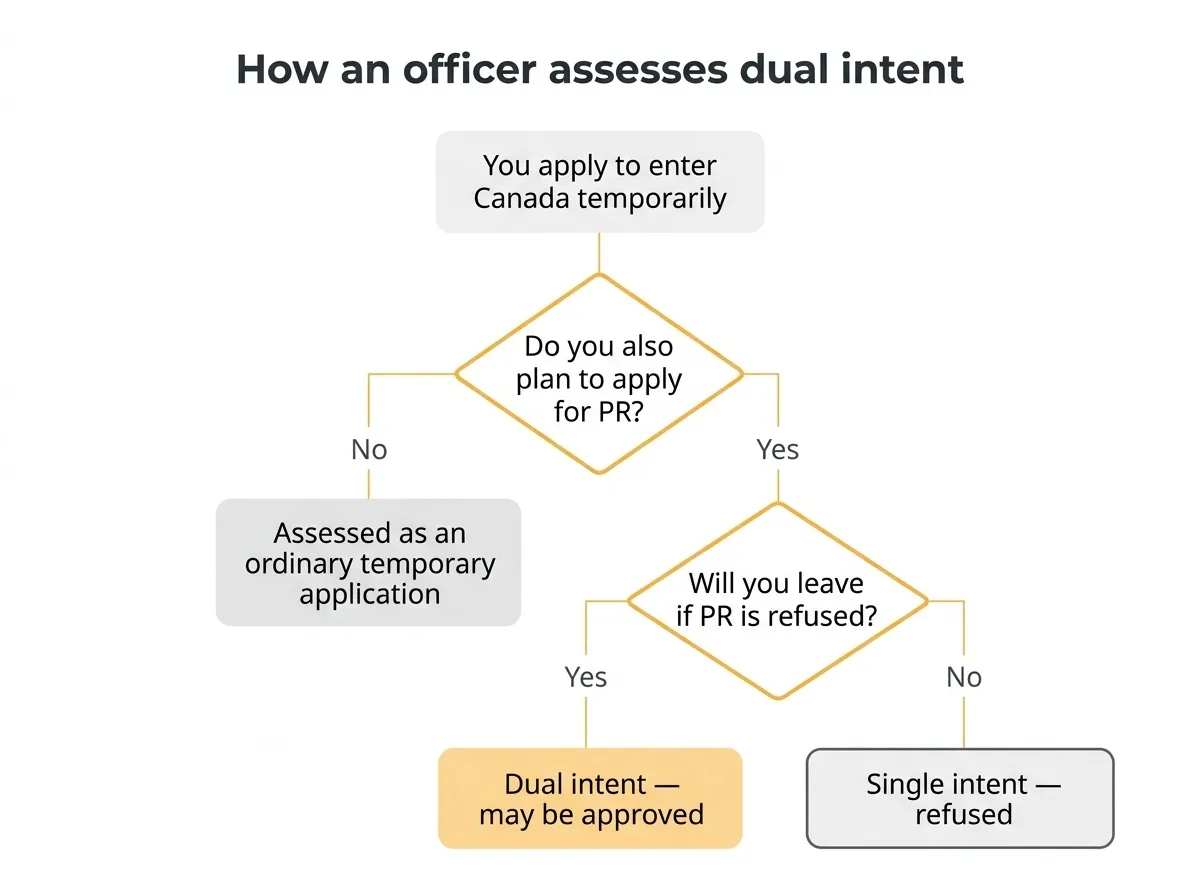
Officers must record their reasoning in the Global Case Management System, and dual intent should be mentioned where it formed part of the decision. That is why GCMS notes are the first thing to obtain after a refusal: the refusal letter is generic, the notes are not.
Dual Intent for Visitor Visa and TRV Applicants
Can You Visit Canada While Your PR Application Is in Process?
Yes. Applying for a visitor visa with a pending PR application is expressly contemplated by A22(2). You need a genuine purpose, adequate means of support, and the ability to satisfy an officer you will leave on time. Expect closer scrutiny than an ordinary visitor: the officer can see an obvious intention to settle, so your ties abroad must carry more weight.
Dual Intent for Spousal Sponsorship Applicants
If you are being sponsored as a spouse or common-law partner and also want a TRV, officers weigh four further factors: whether the sponsorship application has been approved, whether the PR application has stage one approval, the extent of your retained ties abroad, and your plan if PR is refused.
That last point is the one applicants prepare worst. A vague answer reads as an intention to stay regardless of outcome. Name the job, lease, or family obligation you would return to. If you are already in Canada, a spouse open work permit may let you work while the application is processed, which strengthens your position rather than undermining it.
Dual Intent for Study Permit Applicants
IRCC's instructions state that an applicant for a work or study permit who indicates they have no intention of leaving Canada has shown only a single intent, and their application will be refused, even if they might later qualify for the Canadian Experience Class or a Provincial Nominee Program.
So a study permit applicant should not conceal an eventual interest in immigrating, but must be able to say what happens if PR does not materialise. Planning a post-graduation work permit and an eventual Express Entry application is legitimate and need not be hidden. If you are already here as a visitor, changing a visitor visa to a study permit carries the same analysis.
Dual Intent for Work Permit Applicants
Work permit applicants sit in the most favourable position of any group, since IRCC reminds officers that Canada actively promotes these pathways. A provincial nominee whose PR file is nearly complete, applying for a work permit with provincial support, is the textbook case. The test is unchanged: document the offer, the duration, your ties abroad, and the contingency.
Dual Intent for Parents and Grandparents
Officers take a more generous approach with parents and grandparents who have a PR application in progress or wish only to visit. They will normally be issued a TRV, including a multiple-entry visa, provided they satisfy the officer they will leave on time.
In practice the Super Visa is often the better instrument for long visits, while parents and grandparents sponsorship is the route to settlement. The two can legitimately run in parallel.
Dual Intent and Misrepresentation Under Section 40 of IRPA
Dual intent is lawful. Concealing your PR plans, or asserting a temporary intention you do not hold, is not. If IRCC concludes you gave false information or withheld material facts, that is misrepresentation under section 40, carrying a five-year bar and a permanent notation on your record. That is far worse than a refused visitor visa.
The safe course is the honest one: disclose the PR application, explain the temporary purpose, document the ties and the contingency. An officer looking at a candid file has room under A22(2) to approve it. An officer who catches an omission does not.
What to Do If Your Visa Was Refused for Dual Intent
Do not reapply with the same package. That usually produces the same result.
Order Your GCMS Notes First
Start with GCMS notes to see what the officer actually recorded. You cannot fix a concern you have not read.
Fairness Letters, Appeals and Reapplication
If you received a procedural fairness letter rather than a refusal, the window to respond is short. Where the Immigration Appeal Division has jurisdiction, immigration appeals may be available, and where admissibility is in question the file may go to an admissibility hearing.
Common Dual Intent Mistakes to Avoid
- Hiding the PR application. Concealing a lawful application risks misrepresentation.
- No answer for "what if PR is refused." Officers are instructed to consider exactly that.
- Saying you have no intention of leaving. IRCC gives this as an example of a case for refusal.
- Treating A22(2) as an exemption. Every other requirement still applies.
Dual intent is one of the few areas of immigration law where the honest approach and the strategic approach are the same, but only if the file shows both intentions clearly. SEP Immigration, led by Sepehr Falahati (CICC and IRB member R533959), is a Toronto-based firm representing applicants on temporary residence, permanent residence, and refusals before the Immigration and Refugee Board.
This page is general information, not legal advice. Program instructions change. For official guidance, see IRCC's program delivery update on dual intent and its instructions on in-Canada applicants with permanent residence applications in progress, or speak with a licensed representative.
Frequently asked questions
01Is dual intent legal in Canada?
Yes. Section 22(2) of IRPA provides that intending to become a permanent resident does not prevent you from being granted temporary residence, provided the officer is satisfied you will leave at the end of your authorised stay.
02Should I tell the officer I plan to apply for permanent residence?
Yes. Concealing it risks a misrepresentation finding under section 40, which carries a five-year bar. Disclosing it is lawful, and a well-prepared application explains both the temporary purpose and the permanent goal.
03How do I prove I will leave Canada at the end of my stay?
Evidence of ties abroad carries the argument: ongoing employment, property, dependants, or family obligations, plus a clear purpose and duration for the visit and a specific plan for returning if PR is refused.
04My visa was refused for dual intent. What are my options?
Order your GCMS notes to see the officer's reasoning, then address that concern in a rebuilt application, or pursue a fairness response or appeal where available.
Stay informed
Get our immigration updates first on Google
Add SEP Immigration as a preferred source and our latest news and guides appear more often in your Google results.
About the Author

Sepehr Falahati
CEO of SEP Immigration
- CICC Licensed
- RCIC #R533959
- IRB Member
Sepehr Falahati is a Regulated Canadian Immigration Consultant (RCIC #R533959), licensed by the College of Immigration and Citizenship Consultants (CICC).
Read more about Sepehr FalahatiReviewed By


Continue Reading