
If you are in Canada as a visitor and you need more time, the document you apply for is a visitor record. It is issued from inside Canada, it carries a new expiry date, and that date becomes your new deadline to leave or extend again.
Two things about it surprise almost everyone. A visitor record is not a visa, so it does not guarantee that you can leave Canada and come back. And the expiry date that matters is not the one printed on your visitor visa. It is the date stamped in your passport, or six months from your entry if there is no stamp at all.
Timing decides almost everything here. Applying before your status expires keeps you legal while IRCC decides. Applying afterwards puts you into a separate, discretionary process with a hard 90 day cut-off. This page covers who can apply, how the application works, what maintained status does and does not protect, and what to do if the date has already passed.
What Is a Visitor Record and What It Does Not Do
A visitor record is an immigration document that sets out your status inside Canada and how long you may stay. It replaces the authorized period you were given at the border with a new one.
What it does not do is the part worth reading twice:
- It is not a visa. It does not permit entry to Canada. It governs your stay once you are already here.
- It does not authorize work. Working on a visitor record, outside the narrow categories of work that require no permit, is unauthorized work.
- It does not authorize study. A programme longer than six months needs a study permit.
- It does not guarantee re-entry. If you leave Canada, your ability to return depends on your visa or travel authorization, not on the visitor record.
What it does protect is something quieter but more valuable over time: an unbroken record of legal status. Officers assessing a future study permit, work permit, or permanent residence application can see whether you extended properly or let your status lapse.
Who Can Apply for a Visitor Record in Canada
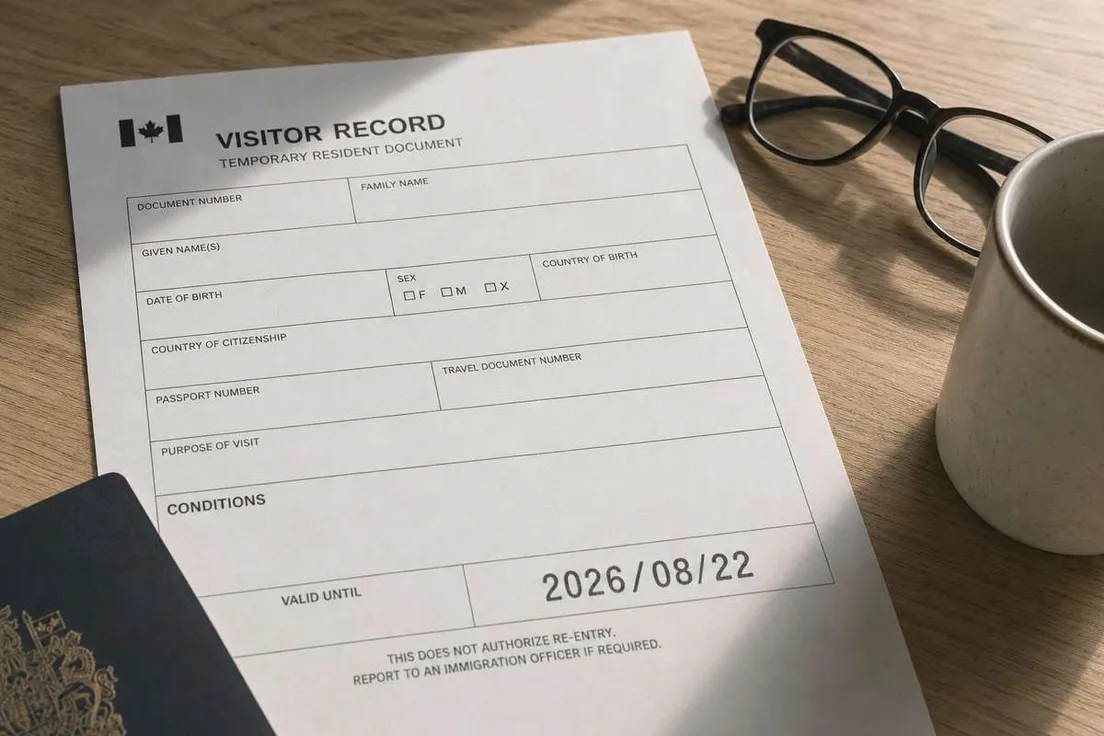
A visitor record covers more situations than most people realise. You can apply if you want to extend your stay as a visitor, as a worker authorised to work without a work permit, or as a student authorised to study without a study permit. You can also apply to change your temporary resident category, moving from a study permit or a work permit to visitor status.
It does not matter how you first entered Canada. Whether you arrived on a visitor visa, a Business Visitor Visa, an electronic travel authorization, or another document, the route to more time as a visitor is the same, as IRCC sets out on its extend your stay in Canada pages.
Changing to visitor status is a common step for people whose circumstances have shifted: a graduate waiting on a post-graduation work permit decision, a worker whose contract has ended, or a spouse waiting on a spouse open work permit. It buys legal time while the next step is sorted out. It does not, however, work as a way to extend a work or study permit by another route, and officers assess it on that basis.
Moving in the other direction is a separate application. If your plan is to begin studying rather than simply to stay longer, see our guide to changing a visitor visa to a study permit. If you are already waiting on a permanent residence decision, a bridging open work permit may be the better instrument, since it preserves the right to work that a visitor record removes.
When to Apply to Extend Your Stay in Canada
Apply at least 30 days before your current status expires. That is the official guidance and it is not padding, because the consequences of applying late are disproportionate to the delay.
Finding Your Real Expiry Date
Your status expiry is shown on the stamp in your passport, on your study permit, on your work permit, or on your current visitor record if you have already extended once. If a border officer did not stamp your passport and gave you no document, your authorized stay is six months from the day you entered Canada.
The date printed on your visitor visa is a different thing entirely. It tells you how long you may use that visa to travel to Canada. It says nothing about how long you may stay once you are here. People routinely count from the visa expiry, overstay without realising, and discover the problem after the restoration window has already closed.
Maintained Status While Your Extension Is Processed
If you apply to extend before the date by which you were supposed to leave, you may legally remain in Canada until a decision is made. This is maintained status, previously called implied status. You keep the conditions of your existing status while you wait, which for a visitor means you may stay but may not work or study.
Two limits are worth knowing before you rely on it.
First, temporary resident permit applicants do not get maintained status at all. That applies to both first applications and any subsequent ones, and it catches people who assume the general rule covers them.
Second, and this is the trap that has caught the most people since IRCC clarified it, maintained status does not apply if your application is returned as incomplete rather than refused on its merits. A returned application was never properly filed. The 90 day restoration clock in that situation runs from the end of your original authorized stay, not from the date IRCC sent the file back, so a person can be most of the way through the window before they even learn there is a problem. This is why a complete, correctly paid application matters more than a fast one.
How to Apply for a Visitor Record
Step 1: Confirm the Date Your Status Expires
Work from the passport stamp, permit, or existing visitor record. If there is no stamp, count six months from entry. Do not use the visa expiry date.
Step 2: Apply Before That Date, With 30 Days to Spare
Filing before expiry is what secures maintained status. Everything else in the process is recoverable. This is not.
Step 3: Complete the Application to Extend or Change Conditions
Use the form for changing conditions, extending a stay, or remaining in Canada as a visitor. Your answers should be consistent with what you told the officer at the border, because inconsistencies between entry and extension are a common refusal ground.
Step 4: Prepare Your Supporting Documents
You need your passport, evidence of the funds supporting a longer stay, and a letter explaining why you need more time. The letter is doing the real work: an officer must be satisfied that you will leave at the end of the authorized period, so the reason for extending and your ties outside Canada both belong in it.
Step 5: Pay the Fees and Submit Online
The visitor record fee is charged per person and has been CAD 100 as of August 2026. Fees change, so confirm the current amount on IRCC's official fee list before you pay, and make sure every family member included is covered. An underpaid application is an incomplete one.
Step 6: Give Biometrics If You Are Asked
If a biometrics instruction letter arrives, book the appointment immediately. Biometrics are often not required again for in-Canada extensions where you have given them before and they remain valid, but where they are requested, a delayed appointment simply becomes a delayed decision.
Step 7: Watch the New Expiry Date
If approved, the visitor record should reach you by mail within six weeks of your decision letter. Read the expiry date on it rather than assuming you received the period you asked for. Officers routinely grant less time than requested, and counting six months from approval when the record says otherwise is how a lawful extension turns into an overstay.
Visitor Status Expired: Restoration Within 90 Days
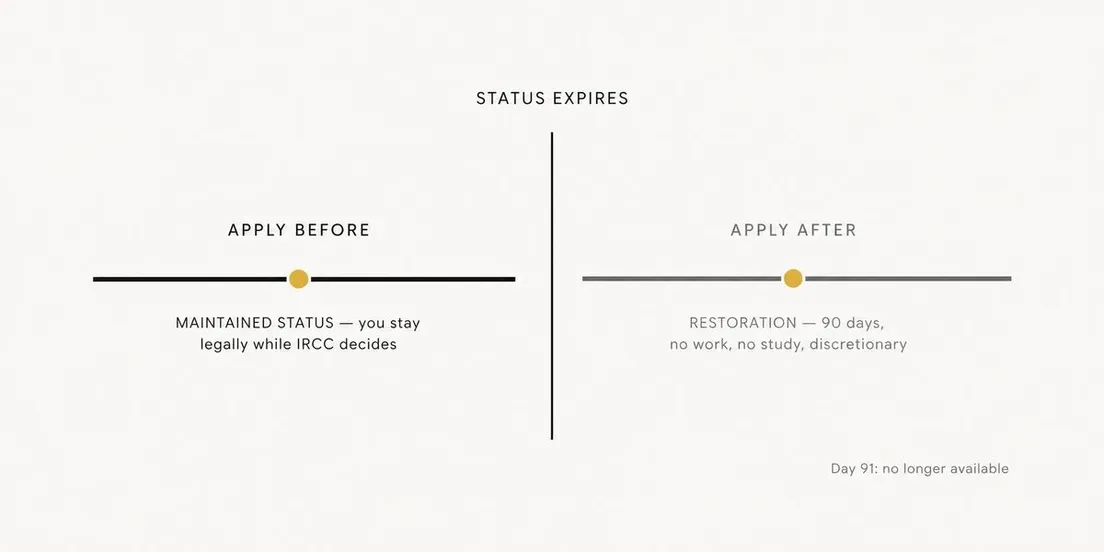
If your status has already expired and you did not apply in time, you lose temporary resident status. You may apply to restore it, but only within 90 days of the expiry date. On day 91 the option is gone, and the remaining route is to leave Canada.
Restoration is filed together with a visitor record application, and both fees apply. The restoration fee is separate from and larger than the visitor record fee, and the published amount has moved more than once recently, so verify it on the official fee list rather than relying on figures quoted on third party sites.
Three things about restoration are consistently misunderstood:
- You are out of status the entire time it is pending. Unlike maintained status, restoration does not restore anything until it is approved.
- It does not authorize work or study. You must stop both the day your permit expired. A single day of unauthorized work after expiry can sink the application and follow you into future files.
- It is discretionary. Meeting the 90 day deadline makes you eligible to be considered. It does not make approval likely on its own, and the explanation for the overstay carries real weight.
Restoration also does not erase the gap. Maintained status leaves your history unbroken; restoration leaves a visible out-of-status period even when it succeeds. That distinction can matter later in a permanent residence assessment.
Workers and Students Can Now Restore as Visitors
This changed recently and a great deal of published guidance has not caught up. Under officer instructions updated on May 1, 2026, a worker or student who has lost status may apply to restore their status as a visitor without leaving Canada first. Previously, someone in that position generally had to depart and re-enter as a visitor.
The conditions are that you apply within the 90 day window, remain in Canada until a decision is made, file a visitor record application alongside the restoration application with both fees paid, and satisfy an officer that you meet the requirements of a visitor. It is a meaningful opening for a worker whose job has ended or a student who no longer intends to study, and it keeps options alive that used to close.
Travelling Outside Canada on a Visitor Record
A visitor record shows your status inside Canada. It does not carry you back across the border.
If you are visa-required, you need a valid visitor visa each time you enter Canada, with one exception: returning directly from a visit to the United States or Saint Pierre and Miquelon. An expired visa combined with a valid visitor record will not get you back in.
If you are visa-exempt, an electronic travel authorization is what you need to fly to a Canadian airport, and it is valid for five years or until the linked passport expires. Travel with the passport tied to it. Arriving by car, bus, train or boat requires only a valid passport or travel document.
There is a useful exception for people who hold a valid study or work permit and need to travel: you may apply for a new visitor visa from inside Canada if your existing one has expired or was single entry. That option is not available to someone holding only a visitor record.
Visitor Record, Visitor Visa and Super Visa Compared
| Visitor record | Visitor visa (TRV) | Super visa | |
|---|---|---|---|
| Applied for | Inside Canada | Outside Canada | Outside Canada |
| Purpose | Extends your stay | Permits entry | Permits entry, longer stays |
| Permits re-entry | No | Yes, while valid | Yes, multiple entries |
| Who it is for | Anyone already in Canada as a visitor | Visa-required travellers | Parents and grandparents |
| Authorizes work or study | No | No | No |
Parents and grandparents visiting family are the group most often served better by a different document. The super visa allows much longer authorized stays per entry and multiple entries over its validity, which removes the cycle of extending every six months. Anyone repeatedly filing visitor records to stay with family in Canada should look at whether they qualify for it instead.
Common Reasons Visitor Extension Applications Are Refused
- Counting from the visa expiry date rather than the passport stamp, so the application is filed after status has already lapsed.
- Applying too close to the deadline and having the file returned as incomplete, which removes maintained status entirely.
- A thin explanation for the extension. "I want to stay longer" does not address what the officer must decide.
- Weak evidence of intention to leave. Ties outside Canada matter more the longer the cumulative stay becomes.
- Insufficient proof of funds to support the additional period without working.
- Working or studying while out of status, which is fatal to a restoration application.
- Assuming the granted period matches the requested one and overstaying a shorter record than expected.
How SEP Immigration Helps With Visitor Records and Extensions
Most visitor extension problems are timing problems, and they are fixable before they happen rather than after. We confirm the date your status actually expires, file well ahead of it, and build the explanation and financial evidence around what an officer has to be satisfied of. If your status has already lapsed, we assess honestly whether restoration is realistic in your circumstances and what the alternatives are if it is not.
This page is general information, not legal advice, and fees, processing times and officer instructions change without much notice. Details reflect IRCC guidance published as of August 2026 and should be confirmed on canada.ca or with a licensed representative before you apply.
Frequently asked questions
01
When should I apply to extend my stay in Canada?
At least 30 days before your current status expires. Applying before the expiry date is what gives you maintained status. Applying after it puts you into restoration, which is more expensive, discretionary, and leaves a gap in your immigration history.
02
Can I work or study on a visitor record?
No. It authorizes your presence as a visitor and nothing more, apart from the narrow categories of work and study that require no permit. Unauthorized work or study affects every application you make afterwards.
03
What happens if my visitor status already expired?
You generally have 90 days from expiry to apply for restoration, filed together with a visitor record application. You must remain in Canada, stop any work or study immediately, and understand that you are out of status while it is pending. Restoration is discretionary.
04
Can a worker or student restore their status as a visitor?
Yes. Since May 2026, a worker or student who has lost status may restore as a visitor without leaving Canada, provided they apply within 90 days, stay in Canada, file a visitor record application with both fees, and meet the requirements of a visitor.
05
Can I leave Canada and come back on a visitor record?
Not on the visitor record alone. Visa-required travellers need a valid visitor visa to return, except when coming directly back from the United States or Saint Pierre and Miquelon. Visa-exempt travellers need a valid electronic travel authorization to fly, though not to arrive by land or sea.