

The entire outcome of a work permit renewal turns on one thing: whether your application reaches IRCC before your current permit expires. File in time and you keep working under maintained status while the decision takes however long it takes. File a day late and you must stop working immediately, even if the extension is eventually approved.
That is the headline, but it is not the whole picture. Maintained status protects your right to work and nothing else, and there are things you must do before your permit lapses that no amount of legal status will let you do afterwards.
This page covers when to apply, what your employer has to do first, what maintained status actually covers, how a change of conditions differs from a straight extension, and what remains possible if the date has already passed. If your plan is to stop working and remain in Canada while you sort things out, our visitor record page covers that route instead.
Who Needs to Apply to Extend or Change a Work Permit
You need to apply if you want to keep working past your permit's expiry date, or if the conditions of your work are changing in a way your current permit does not cover. That includes changing employers, changing your job or occupation, or changing your work location.
It also covers situations people do not always think of as extensions: removing a restriction from an open permit once you have completed a medical exam, correcting an error IRCC made on your permit, or updating personal details on the document.
The distinction that matters most is between an employer-specific permit and an open one. An employer-specific permit ties you to a named employer, job and location, and renewing it involves your employer directly, as IRCC sets out on its extend or change the conditions on your work permit pages. An open permit, such as a bridging open work permit or a spouse open work permit, does not, and you may change employers freely while it is valid. You still have to extend it before it expires.
When to Apply for a Work Permit Extension
IRCC's stated minimum is at least 30 calendar days before your permit expires. Treat that as a floor rather than a target. In-Canada work permit processing has run to many months, and the earlier you file, the smaller the window in which you are working on an expired physical document.
One mechanical detail is worth knowing precisely, because it has cost people their status. If you apply online, your application must be submitted before midnight Coordinated Universal Time on the day your permit expires. That is UTC, not your local time, which in most of Canada means the deadline falls during the afternoon or evening of the previous day rather than at the end of the day you were counting on.
Check Your Passport Before You Check Anything Else
IRCC will not issue a work permit that extends beyond your passport's validity. If your passport expires in eight months, your new permit will expire in eight months, regardless of how long your job offer or Labour Market Impact Assessment runs.
This is the single most common self-inflicted problem in work permit renewals, and it is entirely avoidable. Renew the passport first, then apply. Doing it in the other order can cost you years of authorized work and force another application you did not need to make.
What Your Employer Must Do First

For an employer-specific work permit, your employer has a step that must be completed before you can file anything. There are two versions of it.
If the position requires a Labour Market Impact Assessment, your employer applies for a new one from Employment and Social Development Canada. If the position is exempt from that requirement, your employer instead submits a new offer of employment through the Employer Portal and pays the employer compliance fee, which has been CAD 230.
Neither step is needed if you hold an open work permit, or if your employer is exempt from the employer compliance process. Employers are also not required to pay the compliance fee where the worker is exempt from paying the work permit processing fee.
The practical consequence is that your timeline is not entirely yours. A new Labour Market Impact Assessment takes time to obtain, and if your employer starts it a month before your permit expires, you are already in trouble. Work backwards from your expiry date and make sure your employer knows their deadline, not just yours.
The Quebec Exemption Introduced in March 2026
Quebec employers should know about a measure that took effect on March 13, 2026 and is not yet widely reflected in published guidance. A Quebec employer may not need a new Labour Market Impact Assessment to extend a worker's permit, and can submit only an offer of employment to IRCC, with an exemption from the compliance fee.
It applies where the work is in Quebec and the worker has applied for permanent selection after being invited by the Quebec government through its skilled worker selection program, subject to conditions on the timing and status of the existing permit. Where it applies, the worker can continue for up to twelve months, and does not have to be in the same job as before. It is worth checking against the current Quebec guidance before assuming a new assessment is required.
Maintained Status: What It Protects and What It Does Not
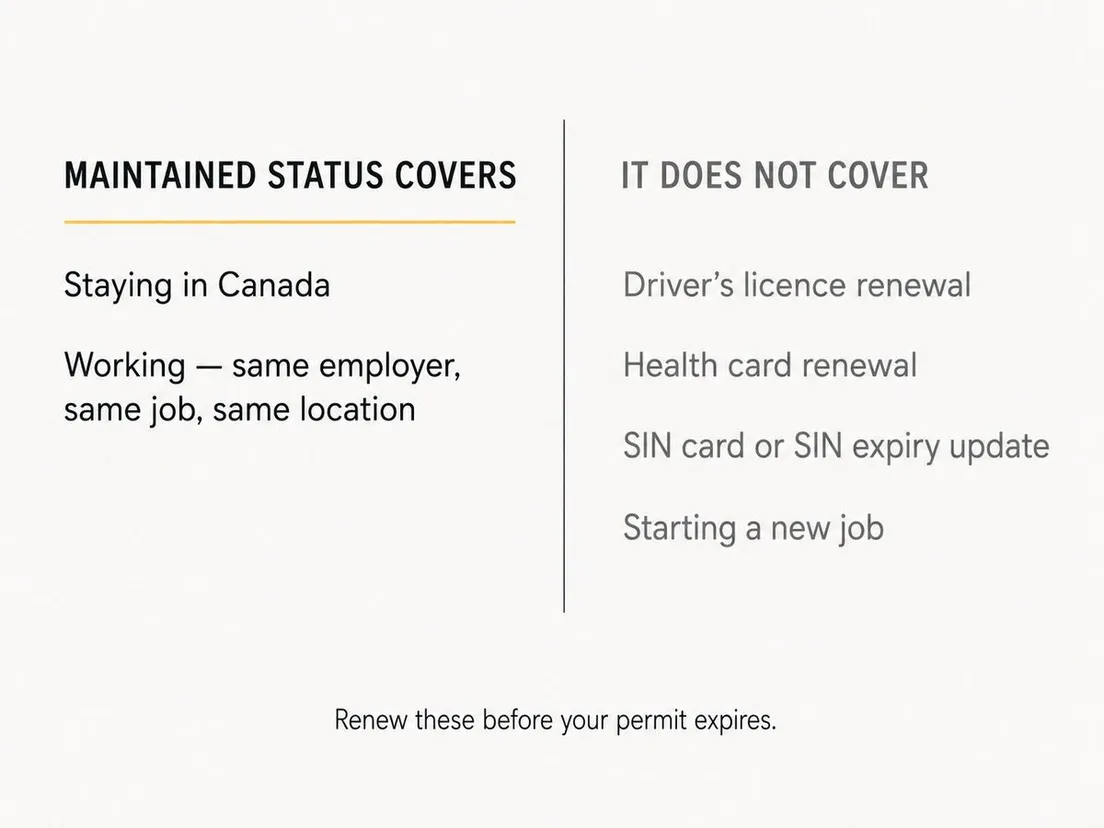
If you applied to extend or change your work permit before it expired, you may legally stay in Canada while IRCC processes the application, and you may keep working under the same conditions as your current permit. For an employer-specific permit that means the same employer, the same job and the same work location. Open permit holders can still change employers and jobs.
Applying online produces a work permit extension letter you can show your employer as proof of your right to keep working. Paper applications do not generate this letter, because completeness is not confirmed until the file is reviewed, which is one of several reasons to file online. You are also not eligible for the letter if you applied after your permit had already expired.
What You Lose the Day Your Permit Expires
This is the part almost no guide covers properly, and it affects people's lives more immediately than the immigration status question does.
While you are on maintained status with an expired permit in hand, you cannot renew provincial or territorial documents. That means your driver's licence and your health card. You also cannot apply for a social insurance number card or update the expiry date on your existing one. You can work, and you can stay, but the documents that let you drive, see a doctor and be paid without friction all sit outside that protection.
The fix is simple and has to happen in advance. Renew your driver's licence, your health card and your social insurance number while your permit is still valid, and check the expiry dates on all three the same day you start preparing the extension. If your work carries physical risk, consider private health coverage for the gap.
Two Situations Where Maintained Status Does Not Apply
First, if your application is returned as incomplete rather than refused on its merits, it was never properly filed and maintained status never applied. This catches people who filed on time but underpaid a fee or missed a document.
Second, temporary resident permit holders do not get maintained status at all, on an initial application or any subsequent one.
It is also worth being careful about travel. Leaving Canada while on maintained status generally means you may be re-admitted, but not that you can resume working before the new permit is issued. If you have to travel, get advice on the specific facts first.
Changing Employers or Job Conditions
A change of conditions uses the same application as a straight extension, but the rule governing what you may do while it is pending is different, and getting it wrong is unauthorized work.
You keep maintained status and you may keep working, but only under your original conditions. You may not start the new job, the new role or the new location until the new permit is actually issued. A worker who resigns and starts with the new employer on the strength of a submitted application has stopped being authorized to work, whatever the application says.
Apply as soon as you know the change is coming rather than waiting for the expiry date to approach, since the constraint here is the decision, not the deadline.
Fees for a Work Permit Extension
The work permit processing fee has been CAD 155 per person. An open work permit carries an additional open work permit holder fee, which has been CAD 100. Biometrics, where required, have been CAD 85. Restoration, if you have already lost status, adds a separate and larger fee on top of the permit fee.
These figures reflect the position in August 2026 and IRCC adjusts them periodically, so confirm the current amounts on the official fee list before you pay. An underpaid application is an incomplete application, and an incomplete application is returned, which as above means maintained status never applied.
Can a Post-Graduation Work Permit Be Extended?
Generally no. The post-graduation work permit is issued once and is not renewable in the ordinary sense.
There is a narrow exception. If your permit was issued for a shorter period than your programme qualified you for because your passport was expiring, you may be able to apply for the remaining time after renewing your passport. That is a recovery of time you were already entitled to, not an extension.
Otherwise, the options are to move to a different permit category, such as an employer-specific permit or a bridging open work permit if you have an acknowledgement of receipt for a permanent residence application, or to change to visitor status while you plan the next step. If permanent residence is the goal, the Canadian Experience Class route through Express Entry is usually what the post-graduation permit was building toward in the first place.
What to Do If Your Work Permit Already Expired
Stop working. That is the first and most important step, and it applies from the day the permit expired, not from the day you notice.
You generally have 90 days from the date you lost status to apply for restoration as a worker. The application requires the restoration fee plus the work permit fee, and if your employer's step is required it still has to be done. Two things about restoration are consistently misunderstood: it does not authorize you to work while it is pending, and it is discretionary rather than automatic. Meeting the 90 day deadline makes you eligible to be considered, nothing more.
If you were on maintained status and your extension was refused, your status ended at the moment of refusal, and the 90 day clock runs from that date rather than from your original permit expiry.
Restoration as a worker is not the only option. Since May 2026, a worker who has lost status may also restore as a visitor without leaving Canada, which is worth considering if there is no immediate route to a new work permit.
Common Reasons Work Permit Extensions Are Refused or Returned
- Filing after the UTC deadline on the expiry date, which removes maintained status entirely.
- A passport expiring before the intended permit end date, producing a permit far shorter than expected.
- The employer step not completed, so there is no valid assessment or offer of employment number to reference.
- An expired Labour Market Impact Assessment submitted in support of the application.
- Underpaid fees or a missing document, returning the file as incomplete after the expiry date has passed.
- Starting new work before the new permit issues during a change of conditions.
- Inconsistencies between the application and the job offer, particularly on wage, occupation and hours.
How SEP Immigration Helps With Work Permit Extensions
Most of the value here is in the calendar. We work backwards from your expiry date to set the employer's deadline as well as yours, check the passport and provincial documents before anything is filed, and make sure the application is complete the first time, because a returned file after the expiry date costs far more than the delay suggests. If your permit has already lapsed, we assess honestly whether restoration is realistic and what the alternatives look like if it is not.
Official sources
- Immigration, Refugees and Citizenship Canada, extend or change the conditions on your work permit, and guidance for employers extending a worker's permit
- Immigration, Refugees and Citizenship Canada, official fee list and restoration of temporary resident status guidance
This page is general information, not legal advice, and fees, processing times and program rules change without much notice. Details reflect IRCC guidance published as of August 2026 and should be confirmed on canada.ca or with a licensed representative before you apply.
Frequently asked questions
01
Can I keep working while my work permit extension is being processed?
Yes, if you applied before your permit expired. Maintained status lets you keep working under the same conditions as your existing permit, meaning the same employer, job and location for an employer-specific permit. If you applied after expiry, you have no maintained status and must stop working immediately.
02
When should I apply to extend my work permit?
At least 30 calendar days before expiry is the official minimum, and considerably earlier is sensible given processing times. Note also that maintained status protects your right to work but not your driver's licence, health card or social insurance number.
03
Does my employer have to do anything before I apply?
For an employer-specific permit, yes, and it comes first. Your employer obtains a new Labour Market Impact Assessment, or where the position is exempt, submits a new offer of employment through the Employer Portal and pays the compliance fee. Open work permit holders need no employer step.
04
Can I change employers while my extension is pending?
You may apply to change employer, job or location and you keep maintained status, but you may not start the new work until the new permit is issued. You continue under your original conditions until then.
05
Can I renew my driver's licence or health card while on maintained status?
No. Once your permit has expired you cannot renew provincial documents such as a driver's licence or health card, and you cannot apply for or update a social insurance number card. Renew all of them before your permit expires.
06
What happens if my work permit already expired?
Stop working immediately. You generally have 90 days from losing status to apply for restoration as a worker, paying the restoration fee plus the permit fee. Restoration does not authorize work while pending and is discretionary. If an extension was refused while you were on maintained status, the 90 days runs from the refusal date.