
Top Cities for Americans Moving to Canada: 8 Picks
Reviewed by Mohsen Khorvash and Mahsa Barati

Toronto, Vancouver and Montreal get most of the attention, but the right Canadian city for an American depends on two things most city rankings skip: the immigration status you can actually get, and what the city costs once you arrive. This guide ranks eight cities on jobs, rent and climate, and on how each one fits the routes Americans use most, such as the CUSMA professional work permit and Express Entry.
No Canadian city runs its own immigration program. Every route to living here goes through a federal program or a province's Provincial Nominee Program, so it pays to choose a city with your status in mind rather than the other way round.
Immigration Routes That Decide Where Americans Can Live
U.S. citizens get easier entry to Canada than most nationalities, but easy entry is not the same as the right to stay.
Visiting Canada Is Not the Same as Moving There
A visitor can generally stay up to six months, cannot take a job with a Canadian employer and has no access to provincial health coverage. A scouting trip to compare neighbourhoods is a sensible first step, but the trip itself changes nothing about your status.
Work Permits Built for U.S. Citizens
CUSMA allows American citizens in 63 listed professions, including engineers, accountants and management consultants, to work in Canada with a pre-arranged job and no Labour Market Impact Assessment. Because U.S. citizens are visa-exempt, they can usually apply at the port of entry once the employer has submitted the offer through IRCC's employer portal. Intra-company transferees moving with a U.S. employer to a Canadian branch use a related route. Both tie you to a job, which in practice means the employer chooses your city.
Permanent Residence Through Express Entry and Provincial Programs
For a permanent move, many Americans qualify through Express Entry, where native English, U.S. degrees and skilled work experience score well. From November 3, 2026, a full-time job offer in a high-wage occupation can add up to 100 Comprehensive Ranking System points, with no LMIA needed for those points. Provincial streams, from Ontario's to the Nova Scotia Nominee Program, add another layer, and some reward settling outside the largest metros. Americans married to or in a common-law relationship with a Canadian can instead apply through spousal sponsorship. Once approved, permanent residence lets you live and work anywhere in the country.
8 Top Canadian Cities for Americans, Ranked
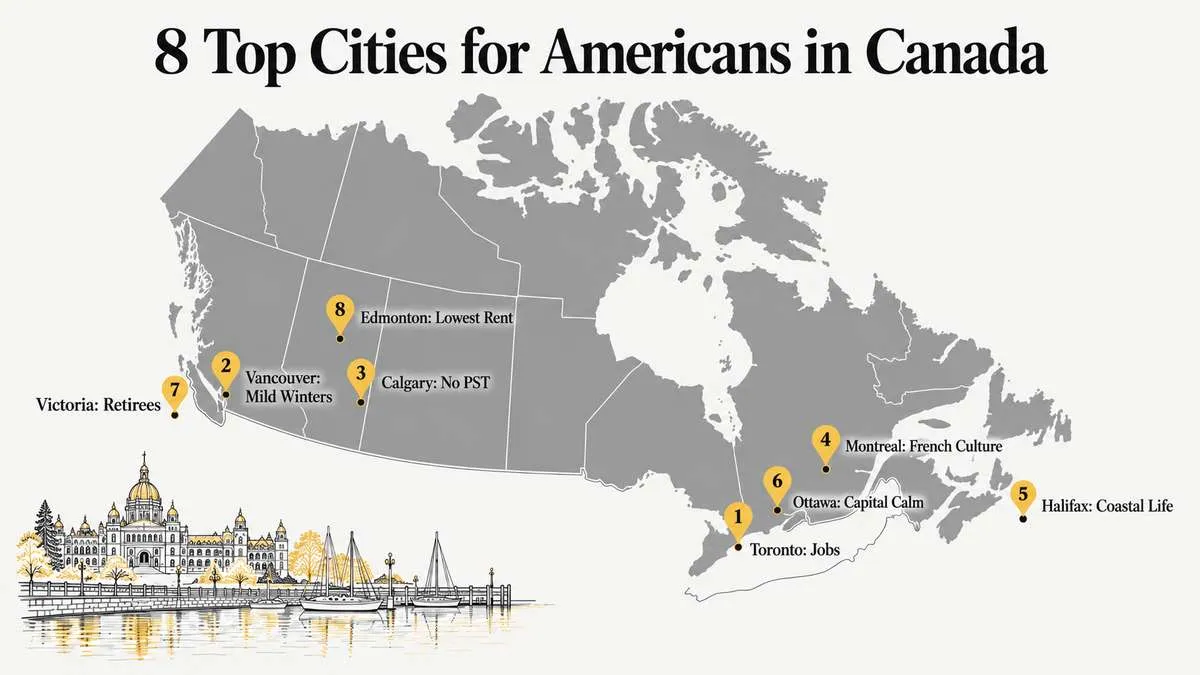
The order below weighs job depth, housing costs and how easily an American can settle. Rent figures are Statistics Canada's average asking rents for two-bedroom units in the second quarter of 2026.
1. Toronto, Ontario

Toronto is Canada's largest economy, with finance, technology, media and a heavy concentration of corporate head offices. It is where most CUSMA professionals and intra-company transferees land, simply because that is where the employers are. The trade-off is cost: two-bedroom asking rents averaged $2,650, second only to Vancouver among the major cities tracked. Ontario applies no waiting period for provincial health coverage, which removes one early expense. The province's own routes are covered on our immigrate to Ontario page.
2. Vancouver, British Columbia

Vancouver is the closest major Canadian city to the U.S. West Coast, under an hour's drive from the Washington border, with the mildest winters of any large Canadian city and strong technology and film sectors. It is also the most expensive, at $3,030 for a two-bedroom, though that figure fell 4.1% over the year. One detail matters for anyone relying on the province: BC's nominee program scores Metro Vancouver job offers lowest on its regional factor, which our guide to immigration to Vancouver explains.
3. Calgary, Alberta

Calgary pairs a large-city job market in energy, finance and growing technology with the Rockies on the doorstep. Alberta charges no provincial sales tax, and two-bedroom asking rents averaged $1,890, down 6.4% year over year. Winters are long and cold, which is the main reason Americans from warmer states hesitate. The Alberta streams that do and do not work for Calgary job offers are set out in our page on immigration to Calgary.
4. Montreal, Quebec

Montreal offers festivals, universities, a large video game and AI sector and lower housing costs than Toronto or Vancouver, with asking rents down 5.2% over the year. Language is the real question. Daily life, public services and many workplaces run in French, and Quebec selects its own economic immigrants through programs that reward French ability. Our overview of Quebec immigration sets out how that system differs from the rest of Canada.
5. Halifax, Nova Scotia

Halifax appeals to Americans who want the coast at a smaller scale, with jobs in health care, ocean technology, defence and its universities. Older guides describe it as a bargain, and that no longer holds: two-bedroom asking rents reached $2,400, up 5.3% over the year and above both Calgary and Edmonton. Atlantic Canada also tends to keep fewer newcomers than the big metros, so check that your field has real local demand before you commit.
6. Ottawa, Ontario
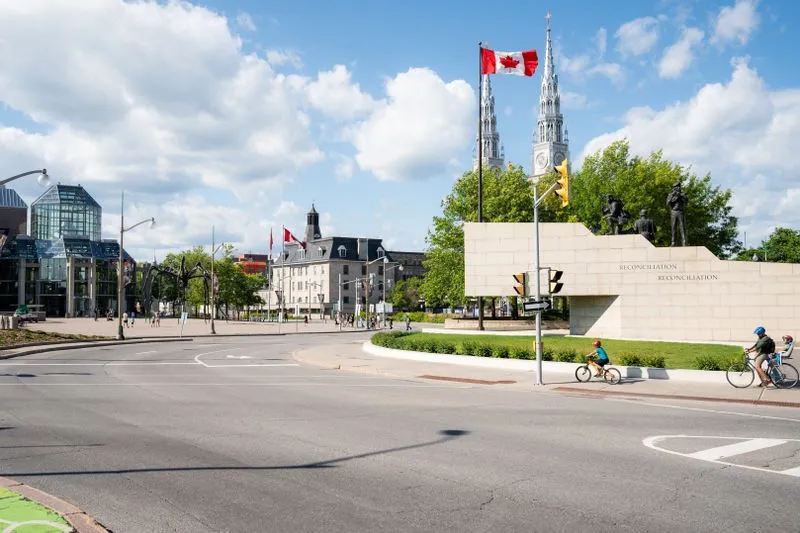
Ottawa offers a calmer capital with a stable public-sector economy and a technology cluster in Kanata. One point catches Americans out: federal public service hiring gives preference to Canadian citizens, so a newly arrived permanent resident competes for those roles at a disadvantage until citizenship. Gatineau, across the river, sits in Quebec and falls under Quebec's immigration and language rules, so check which side of the river a job or home is on.
7. Victoria, British Columbia

Victoria has the mildest climate in Canada, a walkable downtown and a slower pace that draws many American retirees. Costs are close to Toronto's, with two-bedroom asking rents at $2,640, and the private job market is small, with the provincial government as the anchor employer. Anyone planning to retire here should read the retirement question in the FAQ below before making plans.
8. Edmonton, Alberta

Edmonton has the lowest rents of the cities on this list, at $1,570 for a two-bedroom, and shares Alberta's lack of a provincial sales tax. Energy, government, health care and the University of Alberta anchor the job market, and the river valley gives the city more green space than its reputation suggests. The cost of that value is a harsh winter, with long stretches well below freezing.
Rent and Living Costs in the Top Cities for Americans
Rent varies more between these cities than almost any other expense, so it is the first number worth comparing.
Average Asking Rents for a Two-Bedroom in 2026
| City | Average asking rent, two-bedroom (Q2 2026) |
|---|---|
| Vancouver | $3,030 |
| Toronto | $2,650 |
| Victoria | $2,640 |
| Halifax | $2,400 |
| Calgary | $1,890 |
| Edmonton | $1,570 |
| All census metropolitan areas | $2,130 |
Asking rents are what new listings advertise, which makes them the right benchmark for someone signing a first lease rather than the average paid by long-term tenants.
Sales Tax and Health Coverage Differences by Province
Alberta is the only province with no provincial sales tax, a saving that applies to almost everything you buy in Calgary or Edmonton. Health coverage timing also differs. Ontario, Alberta, Manitoba and Saskatchewan do not apply a waiting period, while British Columbia and Quebec do, so newcomers heading to Vancouver, Victoria or Montreal should budget for private insurance during the first months.
What Americans Should Settle Before Choosing a City
A few issues follow Americans to any Canadian city, and each is easier to handle before the move than after it.
U.S. Tax Filing Continues After You Move
The United States taxes its citizens on worldwide income wherever they live, and Canada taxes its residents on worldwide income too. The tax treaty and foreign tax credits usually prevent paying twice on the same income, but they do not remove the need to file in both countries. Speak to a cross-border tax professional before you sell property, move retirement accounts or open Canadian investment accounts.
Work Rights for a Spouse or Partner
Since January 21, 2025, a spouse of a foreign worker generally qualifies for an open work permit only if the worker is in a TEER 0 or 1 occupation, or a select TEER 2 or 3 occupation, with at least 16 months left on their permit. IRCC's notice on open work permits for family members also states that spouses of workers covered by free trade agreements are not affected, which matters for families arriving through CUSMA.
The H-1B Open Work Permit Remains Closed
Many guides still list Canada's open work permit for U.S. H-1B holders as an option. It reached its cap of 10,000 applications on July 17, 2023, and IRCC's H-1B work permit page still shows it as closed. A new accelerated pathway was announced in the 2025 federal budget, but until IRCC publishes criteria and an opening date, it is not a route you can plan a move around.
Choosing a city becomes much easier once you know which status you qualify for. SEP Immigration, led by Sepehr Falahati, a Regulated Canadian Immigration Consultant, can assess your options as a U.S. citizen and match them to the city you have in mind.
This article is general information, not legal advice, and immigration programs, rents and work permit rules change often. Verify current requirements on IRCC's pages at canada.ca before acting; information is current as of October 2026.
Frequently asked questions
01Do Americans need a visa or an eTA to visit Canada?
No. U.S. citizens need neither a visitor visa nor an electronic travel authorization, and a valid U.S. passport is the standard travel document. Visa-free entry covers visits only, so it does not give you the right to work for a Canadian employer or to settle.
02Is there a retirement visa for Americans in Canada?
No. Canada has no retirement visa. Without a qualifying work, study or family route, a retired American can visit for up to six months at a time but cannot settle permanently on savings or a pension alone.
03Can I keep working remotely for my U.S. employer from Canada?
During a visit, remote work for a foreign employer is generally possible as long as you are not entering the Canadian labour market. Living in Canada long term still requires a work permit or permanent residence, and becoming a Canadian tax resident changes your tax position.
04Can Americans hold dual U.S. and Canadian citizenship?
Yes. Canada allows dual citizenship, and becoming Canadian does not require giving up U.S. citizenship. The U.S. tax filing obligation continues for as long as you remain a U.S. citizen.
05How long before an American permanent resident can become a Canadian citizen?
Permanent residents need at least 1,095 days of physical presence in Canada in the five years before applying. Applicants must also file Canadian taxes where required and, if aged 18 to 54, meet the language and knowledge requirements.
Stay informed
Get our immigration updates first on Google
Add SEP Immigration as a preferred source and our latest news and guides appear more often in your Google results.
About the Author

Sepehr Falahati
CEO of SEP Immigration
- CICC Licensed
- RCIC #R533959
- IRB Member
Sepehr Falahati is a Regulated Canadian Immigration Consultant (RCIC #R533959), licensed by the College of Immigration and Citizenship Consultants (CICC).
Read more about Sepehr FalahatiReviewed By


Continue Reading