Driver's License in Canada for Newcomers
Reviewed by Mohsen Khorvash and Mahsa Barati
Newcomers can keep driving on the license they brought with them, but only for a short time, and the clock starts when you become a resident of a province. In Ontario that window is 60 days. Whether you can then swap your license at a counter or have to sit knowledge and road tests depends on which country issued it and which province you now call home.
Exchanging your license belongs on the same short list as the other things to do after landing in Canada, and the paperwork overlaps. The proof of address you collect when registering for your provincial health card usually works at the licensing office too. This guide covers Ontario, British Columbia, Alberta and Quebec, the four provinces that receive the most newcomers.
Foreign Driver's License Grace Periods in Canada
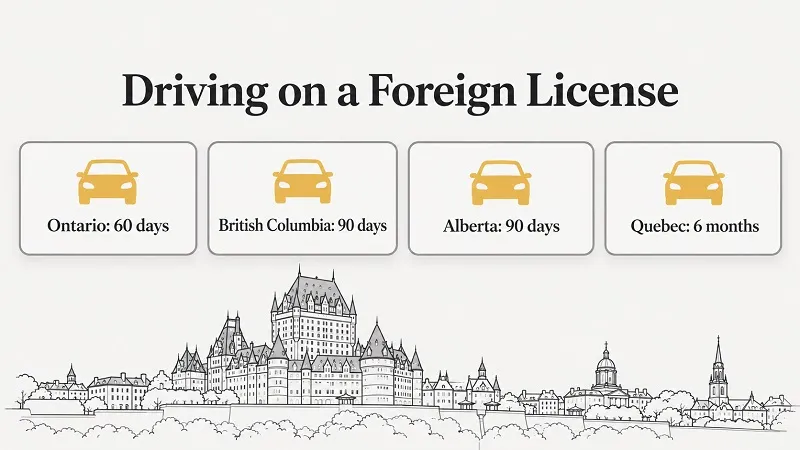
Every province lets a new resident drive on a valid foreign license for a set period, and each one decides how long that period is.
Grace Period by Province
| Province | Driving on a foreign license after becoming a resident | Licensing authority |
|---|---|---|
| Ontario | 60 days | DriveTest and ServiceOntario |
| British Columbia | 90 days | ICBC |
| Alberta | 90 days, even if you leave the province during that time | Alberta registry agents |
| Quebec | 6 consecutive months | SAAQ |
Once the period ends, your foreign license is no longer valid for driving in that province. Driving on it anyway means driving without a valid license, which can also leave you with problems on your auto insurance. Testing appointments can take weeks to get, so start the process in your first month rather than your last.
When the Resident Clock Starts
The grace period applies to people who live in the province. Visitors follow separate rules: Ontario lets visitors staying under three months drive on their home license, and Alberta allows visitors up to one year. British Columbia exempts tourists staying up to six months and full-time students at a designated institution. Quebec treats a temporary foreign worker as a new resident when the worker has the right to stay in Canada for more than six months.
Permanent residents count as residents once they settle, so the clock usually starts within days of arrival. Licensing offices accept Canadian immigration documents as proof of status, which is one more reason to keep your permanent resident card valid and to plan for PR card renewal well before it expires.
An International Driving Permit Does Not Replace a Canadian License
An International Driving Permit (IDP) is a translation of your home license. You get it in the country that issued your license, and it only works alongside that license. Alberta and Quebec both recommend carrying one if your license is not in English or French, but an IDP does not extend the resident grace period by a single day.
Driver's License Exchange Agreements by Province
An exchange agreement lets you trade your license for a provincial one without knowledge or road tests. Each province signs its own agreements, so a license that exchanges in one province may not exchange in the next.
Ontario Exchange Countries
Ontario exchanges licenses from every Canadian province and territory, all U.S. states, and Australia, Austria, Belgium, Croatia, Denmark, France, Germany, Great Britain, Hungary, the Isle of Man, Japan, Kosovo, New Zealand, Northern Ireland, the Republic of Ireland, South Korea, Switzerland, Taiwan and Ukraine. Learner's permits cannot be exchanged from any country.
Alberta Exchange Countries
Alberta's list is longer. Along with U.S. states, it covers Australia, Japan, New Zealand, South Korea, Taiwan, Switzerland, Norway, Iceland, Liechtenstein, the United Kingdom, Guernsey, Jersey, the Isle of Man and most of the European Union, including Italy, Spain, the Netherlands, Poland, Portugal, Greece and Romania. Ukrainian Class B and BE licenses also exchange without testing. A driver from Italy or Spain therefore exchanges directly in Calgary but tests in Toronto.
Lists in British Columbia and Quebec
ICBC and the SAAQ publish their own lists, and both include U.S. states plus a set of foreign countries. Check the current list for your province before you book an appointment, since agreements are added from time to time.
Two Years of Experience for a Full License
An exchange does not always mean a full license. Ontario issues a full Class G only if you show at least two years of driving experience within the last three; otherwise you receive a novice class. Alberta, British Columbia and Quebec apply a similar two-year line before placing you outside their graduated programs.
Getting a Driver's License From a Non-Exchange Country
Many newcomers hold licenses from countries outside these agreements, including India, China and the Philippines. You can still get credit for your experience, but you will take tests.
Ontario's 12-Month Experience Credit Since July 2026
Ontario changed its rules on July 1, 2026. Drivers from non-exchange countries now receive a maximum of 12 months of verified foreign driving experience. With that credit, you can take the G2 road test right away, but you must then wait at least 12 months before the G road test, and that wait cannot be shortened. In practice, a full Ontario license now takes a year or more even for drivers with a decade behind the wheel.
Your foreign license must be valid and original. If it was issued recently but you have been driving longer, an official letter from the issuing authority or consulate is needed to count the extra experience.
Alberta's GDL Exemption Program
In Alberta, you start at a registry office with the Class 7 knowledge test and surrender your licenses. The registry agent sends your file to Service Alberta's Special Investigations Unit, which reviews your driving history for an exemption from the graduated program. You can drive under supervision on a Class 7 while it does. After about 10 business days you return to learn the result and, if accepted, book your road test. Two or more years of proven experience leads to a full Class 5.
Knowledge and Road Tests in British Columbia and Quebec
British Columbia requires a knowledge test and a road test for licenses from outside its exchange list. Knowledge tests for passenger and motorcycle classes are offered in 12 languages, and ICBC provides free phone interpretation. Quebec lets you exchange a license from a non-agreement country if you have held it for at least one year and pass both tests, and drivers with less than 24 months of recognized experience receive a probationary license.
Refugees and Protected Persons Without Their License
Ontario has a separate path for refugee claimants and protected persons whose license was seized by the Canada Border Services Agency. They can present a certified copy stamped by the agency or complete a self-declaration of their driving experience. Credit is capped at 12 months, and all tests still apply. The same self-declaration is open to people from Ukraine who cannot produce their license.
How to Exchange Your Driver's License Step by Step
The order matters here, because two of these steps can only be done from your home country or take weeks to arrange.
Step 1: Request a Driving Record Before You Leave
Ask the authority that issued your license, or its consulate, for an original letter of authentication or driver's abstract. Ontario accepts letters issued within the last six months that show your date first licensed, license class, status and expiry date, on official letterhead. Faxes, photocopies and scans are refused. The full checklist appears on Ontario's foreign licence exchange page from DriveTest.
Step 2: Arrange an Approved Translation
If your license or record is not in English or French, have it translated by a translator your province recognizes. Ontario accepts MTO-recognized translators, British Columbia uses ICBC-approved translators, and Alberta requires an approved document translator for exemption files. A general certified translation from another country may not be accepted.
Step 3: Gather Identity, Status and Residence Documents
Bring original identity documents that show your full legal name and date of birth, your Canadian immigration document, and proof of your address in the province. Alberta lists proof of legal status in Canada as a requirement on its Alberta licence exchange page, and Ontario has passed legislation allowing it to verify immigration status before issuing or renewing a license.
Step 4: Visit the Right Office and Surrender Your License
In Ontario, new residents can only apply at a DriveTest Centre or at ServiceOntario College Park in Toronto, because other ServiceOntario locations do not issue licenses to new residents. Every province includes a vision test. You will surrender your foreign license, and in British Columbia and Alberta it is not returned, so keep your passport handy as photo ID until the new card arrives.
Licensing offices ask for proof of your immigration status, so a status question can quickly become a driving question. If you are unsure where your permit or permanent residence stands, SEP Immigration can review your situation and explain your options.
This article provides general information and is not legal advice, and provincial licensing rules change without notice. Confirm current requirements with DriveTest, ICBC, Alberta registry agents or the SAAQ before you apply; information current as of October 22, 2026.
Frequently asked questions
01How long can I drive in Canada with my foreign license?
It depends on the province you live in. Ontario allows 60 days, British Columbia and Alberta allow 90 days, and Quebec allows six consecutive months. The period starts when you become a resident, and after it ends the foreign license is no longer valid for driving there.
02Can I exchange my Indian driver's license in Canada?
Not directly in Ontario or Alberta, because India is not on either province's exchange list. You can still use your Indian license to get driving experience credit, but you will take knowledge and road tests. In Ontario, the most you can be credited is 12 months, and you take the G2 and G road tests.
03Does an International Driving Permit let me drive longer?
No. An International Driving Permit is a translation of your home license and is used together with it. It does not change the grace period that applies once you are a resident of a province.
04Do I need a road test if I have years of driving experience?
Only if your license comes from a country without an exchange agreement with your province. Drivers from exchange countries skip the tests, and with at least two years of proven experience they usually receive a full license. Drivers from other countries take the road tests regardless of experience.
05Do I need a translation of my driver's license?
If your license or driving record is not in English or French, plan on it. Ontario, British Columbia and Alberta each require translations from translators they approve, and an application can be put on hold until the translation is provided.
06Can I get a driver's license on a work or study permit?
Generally yes, if you live in the province, since licensing is based on residence rather than permanent status. Alberta asks every applicant for proof of legal status in Canada, and Quebec treats a temporary foreign worker who may stay more than six months as a new resident. British Columbia exempts full-time students at designated institutions from its 90-day rule.
Stay informed
Get our immigration updates first on Google
Add SEP Immigration as a preferred source and our latest news and guides appear more often in your Google results.
About the Author

Sepehr Falahati
CEO of SEP Immigration
- CICC Licensed
- RCIC #R533959
- IRB Member
Sepehr Falahati is a Regulated Canadian Immigration Consultant (RCIC #R533959), licensed by the College of Immigration and Citizenship Consultants (CICC).
Read more about Sepehr FalahatiReviewed By


Continue Reading