
Stay in Canada After IEC: Your Options
Reviewed by Mohsen Khorvash and Mahsa Barati

An International Experience Canada work permit has a fixed end date, and for most participants it cannot simply be renewed. Staying in Canada after IEC means moving into a different status before that date: another IEC participation, a new work permit, a study permit, a visitor record, or an application for permanent residence.
Which route is open depends on your citizenship, the jobs you held, your relationships and how much time is left on the permit. Participants with a year of skilled Canadian work behind them can often qualify under the Canadian Experience Class and enter the Express Entry pool right away. Others are better served by a provincial nominee program stream tied to their employer and province. If a permanent residence application is already filed, a bridging open work permit may cover the gap.
One rule runs through all of these routes. What you file before your IEC permit expires decides whether you can keep working, keep living here lawfully, or have to stop and wait.
IEC Work Permit Extension Rules and Maintained Status
IRCC treats an IEC permit as a single, time-limited participation and allows changes only in a short list of situations.
When an IEC Work Permit Can Be Changed
A change is possible when IRCC made an error on the expiry date, when your permit was cut short by an expiring passport and you now hold a new one, or when you need medical restrictions removed after completing an exam. Young Professionals and International Co-op participants can also ask for a longer permit if the same employer extends the same job, up to the maximum their country's agreement allows. These requests go by mail to the Case Processing Centre in Edmonton, must be submitted before the permit expires, and can be made only once per participation.
Wanting more time is not on the list. A permit shortened because your health insurance did not cover the full stay cannot be lengthened later, even if you buy more coverage after arriving. Outside these cases, a standard work permit extension in the IEC category is not available, and the realistic choices are the routes below.
Maintained Status After IEC Depends on What You File
If you apply for a different work permit before your IEC permit expires, your status continues past the expiry date and you can keep working under your current conditions until IRCC decides. This is maintained status, and it is what allows an employer to apply for an LMIA and keep you on staff while the file is processed.
The protection is narrower than many participants expect. Applying for a new IEC participation does not create maintained status. Applying for a study permit lets you remain in Canada, but you must stop working when the IEC permit expires. Leaving Canada, even for a short trip across the border, ends maintained status on the spot.
Second IEC Participation and In-Canada Permit Issuance
Citizens of some countries may take part in IEC more than once, in the same category or a different one, and recognized organizations can offer an additional participation to some candidates. A few countries require a gap between participations, so check your country's terms before counting on a second permit.
Since flagpoling ended in December 2024, a participant who applied for a second IEC permit while still holding a valid one, and who has received the port of entry letter, can ask IRCC through its web form to issue the new permit from inside Canada. The request must be made before the letter expires and while you still have valid status. If your first permit will expire before the second is issued, apply for a visitor record in time and stop working until the new permit arrives.
New Work Permit Options After the Working Holiday
When another IEC participation is not possible, a different category of work permit is the most direct way to keep working.
LMIA-Based Work Permit Through Your Employer
An employer who wants to keep you can apply for a Labour Market Impact Assessment, showing it advertised the position and could not fill it with a Canadian citizen or permanent resident. A positive LMIA supports an employer-specific permit tied to that employer, job and location. Low-wage positions face extra limits, including regions where ESDC is not currently processing them, so the wage and work location need checking before the employer starts recruiting.
LMIA-Exempt Routes, Including Francophone Mobility
Some permits skip the labour market test altogether. French speakers with moderate oral French (NCLC 5) and a job offer outside Quebec can use Francophone Mobility, which is employer-specific but needs no LMIA. Other exemptions cover intra-company transfers, trade agreement professionals and similar categories, and our overview of LMIA exemptions sets out the main ones.
Spouse Open Work Permit Through a Partner in Canada
If your spouse or common-law partner is working or studying in Canada, you may qualify for a spouse open work permit, although the rules narrowed in January 2025. The working partner must generally hold a TEER 0 or 1 job, or one of the listed TEER 2 or 3 occupations, with at least 16 months left on their permit. For students, only certain master's, doctoral and professional programs qualify. If your partner is a Canadian citizen or permanent resident, an inland spousal sponsorship application usually makes you eligible for an open work permit while it is processed.
Permanent Residence After IEC Through Express Entry and PNP
For participants who want to stay for good, the work done during IEC can form the basis of a permanent residence application.
Canadian Experience Class With Working Holiday Experience
IEC work counts toward the Canadian Experience Class when it meets the same tests as any other Canadian experience: at least 1,560 hours in the three years before you apply, in TEER 0, 1, 2 or 3 occupations, paid, and done while authorized to work. Self-employment and work done while studying full-time do not count, and you also need approved language test results.
This is where many Working Holiday plans stall. Jobs in hospitality, retail and seasonal tourism are often classed as TEER 4 or 5, and those hours do not qualify however many there are. Check the NOC code of each job early, because a move into a supervisory or skilled role with months left on your permit can still produce qualifying experience. IRCC has focused many 2026 invitation rounds on CEC candidates, and from November 3, 2026, additional points apply for Canadian experience and job offers in designated high-wage occupations. A proposal to merge the three Express Entry programs into one class is under consultation and has not taken effect.
Provincial Nominee Program Streams for Workers
Most provinces run streams for temporary workers already employed there, often with a job offer requirement that an IEC participant can meet through a current employer. Some accept TEER 4 or 5 occupations that Express Entry excludes. A nominee who receives a work permit support letter from the province may also get an employer-specific permit while the permanent residence file is processed. The temporary open work permit policy for some PNP candidates ended on December 31, 2025, so older guidance on that point no longer applies.
Bridging Open Work Permit While PR Is Processed
A bridging open work permit lets you keep working after your current permit runs out, but only if you apply while that permit is still valid or you are on maintained status, and only once your permanent residence application has reached the required stage. For Express Entry candidates, that means a submitted application and an acknowledgement of receipt. For PNP candidates outside Express Entry, it means a positive completeness check. Counting back from the IEC expiry date, the permanent residence application usually needs to go in months earlier than people plan.
Study Permit and Visitor Record Options After IEC
Two further options keep you in Canada lawfully without a new work permit.
Switching to a Study Permit From Inside Canada
Because you hold a valid work permit, you can apply for a study permit from inside Canada once a designated learning institution has accepted you. Most applicants also need a provincial or territorial attestation letter and proof of funds. Graduating from an eligible program can lead to a post-graduation work permit, which builds the Canadian experience a later PR application needs. Not every program qualifies, so choose one with that eligibility in mind.
Visitor Record to Stay Without Working
If you want time to travel, wait for a second IEC permit or prepare another application, you can apply to extend your stay as a visitor. Apply before the IEC permit expires, ideally at least 30 days ahead. You must stop working on the expiry date and show that you can support yourself for the rest of your stay. The application itself is described on the IRCC page for extending your stay in Canada as a visitor.
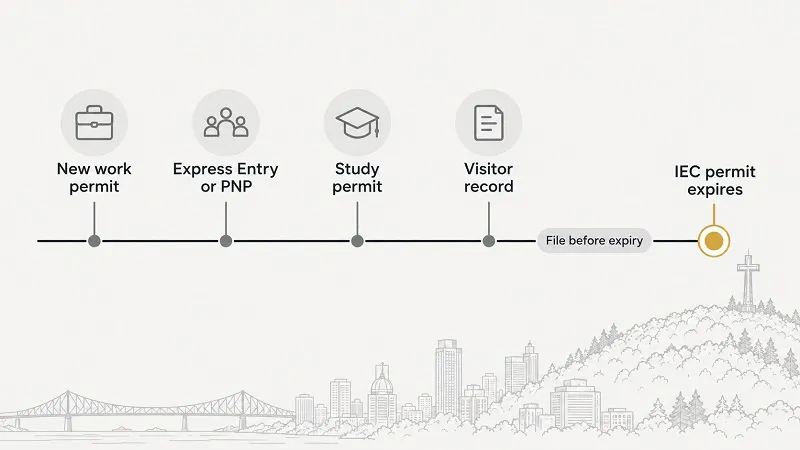
Planning Around Your IEC Permit Expiry Date
Most problems in this area come from the order in which applications are filed rather than from eligibility.
Working Backwards From the Expiry Date
Start with the date printed on your permit, not the date you entered Canada. Settle on a route at least six months out, longer if an employer needs to recruit for an LMIA or you are waiting on language test results. If a passport will limit the validity of a new permit, renew it first. While on maintained status you generally cannot renew provincial documents such as a health card or driver's licence, so renew those before the IEC permit expires.
Before relying on a change to your current permit, compare your situation with the IRCC list of cases where an IEC work permit can be changed. If yours is not on it, treat the permit as ending on its printed date.
Restoration if the IEC Permit Has Already Expired
If your permit expired with nothing filed, you are out of status. You generally have 90 days to apply to restore your status, paying the restoration fee plus the fee for the permit or visitor record you are seeking. You cannot work while restoration is pending, and approval is discretionary. Under officer instructions updated in May 2026, a former worker may apply to restore as a visitor without leaving Canada first. After 90 days, the remaining option is to leave.
SEP Immigration reviews IEC participants' files against their permit expiry date and identifies which route fits their work history, family situation and timeline. If your permit ends within the next year, contact us to map out what needs to be filed and when.
This article provides general information, not legal advice, and IEC and work permit rules change frequently. Verify current requirements on Canada.ca (IRCC) before applying; information is current as of October 2026.
Frequently asked questions
01Can I keep working while I wait for my second IEC work permit?
Only while your first IEC permit is still valid. A new IEC participation does not give you maintained status, so if the first permit expires before the second one is issued, you need a visitor record and must stop working until the new permit arrives.
02Does part-time Working Holiday work count toward the Canadian Experience Class?
Yes, if the jobs are in TEER 0, 1, 2 or 3 occupations. Part-time hours add up to the 1,560-hour requirement, so 15 hours a week over 24 months is equivalent to one year of full-time work, provided all of it falls within the three years before you apply.
03Can my employer extend my Working Holiday permit?
No. Job-based changes to an IEC permit apply only to Young Professionals and International Co-op participants. A Working Holiday participant whose employer wants to keep them needs a different permit, usually supported by an LMIA or an LMIA exemption.
04Can I leave Canada and return on my old IEC permit while another application is pending?
Once your IEC permit has expired, no. Leaving Canada ends maintained status immediately, and you cannot use an expired permit to re-enter as a worker. Plan any travel for after the new permit is issued.
05How long can I stay as a visitor after my IEC permit ends?
Usually up to six months from approval, though officers can grant less. Check the date on your visitor record rather than counting from the day you applied, and apply again before that date if you need more time.
Stay informed
Get our immigration updates first on Google
Add SEP Immigration as a preferred source and our latest news and guides appear more often in your Google results.
About the Author

Sepehr Falahati
CEO of SEP Immigration
- CICC Licensed
- RCIC #R533959
- IRB Member
Sepehr Falahati is a Regulated Canadian Immigration Consultant (RCIC #R533959), licensed by the College of Immigration and Citizenship Consultants (CICC).
Read more about Sepehr FalahatiReviewed By


Continue Reading