
Social Insurance Number (SIN) in Canada
Reviewed by Mohsen Khorvash and Mahsa Barati
A Social Insurance Number, or SIN, is the 9-digit number Service Canada issues so you can work in Canada, get paid, file taxes and access federal programs such as Employment Insurance and the Canada Pension Plan. Applying is free, and for most newcomers it is the first government task after landing, because an employer cannot put you on payroll without it.
The rules depend on your status. A new permanent resident applies with a PR card or, in the first year, the Confirmation of Permanent Residence. A worker or student applies with a permit that allows work and receives a number that starts with 9 and expires with that permit. This guide covers who can apply, the documents for each status, the three ways to apply and how to keep a temporary SIN valid. It sits alongside our first 90 days in Canada checklist, which sets out what comes after the SIN.
Social Insurance Number Eligibility by Immigration Status
You can get a SIN if you have legal status in Canada and, as a temporary resident, permission to work.
SIN for Permanent Residents and Canadian Citizens
Citizens and permanent residents receive a SIN that does not start with 9 and does not expire. Once you have landed, your permanent residence is already in effect, so you can apply right away, whether you came through Express Entry, a provincial nomination or family sponsorship. You do not need to wait for the PR card to arrive.
SIN for Work Permit and Study Permit Holders
Temporary residents qualify only if their IRCC document authorizes work. Holders of an employer-specific permit or an open work permit can apply as soon as the permit is issued. A study permit qualifies only if it states that you "may accept employment" or "may work" in Canada. If that condition is missing, contact IRCC about an amended permit before you apply.
Most permits are issued at the border, and a missing work condition is far easier to fix before you leave the port of entry than months later. Our guide to the port of entry letter explains what happens at that point. Graduates moving onto a post-graduation work permit keep the same SIN and update its expiry date once the new permit is issued.
SIN for Children and Newborns
Anyone 12 or older can apply for their own SIN. For a child under the age of majority in their province or territory, a parent or legal guardian can apply on the child's behalf. Parents of a baby under one year old can request the SIN through their province's newborn registration service while registering the birth. In the territories, the application goes directly to Service Canada.
Documents Required for a Social Insurance Number Application
Every application needs one primary document that proves your status, one secondary document that proves your identity, and a supporting document if your name has changed.
Primary Document for Permanent Residents and Temporary Residents
The primary document must be issued by the Canadian government and match your current status.
| Your status | Accepted primary document |
|---|---|
| Canadian citizen | Provincial or territorial birth certificate, certificate of Canadian citizenship, or Registration of Birth Abroad issued before 1977 |
| Permanent resident | PR card, COPR used within one year of becoming a permanent resident, or Record of Landing issued before June 28, 2002 |
| Work permit holder | Valid work permit issued by IRCC |
| International student | Study permit stating you "may work" or "may accept employment" |
| Visitor record holder | Visitor record showing you are authorized to work |
Email messages from IRCC are not accepted as proof of work authorization. Once the first year after landing has passed, only the PR card works for a permanent resident.
Secondary Identity Document
The second document must be valid and show your full legal name and date of birth. A foreign passport is the usual choice for newcomers. A provincial driver's licence, a provincial ID card or other Canadian government ID also works.
Name Changes and Translated Documents
If your current legal name differs from the one on your primary document, add a document that links the two, such as a marriage certificate, a divorce decree or a legal change of name certificate. Documents in a language other than English or French need the original plus a translation, done either by a certified translator or by a non-certified translator who swears an affidavit. Family members cannot translate your documents.
How to Apply for a SIN in Canada
There is no fee, and the same three steps apply to permanent residents and temporary residents.
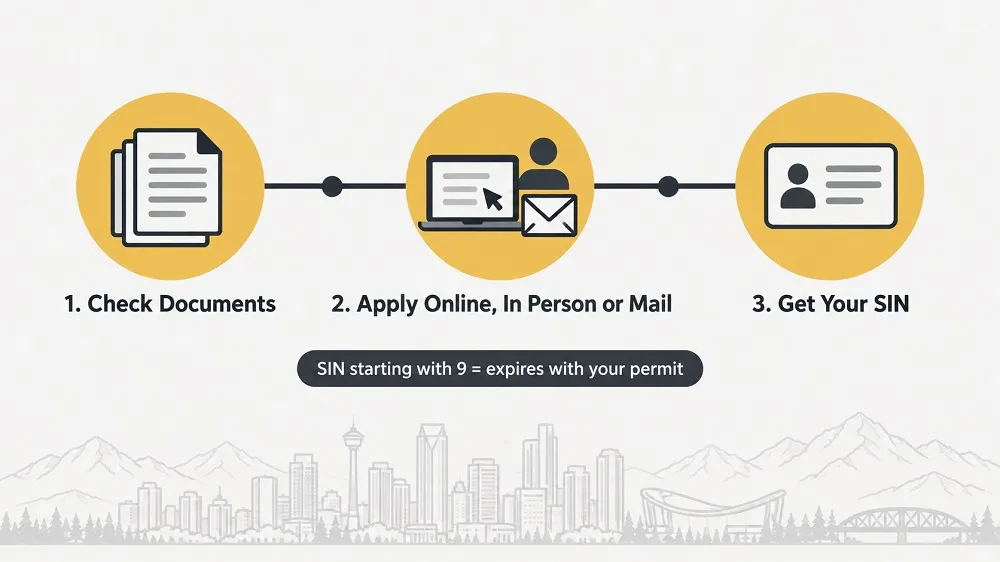
Step 1: Check Your Documents Before You Apply
Confirm that both documents are valid and that the details match. Service Canada records your name exactly as it appears on your primary document, so a spelling difference on your application will not carry over. If a document itself contains an error, the issuing office has to correct it before you apply.
Step 2: Choose an Online, In-Person or Mail Application
Each method asks for different copies and takes a different amount of time.
| Method | What you submit | When you get your SIN |
|---|---|---|
| Online | Clear digital copies of both sides, with the borders visible | About 5 business days, viewable in My Service Canada Account |
| In person at a Service Canada Centre | Original documents | During your visit |
| By mail to the Social Insurance Registration Office in Bathurst, NB | Original documents, returned to you by mail | About 20 business days |
In person is the only route that gives you the number the same day without parting with your passport or permit. If you apply online and realize you made a mistake or left out a document, you cannot edit the application and must submit a new one with all documents.
Step 3: Receive Your Confirmation of SIN
Service Canada no longer issues plastic SIN cards. You receive a confirmation of SIN letter, and you can view or print the number later through My Service Canada Account. Older plastic cards remain valid. If more than 10 business days have passed since an online application, or more than 25 since a mail application, contact the SIN Program.
Temporary SIN Starting With 9 and Your Permit Expiry
A SIN that starts with 9 is tied to your IRCC document and expires on the same date as your work permit, study permit or visitor record.
Updating Your SIN After a Work Permit Extension
When IRCC issues a new permit, apply to Service Canada with it to update the expiry date on your SIN record, because the two dates must match. The update is free, you keep the same number, and the old SIN document should be destroyed once the update is done. Service Canada's page on the SIN for temporary residents sets out the process.
Maintained Status and an Expired SIN
If you applied to extend your permit before it expired, you are on maintained status and can keep working under the same conditions, even though your SIN shows a past expiry date. You cannot update the SIN during this period. The update happens only after IRCC issues the new permit, so keep proof of your extension application ready for your employer in the meantime.
Changing From a Temporary SIN to Permanent Residence
When you become a permanent resident, apply to update your SIN record with your COPR or PR card. Your temporary number is replaced by a permanent SIN that does not start with 9 and does not expire. Give the new number to your employer and your bank so your tax slips and records follow you.
Protecting Your Social Insurance Number
Your SIN is confidential, and if someone else uses it, you could lose benefits or owe tax on income you never earned.
When You Must Provide Your SIN
The law requires your SIN in three situations: for your employer once you are hired, for financial institutions that report interest or investment income, and for government services such as tax returns, Employment Insurance and student loans.
When You Can Refuse to Give Your SIN
A SIN is not an identity document. You do not have to provide it to fill out a job application, rent a property, apply for a credit card or mortgage, sign up for phone or internet service, rent a car or apply to college or university. If a business asks, offer a passport or driver's licence instead. Service Canada's guidance on protecting your SIN lists these situations and how to escalate if a business refuses service.
Lost SIN, Fraud and Replacement Numbers
If you forget your number, check My Service Canada Account or a past tax slip, since Service Canada will not give it out over the phone. A new SIN is issued only when there is clear evidence that your current number has been used fraudulently. Treat calls, texts or emails claiming your SIN has been suspended or compromised as scams, and contact Service Canada directly if you are unsure.
A SIN that starts with 9 is only as current as the permit behind it, so the deadline that matters is the one on your immigration status. SEP Immigration, led by Sepehr Falahati (RCIC #R533959), helps workers, students and new permanent residents keep that status on track.
This page is general information, not legal advice, and Service Canada and IRCC requirements can change. Verify current rules on the Government of Canada's Social Insurance Number pages; information is current as of October 2026.
Frequently asked questions
01Is there a fee to apply for a SIN in Canada?
No. Applying for a SIN is free, whether you apply online, in person or by mail, and there is no fee to update the expiry date on a temporary SIN.
02How long does it take to get a SIN?
In person, you get your SIN during your visit if your documents are in order. Online applications take about 5 business days and mail applications about 20 business days, provided nothing is missing.
03Can I work while my SIN application is processing?
Yes, if your permit authorizes work. Service Canada says temporary residents can start working once they have applied and do not need to wait for the number to arrive.
04Can I use my COPR to apply for a SIN?
Yes, but only within one year of becoming a permanent resident. After that, Service Canada requires your PR card as the primary document.
05Does my SIN change when I renew my work permit?
No. You keep the same number and update its expiry date to match the new permit. The number changes when you become a permanent resident and receive a SIN that does not start with 9.
06Do I need a SIN to rent an apartment in Canada?
No. Renting a property is one of the situations where you do not have to provide your SIN. You can offer a passport or driver's licence to confirm your identity instead.
Stay informed
Get our immigration updates first on Google
Add SEP Immigration as a preferred source and our latest news and guides appear more often in your Google results.
About the Author

Sepehr Falahati
CEO of SEP Immigration
- CICC Licensed
- RCIC #R533959
- IRB Member
Sepehr Falahati is a Regulated Canadian Immigration Consultant (RCIC #R533959), licensed by the College of Immigration and Citizenship Consultants (CICC).
Read more about Sepehr FalahatiReviewed By


Continue Reading