
Renting in Canada as a Newcomer: 2026 Guide
Reviewed by Mohsen Khorvash and Mahsa Barati

For most new arrivals, the first lease is signed before the first paycheque. That is the core problem with renting in Canada as a newcomer: landlords want a Canadian credit score, local references and steady income, and you have none of them yet. The good news is that the rules on what a landlord can ask for, and what they can charge you upfront, are stricter than many listings suggest.
Housing also ties into your other early deadlines. A Canadian address is what lets you apply for a health card, register children for school and receive your first PR card, which is why it sits near the top of our first 90 days in Canada checklist. This guide covers the documents to prepare, what renting costs in 2026, the deposit rules in each major province, and how to apply when you have no credit history.
Renting in Canada Starts With Your Immigration Documents
Your status document is the first thing a landlord uses to judge how long you can stay, so it shapes how you present your application.
Renting as a New Permanent Resident
Until your card arrives, your Confirmation of Permanent Residence is your proof of status, and a copy belongs in your rental package. Permanent residents have no end date on their status, which removes a common landlord worry. What you usually lack is income history, so pair the COPR with a job offer or bank statements showing your settlement funds.
Renting on a Work Permit or Study Permit
Temporary residents rent in Canada all the time, but landlords will look at the expiry date on your permit and compare it with the lease term. If you hold a study permit, include your letter of acceptance, proof of tuition payment and proof of funds. Graduates moving onto a post-graduation work permit should include the new permit or proof that the application is in progress, plus an employment letter if they have one. A one-year lease that runs past your permit date is not automatically a problem, but be ready to explain your plan.
Why Your SIN Stays Off the Rental Application
Your Social Insurance Number is for employment, taxes and government benefits, not for renting. Many application forms include a SIN field anyway. You can leave it blank and offer photo ID instead, which limits the damage if the form ends up in the wrong hands.
Rental Costs in Canada for Newcomers in 2026
Rents have eased for two years running, but the gap between cities is still large, and the upfront amount is what catches most newcomers out.
Average Rents in Major Canadian Cities
According to Statistics Canada's quarterly rent data for the second quarter of 2026, the average asking rent for a two-bedroom unit across Canada's census metropolitan areas was $2,130 a month, down 3.6% from a year earlier.
| City | Average asking rent, two-bedroom (Q2 2026) |
|---|---|
| Vancouver | $3,030 |
| Toronto | $2,650 |
| Victoria | $2,640 |
| Halifax | $2,400 |
| Calgary | $1,890 |
| Edmonton | $1,570 |
| Regina | $1,480 |
| All census metropolitan areas | $2,130 |
Asking rents are what new listings advertise, so they are the right benchmark for someone signing a first lease. They are also your best defence against scams: a listing far below these figures deserves extra suspicion.
Upfront Money to Budget at Lease Signing
Expect to pay the first month's rent when you sign, plus whatever deposit your province allows. On top of that, set aside money for utility connection fees, tenant insurance, a mattress and basic furniture, since most Canadian rentals come unfurnished. If you plan to offer prepaid rent to strengthen an application, that amount comes on top as well. Opening an account early helps here, because a Canadian account makes transfers to a landlord traceable; our guide to banking for newcomers in Canada covers what you need to open one.
Monthly Costs Beyond the Rent
Check the lease for what is included. Heat and water are often part of the rent in apartment buildings, while electricity, internet and parking are frequently extra. Tenant insurance is not required by law, but many landlords make it a condition of the lease and ask for proof before handing over keys. If you are still waiting for provincial health coverage, private insurance is another monthly cost in your first months; our healthcare guide for newcomers explains the waiting periods by province.
Rental Deposit and Rent Increase Rules by Province
Housing law is provincial, so the deposit a landlord can demand in Vancouver is not the same as in Montreal or Toronto.
| Province | What a landlord can require upfront | Rent increase limit |
|---|---|---|
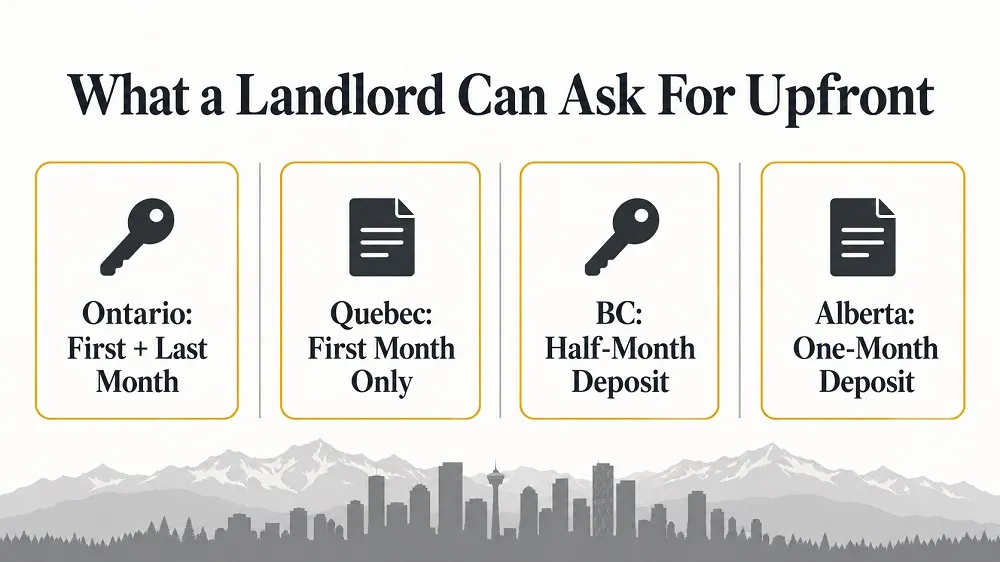
| Ontario | First month's rent and a last month's rent deposit of up to one month. No damage deposit. A refundable key deposit only up to the replacement cost. | 2.1% in 2026 and 1.9% in 2027 for most units, with 90 days' written notice |
| Quebec | First month's rent only. No security, damage, key or last month's deposit. | No fixed percentage. A tenant can refuse an increase, and the Tribunal administratif du logement can set the rent. |
| British Columbia | Security deposit of up to half a month's rent, plus a pet damage deposit of up to half a month's rent. | 2.3% in 2026, once every 12 months, with three months' notice |
| Alberta | Security deposit of up to one month's rent. | No percentage cap |
Ontario: Last Month's Rent and No Damage Deposit
"First and last" is legal in Ontario, but the last month's deposit can only be applied to your final month of rent, never to repairs. A landlord who asks for a damage deposit or a pet deposit on top is asking for something the Residential Tenancies Act does not allow. Post-dated cheques can be requested but not required.
Quebec: First Month's Rent Only
Quebec is the strictest province. A landlord can require the first month's rent when the lease is signed and nothing else, including post-dated cheques. You may choose to offer a deposit on your own, but it only counts as voluntary if the landlord did not ask for it or hint that you would lose the apartment without it.
British Columbia and Alberta Deposit Caps
In British Columbia, the security deposit and pet damage deposit together cannot exceed one month's rent, and a landlord must complete a move-in condition inspection. Alberta allows a single security deposit of up to one month's rent, but it has no cap on how much rent can rise, which makes the lease renewal terms more important to read.
Rental Application in Canada With No Credit History
A missing credit file is the most common reason newcomer applications stall, and the fix is to give the landlord better evidence than a score.
Building a Newcomer Rental Package
Prepare one PDF you can send within minutes of a viewing. Include photo ID, your immigration document, a short cover letter explaining that you are new to Canada, an employment letter or job offer showing salary and start date, and recent bank statements. A reference letter from your landlord or employer abroad, translated into English or French if needed, carries real weight. Fast, complete applications win in competitive markets.
Offering Prepaid Rent Within Provincial Rules
Offering several months of rent upfront is a common newcomer strategy, but it has limits. In Quebec, a landlord cannot ask for it at all, and in Ontario a landlord cannot require more than the legal deposit. If you volunteer prepaid rent, make sure the lease records it, get a receipt, and never offer more than you could afford to lose if the arrangement goes wrong.
Guarantors and Your Rights as an Applicant
A guarantor with Canadian credit, such as a relative or employer, is a strong substitute for your own history. In Ontario, the regulation on tenant selection allows landlords to request a guarantee, credit checks and rental history, and the Ontario Human Rights Commission's guidance on rental housing states that a lack of rental or credit history should not be treated as a negative. Human rights laws across Canada also protect applicants from refusal based on place of origin or ethnic background.
Signing a Lease and Avoiding Rental Scams in Canada
The last two risks for a newcomer are signing terms you cannot enforce and paying someone who does not own the unit.
Standard Lease Forms in Ontario and Quebec
Ontario landlords of most private units must use the provincial standard lease, and Quebec requires its own mandatory lease form. In Ontario, if you ask in writing for the standard lease and do not receive it within 21 days, you can withhold one month's rent, as set out on the province's renting in Ontario rights page. Whatever the province, get every promise about parking, storage or included utilities written into the lease itself.
Rental Scams That Target Newcomers Before Arrival
The most common scam targets people still abroad: a well-priced unit, a landlord who is "travelling" and cannot show it, and a request to wire a deposit to hold it. Do not pay anything for a unit you or someone you trust has not seen in person. Run a reverse image search on the listing photos, confirm the address exists, and treat any request to pay by wire, gift card or cryptocurrency as a scam. A short-term furnished rental for your first weeks gives you time to view places properly.
Move-In Inspection and Rent Payment Records
On move-in day, photograph or video every room, including appliances, floors and existing damage, and send the files to your landlord by email so the date is recorded. Pay rent by e-transfer or cheque rather than cash, and ask for receipts. A year of on-time payments becomes the Canadian rental reference you did not have when you arrived.
Your housing plans work best when your immigration status is settled. SEP Immigration, led by Sepehr Falahati (RCIC #R533959), helps newcomers with permits, permanent residence and the steps that follow landing.
This page is general information, not legal advice, and tenancy rules and rent figures change. Verify current rules with your provincial residential tenancy authority; information is current as of October 2026.
Frequently asked questions
01Can I rent an apartment in Canada without permanent residence?
Yes. Work permit holders, international students and other temporary residents rent in Canada every day. Landlords mainly want to see that you can pay the rent for the length of the lease, so your permit, your job offer or proof of funds, and the end date of your status all matter.
02Can a landlord ask for first and last month's rent?
It depends on the province. In Ontario, a landlord can collect first month's rent plus a last month's rent deposit, but no damage deposit. In Quebec, a landlord can only require the first month's rent. British Columbia and Alberta allow a security deposit instead, capped at half a month and one month of rent respectively.
03Do I need a Social Insurance Number to rent in Canada?
No. Your SIN is for work, taxes and government benefits. Landlords can confirm your identity and income with other documents, and you can leave the SIN field blank or offer an alternative.
04How much money should I have ready to rent my first apartment?
Plan for the first month's rent, any deposit your province allows, utility connection costs, tenant insurance and basic furniture. If you are offering prepaid rent to make up for having no credit history, budget for that amount on top.
05Can a landlord refuse me because I have no Canadian credit history?
Landlords can consider credit history, but in Ontario the Human Rights Commission says a lack of rental or credit history should not be viewed negatively. A strong rental package with income proof, savings and references gives a landlord other ways to assess you.
Stay informed
Get our immigration updates first on Google
Add SEP Immigration as a preferred source and our latest news and guides appear more often in your Google results.
About the Author

Sepehr Falahati
CEO of SEP Immigration
- CICC Licensed
- RCIC #R533959
- IRB Member
Sepehr Falahati is a Regulated Canadian Immigration Consultant (RCIC #R533959), licensed by the College of Immigration and Citizenship Consultants (CICC).
Read more about Sepehr FalahatiReviewed By


Continue Reading