Find a Family Doctor in Canada as a Newcomer
Reviewed by Mohsen Khorvash and Mahsa Barati

In most provinces, a family doctor or nurse practitioner is how you get prescriptions renewed, tests ordered and specialist referrals made, so finding one is among the more important tasks after you arrive. It is also one of the slowest. Every province runs its own system, almost all of them work through a waiting list, and nearly none will add you until you have a provincial health number. That is why the search really begins with applying for your provincial health card, ideally in your first days here alongside the other first things to do after landing.
This guide explains who can register, the official family doctor finder in each province, what the wait looks like, and how to see a doctor while you are still on a list. It applies whether you arrived as one of Canada's new permanent residents or on a work or study permit, although eligibility differs, as the first section explains.
Health Card and Eligibility Rules for Newcomers
Family doctor registries are open to people insured under the provincial plan, so your immigration status decides whether, and when, you can join one.
Your Health Card Comes Before Any Registry
Ontario's Health Care Connect asks for a valid Ontario health card number, and the mailing address you give must match the one linked to the card. British Columbia's registry asks for your Personal Health Number, Quebec's waiting list requires a RAMQ card, and New Brunswick requires a valid Medicare number. Apply for coverage as soon as you have an address, using your passport and your Confirmation of Permanent Residence or permit as proof of status. If your province has a waiting period before coverage starts, use that time to gather your medical records.
Two provinces let you start earlier. In Nova Scotia, newcomers without a health card register by calling 811, and the registration is completed once the health card number is issued. Manitoba's Family Doctor Finder accepts phone registrations from people who do not yet have a Personal Health Information Number.
Temporary Residents, Refugees and Visiting Parents
Work and study permit holders who qualify for provincial coverage can use the same registries once they hold a health card, though eligibility for that coverage depends on the province and the length of the permit. If you are in Canada on a study permit, check whether your province insures international students or whether you rely on a school health plan, because only provincially insured students can join a registry. Refugee claimants and protected persons are covered by the Interim Federal Health Program until provincial coverage begins. Parents and grandparents visiting on a Super Visa are not covered by provincial plans and cannot register, so their private insurance and walk-in clinics are the route to care.
Medical Surveillance Is a Separate Obligation
If your immigration medical exam found inactive tuberculosis, IRCC may have placed you on medical surveillance. You would have received a Medical Surveillance Undertaking form (IMM 0535) during the landing process, or by email if you were already in Canada, and it requires you to contact your local public health authority within 30 days of arrival, or within seven days for complex cases. Public health arranges that follow-up whether or not you have a family doctor, so do not wait for a registry match before reporting.
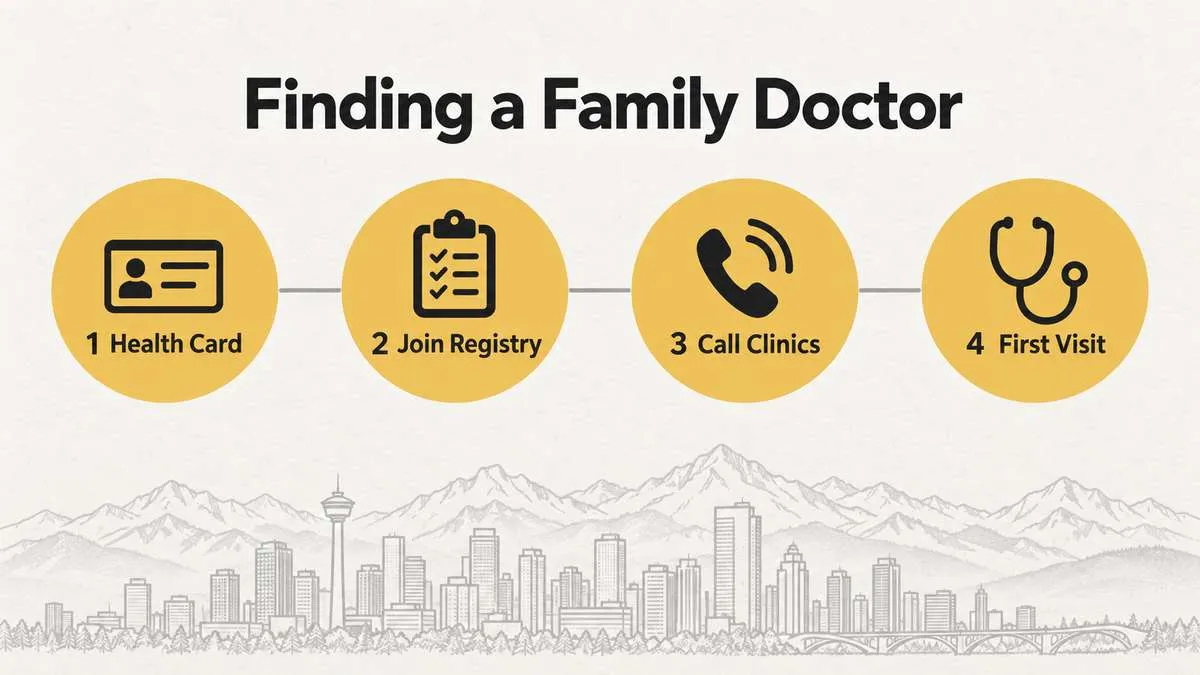
How to Find a Family Doctor in Canada, Step by Step
The process is broadly the same across the country, even though each province names its program differently.
Step 1: Join Your Province's Family Doctor Registry
Registration is free and usually takes a few minutes online, or by phone through 811 or a dedicated line. You give your health number, address and some basic health information, and a coordinator in your region looks for a family doctor, nurse practitioner or team accepting new patients. Register every family member who needs a provider, since several programs try to place a household with the same clinic. Joining does not guarantee a quick match. Coordinators reach you through the details on file, and Ontario notes that up-to-date information helps people get matched faster, so update your record whenever your address, phone number or health changes.
Step 2: Accept a Nurse Practitioner
In almost every province, your match can be a nurse practitioner rather than a physician. Nurse practitioners diagnose and treat common conditions, order tests, prescribe medication and, in most provinces, refer to specialists. Registries count them as primary care providers, so telling the program you are open to either widens the pool and can shorten the wait.
Step 3: Contact Clinics and Community Health Centres Directly
Registries are not the only door. New clinics, doctors returning from leave and physicians relocating from another province sometimes take patients directly before they appear on any list. Call clinics near your home, check the websites of local family health teams or primary care networks, and ask walk-in clinics whether any of their doctors are building a practice. Community health centres serve many newcomers and often offer interpretation, and some hospitals run family medicine teaching units that accept patients.
Step 4: Use Settlement Agencies and Your Own Network
IRCC-funded settlement agencies help permanent residents and many temporary residents outside Quebec at no cost, and their staff often know which local clinics are accepting patients or have doctors who speak your language. Coworkers, neighbours and community or faith groups are worth asking too, because doctors sometimes take referrals from existing patients.
Step 5: Prepare for the First Appointment
The first visit is usually an intake appointment where you and the clinician decide whether to continue together. Bring your health card, a list of current medications with doses, vaccination records for each family member, and any test results or specialist letters from home, translated into English or French where possible. A short written summary of past surgeries, chronic conditions and family medical history helps the doctor pick up your care where your previous one left off.
Family Doctor Finder Programs by Province
The table lists the official program in each province and territory, and the sections that follow cover the provinces where most newcomers settle.
| Province or territory | Program | How to register | What you need |
|---|---|---|---|
| Ontario | Health Care Connect | Online, or call 811 | Ontario health card number |
| Quebec | Québec Family Doctor Finder (GAMF) | Online, or through 811 | RAMQ health insurance card |
| British Columbia | Health Connect Registry | Online, or call 8-1-1 | Personal Health Number |
| Alberta | Alberta Find a Doctor | Search online, then contact clinics | Alberta health card for clinic intake |
| Saskatchewan | No central registry | Saskatchewan Health Authority clinic listings, then contact clinics | Saskatchewan health card |
| Manitoba | Family Doctor Finder | Online, or call 204-786-7111 (1-866-690-8260 toll-free) | PHIN, or register by phone without one |
| New Brunswick | NB Health Link | Online, or call 1-833-354-2300 | New Brunswick Medicare card |
| Nova Scotia | Need a Family Practice Registry | Online, or call 811 | Nova Scotia health card, or call 811 before it arrives |
| Prince Edward Island | Patient Registry | Online or by phone | PEI health card |
| Newfoundland and Labrador | Patient Connect NL | Online, or call 1-833-913-4679 | MCP number |
| Yukon | Primary care provider waitlist | Online through the Yukon government | Yukon health card |
| Northwest Territories and Nunavut | Local health centre | Contact your community health centre | Territorial health card |
Find a Doctor in Ontario Through Health Care Connect
Ontario's program is Health Care Connect, and you can register online or by calling 811 (TTY 711) at any hour. A nurse called a Care Connector then searches for a family doctor, nurse practitioner or primary care team in your community, matching people with urgent needs first. You receive a confirmation letter by mail, then a referral letter naming the clinician, who contacts you to book a first appointment. If that appointment does not lead to ongoing care, you can register again by calling 811. You can also search the College of Physicians and Surgeons of Ontario register, which lists practice locations and the languages each doctor speaks, and call those offices yourself.
Getting a Family Doctor in Toronto
Toronto follows the Ontario process, but the number of clinics in the city gives you more options to pursue at the same time. Register with Health Care Connect first, then look for community health centres in your neighbourhood and ask hospitals near you whether they run a family practice unit. Health811 can also point you to local services while you wait. A flexible search radius helps, because a clinic a short transit ride away may be accepting patients when the ones closest to home are full.
Quebec: GAMF Waiting List and the GAP Santé Québec Line
In Quebec, the waiting list is the Québec Family Doctor Finder (Guichet d'accès à un médecin de famille, or GAMF). You register with your RAMQ card, and your place depends on your health status rather than the date you signed up. Many registrations are now collective, which means you are attached to a family medicine group (GMF) rather than to one named doctor, and specialized nurse practitioners can also take you on. Once you are on the GAMF list, the GAP (Guichet d'accès à la première ligne) lets you get a consultation for a specific need within a short time. The GAP does not assign you a family doctor or move you up the list.
British Columbia, Alberta and the Prairies
British Columbia's Health Connect Registry takes registrations online or through HealthLink BC at 8-1-1, which offers help in more than 130 languages, and the province reports matching about 4,000 people a week. Alberta does not run a single provincial waiting list in the same way. Its Alberta Find a Doctor tool shows clinics taking new patients, and you contact them directly. Manitoba's Family Doctor Finder connects registrants with a home clinic through regional staff. Saskatchewan has no central registry, so you rely on the Saskatchewan Health Authority's clinic listings and phone calls, and the province was studying a patient registry as of mid-2026.
Atlantic Canada and the Territories
Nova Scotia's Need a Family Practice Registry also gives you free virtual appointments through VirtualCareNS while you wait. In New Brunswick, NB Health Link places you on the provincial list and, once you are enrolled, lets you book visits with its network of doctors and nurse practitioners before a permanent match. Newfoundland and Labrador's Patient Connect NL accepts people who will lose their provider within three months, and it is the only entry point to the province's Family Care Teams. Prince Edward Island runs a Patient Registry, Yukon keeps a waitlist for primary care providers, and in the Northwest Territories and Nunavut, community health centres are the usual first contact.
How Long It Takes to Get a Family Doctor
No province guarantees a timeline, and waits run from a few weeks to more than a year depending on where you live and how complex your health needs are.
Why Recent Immigrants Wait Longer
Newcomers feel the shortage most. A Statistics Canada study on access to a regular health care provider found that in 2024, 69% of immigrants who had been in Canada for ten years or less had a regular provider, compared with 85% of established immigrants and 82% of people born in Canada. Starting late widens that gap, since the registry clock only begins once you hold a health number, which is why applying for coverage in your first week matters.
How Registries Decide Who Is Matched First
Most programs do not work strictly first come, first served. Ontario matches people with urgent needs first, Quebec ranks registrants by health status, and British Columbia uses the health information you provide to make the best match. Declare pregnancy, children under two, chronic conditions and recent diagnoses when you register, and update the record if your health changes. Healthy adults with no ongoing conditions generally wait the longest.
How to See a Doctor in Canada Without a Family Doctor
Being on a waiting list does not mean going without care, and the right place to go depends on how urgent the problem is.
Call 811 for Health Advice
In most provinces, dialing 811 connects you with a registered nurse at no cost, around the clock, for advice on symptoms and where to go next. In Quebec, people on the GAMF list reach the GAP by calling 811 and choosing option 3, and the province explains the online route in its guide to getting a consultation while you wait for a family doctor.
Walk-In Clinics and Urgent Care Centres
Walk-in clinics handle minor illnesses, infections, injuries and prescription renewals, and with a health card the visit is covered. Doctors there can refer you to a specialist, which matters because most specialists in Canada will not see you without a referral. Urgent care centres treat problems that need same-day attention but are not life-threatening, such as sprains, minor fractures or a high fever.
Pharmacists and Public Virtual Care
Pharmacists in most provinces can now assess and prescribe for a list of common minor ailments, such as urinary tract infections, seasonal allergies and some skin conditions, and British Columbia's list covers 21 conditions. Publicly funded virtual visits, such as those offered to people on the Nova Scotia and New Brunswick registries, are worth using before you pay for a private service.
Emergency Departments for Serious Symptoms
For chest pain, difficulty breathing, signs of a stroke, heavy bleeding or any other emergency, call 911 or go to the nearest hospital emergency department. Emergency departments are not designed for routine follow-up or prescription renewals, but they are the right choice whenever a symptom could be life-threatening, and hospitals treat emergencies even when coverage has not started, although uninsured patients are billed.
Access to a provincial health plan, and with it a place on these registries, follows from the immigration status you hold in Canada. If you are planning your move or need to change your status, SEP Immigration can review your situation and explain the options that apply to you and your family.
This page is general information, not legal or medical advice, and provincial programs, phone lines and eligibility rules change often. Confirm current details on your provincial health ministry's website; this information is current as of October 2026.
Frequently asked questions
01Can a family doctor refuse to take me as a patient?
Yes. A doctor whose practice is full can decline new patients, and doctors are not obliged to accept everyone who asks. They cannot refuse you on discriminatory grounds such as race, religion or disability, and they must provide care in an emergency. If a clinic says it is full, ask whether it keeps a waiting list or has a nurse practitioner taking patients.
02Do I have to pay to register with a family doctor?
No. Provincial registries are free, and visits for insured services are billed to the provincial plan. Some clinics charge for uninsured services such as sick notes, form completion or copying records, and some offer an annual block fee that covers those extras. In Ontario, a doctor cannot make paying a block fee a condition of accepting you as a patient.
03What does it mean to be attached or rostered to a family doctor?
Both terms mean you are formally registered as a patient of a specific doctor, nurse practitioner or clinic team, which is what provincial registries aim to achieve. Once attached, you are expected to book routine care with that practice, and many clinics ask you to call them before using a walk-in clinic.
04What happens to my registration if I move?
Within the same province, update your address with the program so the search shifts to your new community. In Quebec, an address change made through the government's address-change service updates your GAMF file automatically and keeps your original registration date. Moving to another province means starting again, because each registry serves only people insured under its own plan, so apply for the new health card, register with the new program and keep copies of your records for your next provider.
05Is private virtual care worth paying for while I wait?
It can be convenient for prescription renewals or a sick note without a clinic visit, but it does not replace a family doctor and does not move you up a registry. Before paying, check whether your province offers free virtual visits to people on its waiting list, whether your employer benefits already include virtual care, and whether the service can refer you for tests and specialists in your province.
Stay informed
Get our immigration updates first on Google
Add SEP Immigration as a preferred source and our latest news and guides appear more often in your Google results.
About the Author

Sepehr Falahati
CEO of SEP Immigration
- CICC Licensed
- RCIC #R533959
- IRB Member
Sepehr Falahati is a Regulated Canadian Immigration Consultant (RCIC #R533959), licensed by the College of Immigration and Citizenship Consultants (CICC).
Read more about Sepehr FalahatiReviewed By


Continue Reading