
Newcomer Tax Return Canada: First-Year Rules
Reviewed by Mohsen Khorvash and Mahsa Barati

Your first Canadian tax return covers a year you only partly spent here, and that changes almost every section of it. Income earned before you arrived is treated one way and income earned after another, and several credits shrink to match the days you were a resident. Filing it correctly also starts the federal and provincial benefit payments many newcomer households rely on, although a few, such as the Canada workers benefit, require a full year of residency first.
This guide is for new permanent residents who have just completed the landing process, people holding a Confirmation of Permanent Residence who arrive later in the year, and temporary residents such as graduates working on a post-graduation work permit. It explains how residency is decided, what goes on the return, which credits are reduced and how to file the 2026 return due in spring 2027.
Tax Residency for Permanent Residents, Work Permit Holders and Students
Immigration status and tax residency are separate tests, and the Canada Revenue Agency (CRA) applies only the second.
Your Date of Entry Starts Your Canadian Tax Year
You become a resident for tax purposes once you establish significant residential ties in Canada: a home here, a spouse or common-law partner living here, or dependants living here. For most newcomers that happens on the day they arrive. Secondary ties such as a Canadian bank account, a driver's licence and provincial health coverage support the picture but rarely decide it on their own.
That date goes on page 1 of your return in month and day format, so June 1 is entered as 0601.
Work Permit and Study Permit Holders Are Often Tax Residents
Temporary status does not make you a non-resident for tax. A worker who rents an apartment and moves here for the length of a spouse open work permit or an employer-specific permit usually has the same ties as a permanent resident, and so do most international students who come for a full program. The 183-day rule people often quote applies to a narrower group: people who spend 183 days or more in Canada in a year without setting up significant ties, who are then deemed residents for the whole year.
Getting a CRA Opinion When Your Ties Are Mixed
If your spouse and children stay abroad while you start work, or you keep a home in your country of origin, the answer is less obvious. Form NR74, Determination of Residency Status (Entering Canada), asks the CRA for a formal opinion. Where a tax treaty applies and both countries could claim you as a resident, the treaty's tie-breaker rules decide which one does.
What to Report on Your First Canadian Tax Return
The return asks for different income depending on which side of your entry date it was earned.
World Income From the Day You Become a Resident
From your entry date to December 31, you report world income: Canadian salary, interest on accounts back home, rent from a property abroad and foreign pension payments, all converted to Canadian dollars. Where a treaty stops Canada from taxing a type of income, you report it and deduct the exempt part on line 25600. Where both countries can tax it, Form T2209 gives you a federal foreign tax credit for the foreign tax you paid.
Income Earned Before You Arrived
Foreign income earned before your entry date is not taxed in Canada. Canadian-source income from that period is different: employment in Canada, business carried on in Canada and gains on taxable Canadian property still go on the return. Your pre-arrival world income is also requested elsewhere, because the CRA uses it to calculate benefit payments and to decide whether you can claim certain credits in full.
Property You Owned Before Landing in Canada
Shares, cryptocurrency, jewellery, art and similar property you own when you become a resident are treated as if you sold them and bought them back at fair market value on your entry date. Gains that built up before you arrived stay outside Canadian tax, but only if you can show what the property was worth on that date, so record valuations now. Foreign property with a total cost above $100,000 later brings a Form T1135 filing requirement, though not for the year you first become a resident.
First-Year Tax Credits for Newcomers in Canada
Non-refundable credits reduce the tax you owe, and in your arrival year several of them are cut to match the days you lived here.
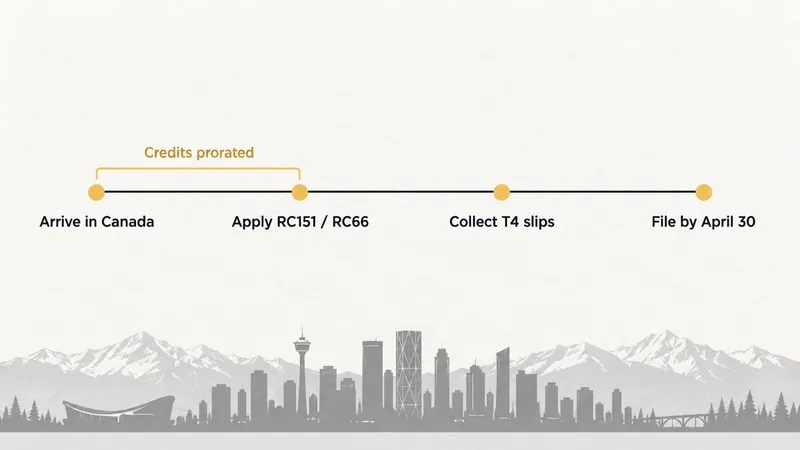
The Prorated Basic Personal Amount
For 2026 the federal basic personal amount is $16,452, and the first federal bracket is taxed at 14% on taxable income up to $58,523. Someone who became a resident on June 1, 2026 was resident for 214 days, so they claim 214/365 of $16,452, or $9,645.83. The spouse amount, the age amount and similar personal credits are prorated the same way, and provincial credits follow the same approach.
Credits Claimed in Full Despite a Partial Year
Credits tied to what you paid, rather than to the calendar, are not prorated. They include CPP or QPP contributions and EI premiums deducted from your pay, tuition, eligible medical expenses and donations made while you were a resident. If your Canadian-source income for the non-resident part of the year was 90% or more of your net world income for that period, you can also claim the remaining credits in full.
Moving Costs, RRSP Deductions and Work Income Benefits
Two deductions newcomers often expect are usually unavailable. Costs of the move to Canada generally can't be deducted, with a narrow exception for full-time post-secondary students who receive a taxable Canadian scholarship, bursary or research grant. RRSP contributions generally can't be deducted on a first return either, because RRSP room comes from earned income reported on an earlier Canadian return.
Newcomer Benefits Before You File: CGEB and Canada Child Benefit
You don't have to wait for your first return to start receiving federal benefit payments,.
Applying for the Canada Groceries and Essentials Benefit With RC151
In July 2026 the GST/HST credit was replaced by the Canada Groceries and Essentials Benefit (CGEB), a tax-free quarterly payment for low- and modest-income households, generally for residents aged 19 or older. Newcomers without children apply with Form RC151, which can be completed through a CRA web form, and only one application is needed per household. For the current payment period, a single person can receive up to $679 a year and a couple with two children under 19 up to $1,358.
The application asks for your world income for up to two years before you arrived, including years with no income. After that, the CRA recalculates the benefit each July from your tax return, which is why filing every year matters even when you owe nothing.
Canada Child Benefit for PR Holders and Temporary Residents
Families with children under 18 apply with Form RC66 and its schedule RC66SCH, which records your status in Canada and your income. Parents filing RC66 don't need a separate RC151, because the same application is used for the CGEB and for provincial child benefits. The CRA's guidance for newcomers to Canada lists the supporting documents, such as proof of birth for each child.
Permanent residents and protected persons can qualify as soon as they are residents. A temporary resident qualifies in the 19th month of living in Canada, provided the permit is still valid, so send the CRA each renewed permit before the old one expires or the payments stop.
How to File Your First Tax Return in Canada
Filing follows the same route as for any other taxpayer, with a few newcomer-specific entries.
Step 1: Get a SIN or a Temporary Tax Number
You need a Social Insurance Number to file online. Permanent residents receive one that does not expire, while temporary residents get a number starting with 9 that is tied to their permit. If Service Canada can't issue you a SIN, file on paper without one and attach a letter explaining why, and the CRA will assign a temporary tax number.
Step 2: Collect Canadian Slips and Foreign Records
Employers issue T4 slips by the end of February, and financial institutions issue T5 slips when interest or dividends pass $50. Alongside them, keep your COPR or permit showing your entry date, statements for foreign income received after arrival, proof of foreign tax paid and the valuations of property you held on arrival.
Step 3: File With NETFILE Software, on Paper or at a Free Clinic
NETFILE-certified software sends your return straight to the CRA and is usually processed in about two weeks, and several packages are free. Paper returns take at least eight weeks. If your income is modest and your situation simple, a volunteer clinic run under the Community Volunteer Income Tax Program can prepare the return at no cost. The CRA's line-by-line instructions for completing a newcomer return are worth reading first, and a return with foreign rentals, foreign pensions or investments held abroad is where a tax professional usually earns the fee.
Step 4: File by April 30 and Pay What You Owe
Your first return is due by April 30 of the year after you became a resident, so for a 2026 arrival the deadline is April 30, 2027. Self-employed people and their spouses have until June 15, 2027 to file, but any balance owing is still due on April 30. Filing late with a balance owing costs 5% of that balance plus 1% for each full month late, for up to 12 months.
Provincial tax is calculated for the province where you lived on December 31. If that was Quebec, you also file a separate provincial return with Revenu Québec.
First-year returns tend to go wrong where immigration and tax overlap, such as an entry date that doesn't match your status documents or a benefit application sent before a permit renewal reaches the CRA. SEP Immigration, led by Sepehr Falahati (RCIC #R533959), can confirm the status dates and documents your return and benefit applications depend on, so your tax preparer starts from accurate records.
This page is general information, not legal or tax advice, and tax rules, rates and benefit amounts change every year. Confirm current details with the Canada Revenue Agency on canada.ca before you file; the information here is current as of October 2026.
Frequently asked questions
01Should I use my landing date or my arrival date on my tax return?
Use the date you became a resident for tax purposes, which is not always your landing date. If you lived and worked in Canada on a permit before confirming permanent residence, you were probably a tax resident from the day you first set up a home here, years before you landed. Your landing date matters to IRCC, not to the CRA.
02Do I have to file a tax return if I had no income in my first year?
You may not owe anything, but you should still file. The CRA recalculates the Canada Groceries and Essentials Benefit, the Canada child benefit and provincial credits each July from your latest return, so a missing return can stop payments you already receive.
03Can I file my taxes before I receive my PR card?
Yes. The CRA does not need your PR card. Your Confirmation of Permanent Residence or permit shows your status and entry date, and a Social Insurance Number is what you need to file online.
04Do international students have to file a tax return in Canada?
Students who are tax residents should file if they had income or want benefits, and filing is worth it even without income. Tuition credits you cannot use while studying carry forward to later years, but only once they are recorded on a return.
05Do I still need to file a tax return in my home country?
That depends on the other country's rules. Some require a final return when you leave, and the United States taxes its citizens wherever they live. A tax treaty or the foreign tax credit usually prevents the same income being taxed twice, but it does not remove the duty to file.
06What if I arrived in Canada in late December?
You still file a return for that year by the following April 30. Your prorated credits will be small, but filing records your entry date with the CRA and starts benefit payments from the following July.
Stay informed
Get our immigration updates first on Google
Add SEP Immigration as a preferred source and our latest news and guides appear more often in your Google results.
About the Author

Sepehr Falahati
CEO of SEP Immigration
- CICC Licensed
- RCIC #R533959
- IRB Member
Sepehr Falahati is a Regulated Canadian Immigration Consultant (RCIC #R533959), licensed by the College of Immigration and Citizenship Consultants (CICC).
Read more about Sepehr FalahatiReviewed By


Continue Reading