
Tour Guide Work Permits in Canada
Reviewed by Mohsen Khorvash and Mahsa Barati
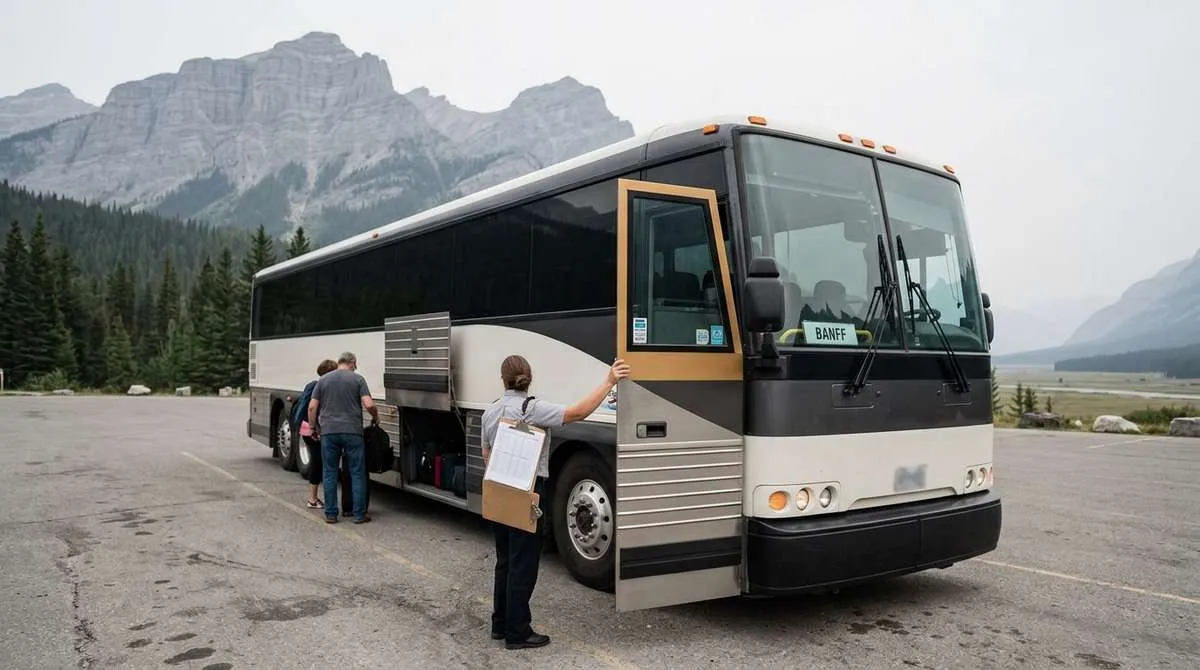
A foreign guide hired by a Canadian tour company needs a work permit, and that permit almost always rests on a positive Labour Market Impact Assessment. Operators discover late that this occupation runs into two rules with nothing to do with the guide's experience or languages. One is the wage the job pays. The other is the city where the work happens.
This page covers what comes after the business visitor exemption stops applying. Whether a permit is needed at all turns on who employs the guide rather than how interactive the role is, and that test is set out in our guide to working in Canada without a work permit.
When a Tour Guide Needs a Canadian Work Permit
Two questions settle the starting position: who pays the guide, and which occupation code the duties belong to.
Guide Roles Outside the Business Visitor Exemption
Four situations take a guide out of exempt territory: being hired by a Canadian tour operator, joining a group already inside Canada rather than accompanying it across the border, going onto Canadian payroll, and selling guided services directly to Canadian clients. None of them depend on the length of the assignment, so a guide leading one three-day itinerary is in the same position as one working a full season. Guides who avoid these triggers may instead enter Canada under a Business Visitor Visa.
Tour Guide NOC Code 64320 and Related Tourism Classifications
Tour and travel guides fall under NOC 64320, a TEER 4 group whose illustrative titles are broad: bus tour guide, boat tour guide, walking tour guide, tour director, tour escort, mine guide, calèche driver and ski resort host all sit inside it.
Two neighbouring codes matter. Outdoor sport and recreational guides, covering rafting and climbing, sit under NOC 64322 and are also TEER 4. Motor coach drivers are classified separately as transit and bus operators at TEER 3, which changes their position on several rules below. The TEER level is an administrative marker rather than a judgement on the work, but it decides the wage stream, the family accompaniment rules and whether the experience counts toward permanent residence.
Tour Guide LMIA Rules and Low-Wage Stream Restrictions
The LMIA route for guiding is constrained before the recruitment even begins, by the offered wage and then by the work location.
Guide Wages Fall Below Every Provincial High-Wage Threshold
Employers often assume they can choose their stream. They cannot. It is set by comparing the offered wage against the provincial hourly wage threshold, which is the provincial median wage plus twenty per cent.
| Province | Hourly wage threshold for LMIAs received as of July 17, 2026 |
|---|---|
| Alberta | $37.50 |
| British Columbia | $38.40 |
| Ontario | $36.92 |
| Quebec | $36.00 |
| Nova Scotia | $31.96 |
| Manitoba | $31.33 |
A guiding job paying close to thirty-eight dollars an hour in British Columbia does not exist in the ordinary market, so every tour guide LMIA is a low-wage LMIA in practice. That carries obligations: round-trip transportation, evidence that affordable housing is available locally, a cap on the proportion of low-wage foreign workers at the site, and a maximum employment duration of one year rather than two.
Paying above the threshold to escape the stream is not a workaround. The offered wage must match the prevailing wage for the occupation, and inflating it to dodge a program requirement is a stated ground for a negative decision.
Processing Restrictions in Major Tourism Markets
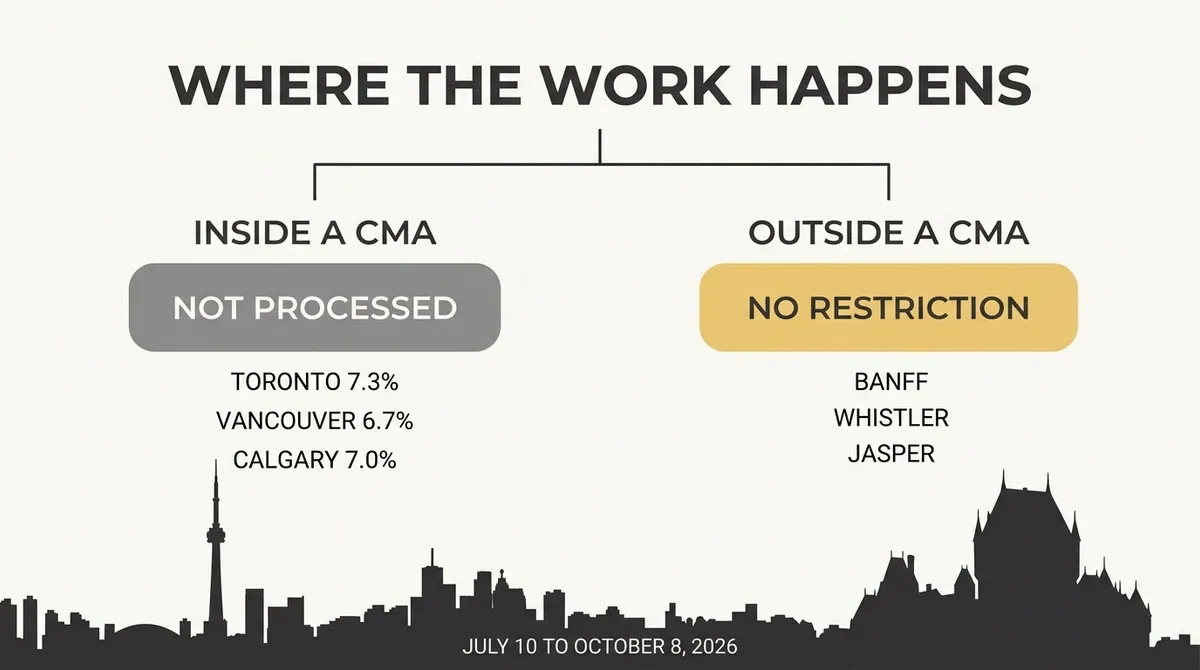
Since September 26, 2024, low-wage LMIA applications are not processed where the work location sits in a census metropolitan area with unemployment of six per cent or higher at the time of submission. Rates are republished quarterly. The figures below cover applications submitted between July 10 and October 8, 2026, with the next revision due October 9.
| Tourism market | Rate in effect to October 8, 2026 | Low-wage LMIA processing |
|---|---|---|
| Toronto | 7.3% | Not processed |
| Vancouver | 6.7% | Not processed |
| Montréal | 6.8% | Not processed |
| Calgary | 7.0% | Not processed |
| Ottawa-Gatineau | 6.7% | Not processed |
| Kelowna | 7.5% | Not processed |
| Québec City | 4.0% | Eligible |
| Victoria | 4.6% | Eligible |
| St. Catharines-Niagara | 5.8% | Eligible |
| Halifax | 5.9% | Eligible |
Geography rewards attention. The measure only bites inside a census metropolitan area, so Banff, Jasper, Whistler and Tofino are untouched, and a location returning a census agglomeration also stays eligible. Niagara Falls sits inside the St. Catharines-Niagara area, which was above the line last quarter and is below it now. That is why the check belongs at submission rather than at planning.
The 120-Day Short-Duration Exemption for Seasonal Tour Work
Several categories are carved out of the restriction, and one suits the work tour operators do. Positions generally of 120 calendar days or less can be exempted where they are truly temporary, meaning tied to a short-term period or single event with no intention to refill the post, or highly mobile, meaning part of a workforce that regularly crosses provincial or international boundaries.
The departmental examples are travelling carnival and fair operators, one-time projects and short events. A coach crew running cross-border itineraries has a stronger case than a guide returning to the same city post each summer, since a recurring seasonal vacancy is what the exemption is not designed for. It is also not automatic: it must be requested in writing, in a document named "Exemption request" uploaded with the application, and requests beyond 120 days are considered only exceptionally.
How to Apply for a Tour Guide Work Permit
Each step below gates the next, and the first two decide whether the rest is worth starting.
Confirm the Occupation Code and Prevailing Wage
Match the duties to the NOC group rather than to the job title used internally. A position billed as a tour coordinator may fall under a different code with a different wage expectation, and a mismatch between code and duties causes trouble later in the file.
Check the Work Location Against the Quarterly Table
Enter the full postal code and see whether it returns a census metropolitan area. If it does, check the rate in force for the submission window against the quarterly table. This takes minutes and decides whether to proceed.
Complete the Low-Wage Advertising and Recruitment
Low-wage recruitment carries its own advertising period and requires targeted efforts toward under-represented groups. Keep records of every advertisement, application received and reason for rejection, since they support the file and any later inspection.
Submit the Application With Any Exemption Request
File through the online portal with the employer fee, attaching the recruitment evidence and, where the position qualifies, the written exemption request. Housing availability and transportation arrangements form part of the low-wage submission.
Apply for the Employer-Specific Work Permit
Once the assessment is positive, the guide applies using the offer of employment and the assessment number, in most cases from outside Canada.
Arrange the Entry Document and Biometrics
Depending on citizenship the guide needs a temporary resident visa or an electronic travel authorization, and biometrics may apply. This runs in parallel with the permit application, not after it.
Tour Guide Work Permit Costs and Processing Times
Costs divide along a line the program enforces. The employer pays the $1,000 assessment fee per position and cannot lawfully recover any part of it from the worker, and under the low-wage stream also carries advertising and round-trip transportation. The guide pays $155 for the permit, $85 for biometrics where required to a family maximum of $170, and $100 for a temporary resident visa if their citizenship calls for one. Where an application is not processed, no fee is charged, a point set out on the department's page covering refusal to process an LMIA application. Figures are current as of September 2026.
Timelines are the harder constraint. The assessment and the permit are handled by separate departments, each with its own queue, and permit processing varies considerably by country of application. Check the current estimate on IRCC's processing times tool and work backward from the season start date. Recruitment beginning in spring for a summer season is usually already too late.
LMIA-Exempt Alternatives for Foreign Tour Guides
For many guides the LMIA is avoidable, and for those planning to stay, what the work builds toward matters.
International Experience Canada Removes the LMIA Requirement
A Working Holiday participant under International Experience Canada receives an open work permit: no labour market test, no wage threshold, no census metropolitan area check and no employer-specific restriction. The guide can move between operators and provinces across a season, which suits an industry that hires in bursts.
The limits are age and citizenship rather than occupation. Participation is open to citizens of countries holding a youth mobility agreement with Canada, generally between 18 and 30 or 18 and 35, with permit length and repeat participation varying by nationality. Conditions for each country appear on the IRCC page setting out who can apply under International Experience Canada. For an operator, recruiting from those countries removes months of process and the assessment fee.
Guiding Experience and Permanent Residence Pathways
Seasonal guides often assume that several years of Canadian work will eventually convert into permanent residence. Not through the Canadian Experience Class, which counts only experience in TEER 0, 1, 2 or 3 occupations. Guiding sits at TEER 4 and falls outside that range however many hours are accumulated.
Provincial routes are where tourism workers find traction, since several nominee streams reach occupations the federal programs exclude. Alberta runs a stream for temporary foreign workers already employed in its tourism and hospitality sector, covered on our page on the Alberta Advantage Immigration Program. The other route is a move into a higher-classified role, since supervisory positions and coach driving sit at TEER levels that do count.
If you are running a tourism operation and need a guide or coach crew in place for a coming season, the work location and the wage need to be tested against the current rules before the recruitment begins. SEP Immigration, led by Sepehr Falahati (RCIC, CICC and IRB member R533959), can review the position and confirm which route is open to it.
Frequently asked questions
01How long is a tour guide work permit usually valid?
Since September 2024 the maximum employment duration on a low-wage LMIA has been one year, reduced from two. Because guide positions sit in the low-wage stream almost without exception, the resulting employer-specific permit is generally issued for up to a year rather than the longer terms employers were used to. Bringing the same guide back for a second season normally means a fresh application.
02Can a tour guide's spouse get an open work permit?
Generally no, for two separate reasons. Since January 21, 2025, spousal open work permit eligibility has been limited to spouses of workers in TEER 0, TEER 1 and a published list of TEER 2 and TEER 3 occupations, and guiding at TEER 4 is outside those categories. The principal worker's permit must also have at least 16 months of validity remaining when the spouse applies, which a one-year permit cannot satisfy in any event.
03What is the difference between a refused LMIA and a refusal to process?
A negative assessment means the file was examined and the position did not pass the labour market test. A refusal to process means it was closed without examination, usually because of the wage and unemployment rules or the workforce cap. No processing fee is charged where an application is not processed, and the employer receives a letter giving the reason. One is answered on the merits, the other by removing the administrative barrier.
04Does a work permit let a foreign coach driver drive in Canada?
No. Immigration authorization and driving authorization are separate. The permit confirms the holder may work in the stated position, but the commercial licence needed to operate a motor coach is issued provincially, and whether a foreign licence is recognised depends on the province and any reciprocal arrangement with the issuing country. Confirm this with the provincial authority before the driver travels.
05Can a guide already visiting Canada apply for the permit from inside the country?
Usually not. The temporary policy allowing visitors to apply for employer-specific permits from within Canada ended in August 2024, and standard in-Canada eligibility rules now apply. In most cases the application is made from outside the country once the assessment is positive, which is another reason the hiring calendar needs to start early.
06Do the same rules apply to interpreters travelling with a tour group?
The employer test works the same way for translators and interpreters as it does for guides, so someone employed and paid by the foreign operator is assessed on the same basis. The classification differs, though. Interpreters fall under a separate code at a higher TEER level, which changes the wage stream, the spousal permit position and whether the Canadian experience counts toward permanent residence.
Stay informed
Get our immigration updates first on Google
Add SEP Immigration as a preferred source and our latest news and guides appear more often in your Google results.
About the Author

Sepehr Falahati
CEO of SEP Immigration
- CICC Licensed
- RCIC #R533959
- IRB Member
Sepehr Falahati is a Regulated Canadian Immigration Consultant (RCIC #R533959), licensed by the College of Immigration and Citizenship Consultants (CICC).
Read more about Sepehr FalahatiReviewed By


Continue Reading