
After-Sales Service and Warranty Work in Canada
Reviewed by Mohsen Khorvash and Mahsa Barati

A technician flying in to repair machinery under warranty usually does not need a work permit. The exemption that allows this is narrow, it is assessed at the border with no advance application, and it turns almost entirely on where the equipment was bought and what the original contract said.
Canadian companies get this wrong in a specific and expensive way. They assume the exemption follows the technician's job, when it actually follows the paperwork behind the machine. A refusal at the port of entry means the technician goes home, the equipment stays down, and the company then has to pursue a Labour Market Impact Assessment or an exempt work permit category before anyone can travel again.
Where the After-Sales Exemption Comes From
Servicing equipment in Canada is work under Canadian immigration law. The technician is not exempt because the activity is not work. They are exempt because they qualify as a business visitor, meaning they are not entering the Canadian labour market.
Three financial tests define that. The primary source of the technician's remuneration must remain outside Canada, their principal place of business must remain outside Canada, and profits from the activity must accrue outside Canada. A technician who ends up on a Canadian payroll fails all three, whatever the contract is called.
Conditions the Equipment and Contract Must Satisfy
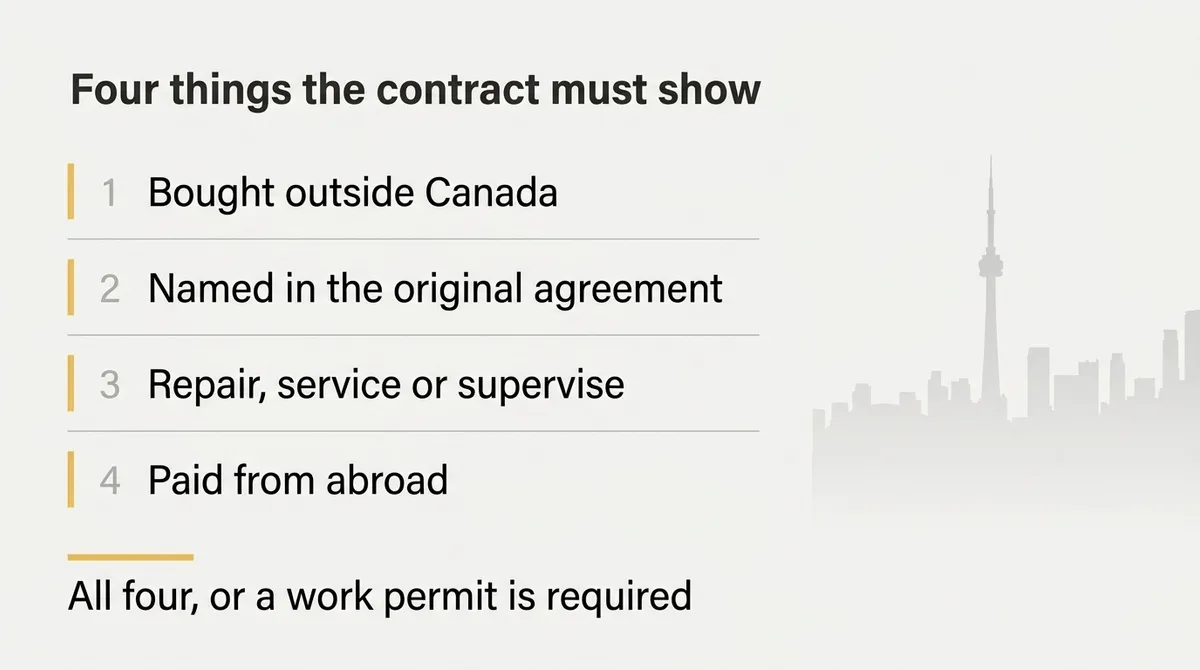
The exemption applies only to specialized commercial or industrial equipment, and only where four things hold.
The Equipment Was Purchased or Leased Outside Canada
This is the condition that disqualifies most files, and it catches companies by surprise. If the Canadian buyer purchased the machine from a Canadian distributor, the after-sales exemption does not apply, no matter how specialized the equipment is or how clearly the warranty covers the repair. The purchase itself has to have happened outside Canada.
The Service Contract Traces Back to the Original Agreement
The service arrangement must be either an extension of the original agreement, or something negotiated as part of the original sales, lease, or rental agreement. A service contract signed later, separately, does not qualify on its own.
The Activity Is Repair, Service, Set-Up, Testing or Supervision
These are the listed activities. Work outside them is not covered, even for the same technician on the same machine during the same visit.
The Financial Centre of Gravity Stays Abroad
The three remuneration tests above must hold throughout. Expenses reimbursed by the Canadian host are acceptable; compensation is not.
Third-Party Service Providers and When the Contract Was Signed
Equipment manufacturers often subcontract servicing, and the timing of that subcontract decides the outcome.
If a third company is contracted to service the equipment after the sales agreement was signed, its technicians are not covered by this exemption. If, however, the original sales agreement states that a third company has been or will be contracted to service the equipment, the exemption applies to that company's technicians.
The practical consequence is that a single sentence in the original sales agreement determines whether a service provider's staff can enter freely for years afterwards. Manufacturers negotiating Canadian sales should be naming their service partners in the agreement at the outset, not arranging servicing later.
Set-Up Work That Crosses Into Trades Territory
Set-up is a listed activity, but it does not extend to hands-on work of the kind construction or building tradespeople normally perform. Electricians and pipe fitters are the examples IRCC gives. A technician who arrives to commission a machine and ends up running conduit or connecting pipework has moved outside the exemption.
There is a real exception. Where the equipment requires proprietary or product-specific knowledge to install or assemble, hands-on work may still fall within the exemption, and prefabricated structures are specifically noted. The test is whether the knowledge is proprietary to the product, not whether the task looks technical.
The same boundary governs supervisors. Supervising the installation of specialized machinery purchased or leased outside Canada is covered, as is supervising the dismantling of equipment purchased in Canada for relocation abroad. Supervision does not normally include doing the work, subject to the same proprietary-knowledge exception.
Software Upgrades Count as New Contracts
Where the original agreement provides for a software upgrade to previously purchased or leased equipment, a person coming to install, configure, or train on that upgraded software may enter as a business visitor. The condition is that the after-sales or lease activity is clearly articulated in the new sales or lease agreement or purchase order.
A purchase order for upgraded software is treated as a new contract for a new product. That framing helps vendors, because it means each upgrade cycle can carry its own service entitlement rather than depending on an ageing original agreement.
Training Canadian Staff After Installation
Training the purchaser's users or maintenance staff on specialized equipment obtained outside Canada falls within the exemption, with two conditions attached. The training should take place after installation is complete, and the trainer must keep their position in their home branch and receive no compensation from the Canadian branch beyond expenses.
Where a trainer or specialist installer works under an after-sales contract held by the foreign branch, the same conditions apply, and the service has to be provided company-wide rather than only for the Canadian office.
Out-of-Warranty Equipment Follows a Different Route
Once the warranty or related service agreement has lapsed, this exemption stops. Servicing equipment that is no longer covered requires a work permit.
That does not mean an LMIA is inevitable. IRCC treats emergency repair personnel and repair personnel for out-of-warranty equipment under the significant benefit provisions, which is an LMIA-exempt route. It is a work permit application rather than a border assessment, so it needs lead time, but it exists precisely for this situation.
The Trap That Catches Canadian Companies
| Arrangement | Status |
|---|---|
| Foreign company sells equipment abroad, sends technician under original warranty | Business visitor, no permit |
| Canadian company contracts a foreign firm to supply services on site | Work permit required |
| Equipment bought from a Canadian distributor, serviced by the foreign maker | Work permit required |
| Third-party servicer named in the original sales agreement | Business visitor, no permit |
| Third-party servicer contracted after the sale | Work permit required |
| Warranty expired, repair still needed | Work permit, potentially LMIA-exempt |
The second row is where most misclassification happens. When a Canadian entity directly contracts services from a foreign company and that company sends an employee to perform them, the employee is entering the Canadian labour market through the contract, even though no Canadian entity pays them. IRCC's example is a Canadian airport engaging an American architecture firm whose architects then work on site. Those architects need permits.
Documents to Carry to the Port of Entry
There is no application and no fee, so the assessment happens entirely at the border with whatever the traveller has in hand, and the onus sits on them.
Officers expect a letter of support from the foreign employer and a letter of invitation from the Canadian host business. For after-sales work the contract matters most, because the exemption depends on its terms, its dates, and what it says about the original purchase. Business cards, business papers, and advertising material may also be considered, and a port of entry letter is not part of this process since no permit is being issued. Where the stay will exceed six months, the officer should issue a visitor record explaining in the remarks why the longer period was granted. IRCC sets out the full criteria in its guidance on business visitors under R186(a), and the out-of-warranty route is covered under significant benefit provisions for repair personnel.
If you are bringing a technician in and are unsure which side of the line your contract falls on, SEP Immigration can review the agreement and the arrangement before anyone books a flight. Sepehr Falahati is a licensed immigration consultant with the College of Immigration and Citizenship Consultants (CICC/IRB, R533959).
This page is general information and not legal advice, and immigration rules and operational guidance change. Verify current business visitor criteria against the Government of Canada guidance at canada.ca before relying on an exemption. Information current as of September 2026.
Stay informed
Get our immigration updates first on Google
Add SEP Immigration as a preferred source and our latest news and guides appear more often in your Google results.
About the Author

Sepehr Falahati
CEO of SEP Immigration
- CICC Licensed
- RCIC #R533959
- IRB Member
Sepehr Falahati is a Regulated Canadian Immigration Consultant (RCIC #R533959), licensed by the College of Immigration and Citizenship Consultants (CICC).
Read more about Sepehr FalahatiReviewed By


Continue Reading