

Healthcare workers have received invitations at scores far below the general cut-off since category-based selection began. If your Comprehensive Ranking System score sits in the 400s and you work in an eligible healthcare occupation, a category round is usually a more realistic route to an invitation than waiting for a general one.
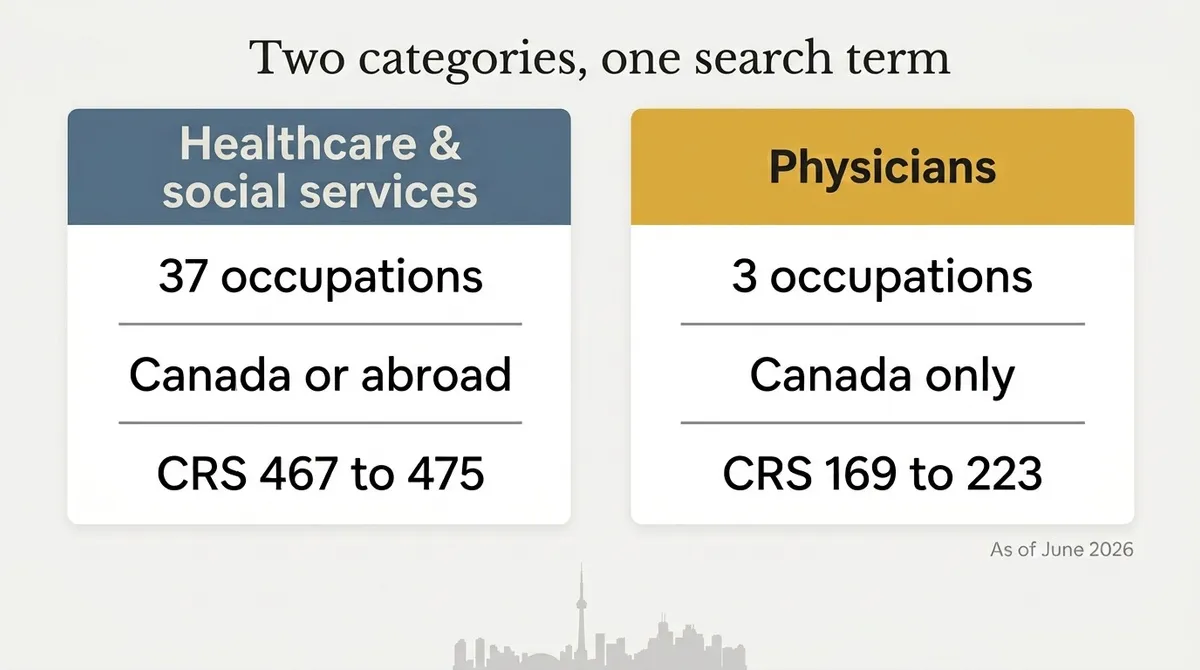
The important thing to understand about 2026 is that healthcare is no longer one category. It is two, and they behave completely differently. Anyone reading a single cut-off figure for Express Entry draws and applying it to their own situation may be looking at a number that has nothing to do with them.
Category rounds do not change how Express Entry works. You still need a profile, you are still ranked by CRS, and you still compete on score. The only difference is who you compete against.
Two Separate Healthcare Categories Operate in 2026
IRCC restructured category-based selection on February 18, 2026. Ten categories are now active, and two of them cover healthcare workers.
Healthcare and Social Services Occupations
This is the large, long-running category, covering 37 occupations across TEER levels 1 to 3. It reaches well beyond clinical roles into allied health, pharmacy, personal care, and social services, and the full list appears further down this page.
Qualifying experience for this category may be gained in Canada or abroad. That matters enormously, because it means an overseas nurse with no Canadian history can compete here on equal footing.
Physicians With Canadian Work Experience
Added in December 2025, this category is narrow and restrictive in ways the broader one is not. It is limited to a small set of physician occupation codes, and the qualifying experience must have been gained in Canada. A doctor practising abroad does not qualify for this category, though they may still qualify under the broader healthcare category.
Because the eligible pool is small, cut-offs have fallen dramatically. IRCC has been able to invite close to everyone who qualifies in a single round.
Eligible Healthcare and Social Services Occupations
The occupations below were the eligible list for the healthcare and social services category as it stood for round #398, held on February 20, 2026. IRCC revises category lists between cycles, so treat this as a dated reference and confirm your own code against the official page before you rely on it.
Your eligibility rests on the occupation code that matches the duties you actually performed, not on the job title your employer uses. Two people with identical titles can hold different codes, and the wrong code on a profile can cost an invitation quietly, without any notification that it happened.
| Occupation | 2021 NOC | TEER |
|---|---|---|
| Audiologists and speech-language pathologists | 31112 | 1 |
| Cardiology technologists and electrophysiological diagnostic technologists | 32123 | 2 |
| Chiropractors | 31201 | 1 |
| Dental hygienists and dental therapists | 32111 | 2 |
| Dentists | 31110 | 1 |
| Dietitians and nutritionists | 31121 | 1 |
| General practitioners and family physicians | 31102 | 1 |
| Licensed practical nurses | 32101 | 2 |
| Massage therapists | 32201 | 2 |
| Medical laboratory assistants and related technical occupations | 33101 | 3 |
| Medical laboratory technologists | 32120 | 2 |
| Medical radiation technologists | 32121 | 2 |
| Medical sonographers | 32122 | 2 |
| Nurse aides, orderlies and patient service associates | 33102 | 3 |
| Nurse practitioners | 31302 | 1 |
| Nursing co-ordinators and supervisors | 31300 | 1 |
| Occupational therapists | 31203 | 1 |
| Optometrists | 31111 | 1 |
| Other assisting occupations in support of health services | 33109 | 3 |
| Other practitioners of natural healing | 32209 | 2 |
| Other professional occupations in health diagnosing and treating | 31209 | 1 |
| Other technical occupations in therapy and assessment | 32109 | 2 |
| Paramedical occupations | 32102 | 2 |
| Pharmacists | 31120 | 1 |
| Pharmacy technical assistants and pharmacy assistants | 33103 | 3 |
| Pharmacy technicians | 32124 | 2 |
| Physician assistants, midwives and allied health professionals | 31303 | 1 |
| Physiotherapists | 31202 | 1 |
| Psychologists | 31200 | 1 |
| Registered nurses and registered psychiatric nurses | 31301 | 1 |
| Respiratory therapists, clinical perfusionists and cardiopulmonary technologists | 32103 | 2 |
| Social and community service workers | 42201 | 2 |
| Social workers | 41300 | 1 |
| Specialists in clinical and laboratory medicine | 31100 | 1 |
| Specialists in surgery | 31101 | 1 |
| Traditional Chinese medicine practitioners and acupuncturists | 32200 | 2 |
| Veterinarians | 31103 | 1 |
Three codes on this list are worth a second look. Specialists in clinical and laboratory medicine, specialists in surgery, and general practitioners and family physicians appear here, and they are also the three codes that make up the separate physicians category. A doctor with Canadian experience is therefore eligible in both, and can be invited through whichever round comes first, which in practice has meant a far lower threshold through the physicians route.
Healthcare Draw Cut-Off Scores in 2026
The figures below are a snapshot of rounds held earlier in 2026 and are provided for orientation only. Cut-offs are set fresh in every round and move with the size of the pool and the number of invitations issued. Confirm current results before relying on any number here.
| Date | Category | Invitations | CRS cut-off |
|---|---|---|---|
| February 19, 2026 | Physicians with Canadian work experience | Limited round | 169 |
| February 20, 2026 | Healthcare and social services | 4,000 | 467 |
| June 25, 2026 | Healthcare and social services | 4,000 | 475 |
The gap between the two categories is the point. Healthcare and social services rounds have clustered in the high 460s and mid 470s, consistent with the 460 to 480 band seen through 2025. Physician rounds in the same period have run between roughly 169 and 223. That is a difference of more than 250 points between two categories that both get described online as healthcare draws.
For context, general and Canadian Experience Class rounds over the same months sat in the low 500s. A nurse at 470 who assumes they are out of contention because they are comparing themselves to a general cut-off has misread their own position.
Eligibility Requirements for a Healthcare Category Round
Four conditions have to hold at the moment a round is run.
- An active Express Entry profile, eligible under the Federal Skilled Worker Program, Federal Skilled Trades Program, or Canadian Experience Class. Category rounds draw only from the existing pool.
- Work experience in a listed occupation. Your primary occupation code must appear on IRCC's current list for that category. Adjacent or similar roles do not count.
- The minimum experience threshold, met within the past three years, in a single eligible occupation.
- A CRS score at or above the cut-off set in that round, with profile submission before the tie-break date and time IRCC specifies.
There is no separate application. You do not opt in to a category or tell IRCC you want to be considered. The system identifies eligible candidates from the pool automatically based on what your profile already says, which is exactly why an inaccurate occupation code can quietly cost you an invitation you would otherwise have received.
The Experience Threshold Doubled in February 2026
This change caught many candidates out. The minimum work experience for the renewed occupation categories rose from six months to twelve months, effective February 18, 2026.
Anyone who qualified under the old six-month threshold and has not since accumulated a full year no longer meets the criteria. Profiles created before the change were not exempted. If you built your profile on the basis of six months of nursing experience in 2025, check where you now stand before assuming you are still in the category.
The agriculture and agri-food category was retired at the same time, which is worth knowing if you were previously relying on it.
Improving Your Position Before the Next Healthcare Round
Because category rounds still rank by score, the levers are the ordinary ones, and language remains the fastest. Test results arrive within days and count twice, once directly and once through skill transferability. French adds further points and opens the separate French-language category, which has cut off lower than healthcare in 2026.
A provincial nomination remains the largest single addition at 600 points, and several provincial nominee programs run healthcare-specific streams. Before pursuing any of that, model where you actually stand using our CRS score calculator, since the right move depends entirely on which factors you are currently losing points on.
Verify your occupation code against the official list rather than a summary, because the list is revised between cycles and an outdated version circulates widely. IRCC publishes the current categories and eligible occupations on its category-based selection page, and every completed round is recorded on the rounds of invitations page.
If you work in healthcare and are unsure which category you fall into or whether your occupation code is right, SEP Immigration can check your profile against the current list and tell you what would move your score fastest. Sepehr Falahati is a licensed immigration consultant with the College of Immigration and Citizenship Consultants (CICC/IRB, R533959).
This page is general information and not legal advice, and Express Entry categories, eligible occupations, and cut-off scores change frequently. Verify current categories and round results against the Government of Canada Express Entry pages at canada.ca before acting. Information current as of September 2026.
Frequently asked questions
01Can I qualify for a healthcare draw with experience gained outside Canada?
Yes, for the healthcare and social services category, which accepts qualifying experience gained in Canada or abroad. The separate physicians category is different and requires the experience to have been gained in Canada.
02When is the next healthcare draw?
IRCC does not announce rounds in advance, and no private website knows the date, size, or cut-off of the next one. Rounds are held at the department's discretion based on labour market needs and how many invitations remain allocated to the category, so intervals have ranged from a few weeks to a few months.
03Can I be eligible for more than one category at the same time?
Yes. Candidates commonly qualify for both an occupation category and the French-language category, and IRCC will consider you in any round you meet the criteria for. Being eligible for two categories does not raise your CRS score, but it does give you more chances to be invited.
04Does a healthcare job offer in Canada add points to my score?
No. Job offer points were removed from the Comprehensive Ranking System in March 2025. A job offer can still support eligibility for many provincial streams, and it remains valuable for that reason, but it no longer adds points directly.
05Do personal support workers qualify for healthcare category rounds?
The category extends beyond regulated professions into personal care and community service roles, but eligibility depends on the specific occupation code rather than the job title your employer uses. Check your code against IRCC's published list, since two people with the same job title can hold different codes.
Stay informed
Get our immigration updates first on Google
Add SEP Immigration as a preferred source and our latest news and guides appear more often in your Google results.
About the Author

Sepehr Falahati
CEO of SEP Immigration
- CICC Licensed
- RCIC #R533959
- IRB Member
Sepehr Falahati is a Regulated Canadian Immigration Consultant (RCIC #R533959), licensed by the College of Immigration and Citizenship Consultants (CICC).
Read more about Sepehr FalahatiReviewed By


Continue Reading