
PR Residency Obligation: The 730-Day Rule Explained
Reviewed by Mohsen Khorvash and Mahsa Barati

Every Canadian permanent resident carries the same condition: at least 730 days of residence in Canada within each five-year period. It is the one obligation attached to permanent resident status, and it is where most people lose that status, usually without realising how close to the line they were.
Two years out of five sounds generous, and it is. The difficulty is rarely the arithmetic. It is that the 730 days do not all have to be spent in Canada, the five-year window moves rather than sitting still, and falling short does not work the way people assume. Most of the anxiety around this rule comes from those three misunderstandings rather than from the threshold itself.
The obligation also has nothing to do with your card. An expired card is a travel problem solved by a PR card renewal, not a status problem. Our answers to common PR card questions cover that side. And the obligation disappears entirely once you become a Canadian citizen, which is why anyone who expects to live abroad long term should be thinking about timing early.
The 730-Day Rule Applies to Every Rolling Five-Year Period
The days do not need to be consecutive. You can accumulate them in any pattern across the five years. What matters is that at the moment you are assessed, whether by a visa officer deciding a travel document application or a border services officer on arrival, the preceding five years contain at least 730 qualifying days.
Because the window rolls, your position changes continuously. Days from more than five years ago drop off the back of the calculation as time passes, so a person who complied comfortably two years ago can fall out of compliance without leaving Canada again, simply because older days aged out. Anyone spending significant time abroad should be counting forward, not backward.
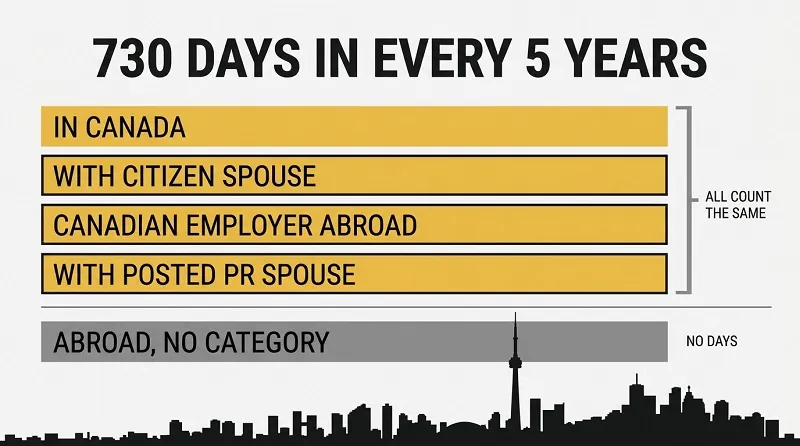
Four Ways to Accumulate Days Toward the Residency Obligation
| Category | What it covers |
|---|---|
| Physical presence | Any day you were in Canada, including arrival and departure days |
| Accompanying a Canadian citizen | Days outside Canada with a citizen spouse or common-law partner, or with a citizen parent if you are a child |
| Employment abroad | Days outside Canada employed full-time by a Canadian business or in the federal, provincial or territorial public administration |
| Accompanying an employed permanent resident | Days outside Canada with a PR spouse, common-law partner, or parent if you are a child, where that person qualifies under the employment category |
Accompanying a Canadian Citizen Spouse or Parent Abroad
This is the most useful and the most frequently misapplied provision. The person you accompany must hold Canadian citizenship, not permanent residence. Two permanent residents living abroad together accumulate nothing under this heading, whatever their circumstances.
"Accompanying" also means what it says. The Regulations require that you ordinarily reside with the person, which means a shared household rather than a marriage conducted across two countries with periodic visits. Officers look for joint tenancy or ownership documents, shared accounts and correspondence showing both names at one address. The relationship must also be genuine and must have existed during the period you are claiming.
Full-Time Employment Abroad With a Canadian Business
The employment category is narrower than its plain wording suggests. The employer must be a Canadian business, and you must be assigned to a position outside Canada as a term of that employment while continuing to be employed by that business. Being hired locally by a foreign subsidiary, or taking a permanent overseas posting that severs the connection to the Canadian operation, generally does not qualify.
Where the category does apply, it is broad in one respect: holidays and leave taken while employed under a qualifying assignment count as well, because the test is the employment relationship rather than where you were on a given day.
How the Five-Year Window Is Measured
Two different calculations apply depending on how long you have held status, and confusing them causes unnecessary alarm among newer permanent residents.
Permanent Residents of Five Years or More
Only the five-year period immediately before the assessment is examined. Nothing earlier is relevant. IRCC's guidance makes the practical consequence explicit: a person who lived outside Canada for many years but then returned and accumulated 730 days within the most recent five-year period complies with the obligation and remains a permanent resident. A long absence in the past is not a permanent mark.
Permanent Residents of Less Than Five Years
Here the test looks forward rather than back, because the first five-year period has not finished. The question is whether you will be able to meet 730 days by the time it does. IRCC instructs officers not to exclude the possibility that someone who has already spent three years abroad could still comply during the remaining two years. A new permanent resident with a long absence behind them is therefore not automatically in breach, which is the opposite of what most people in that position assume.
Falling Short of 730 Days Does Not Automatically End Your Status
Permanent residence is not lost by arithmetic. It ends only through a formal determination that you have failed the obligation, an enforced removal order, an approved renunciation, or becoming a citizen. Until one of those happens, and until any appeal is finally decided, you remain a permanent resident with all the rights that carries.
One of those rights matters a great deal at the border. A permanent resident who arrives at a Canadian port of entry and can establish their status has a right to enter the country, even where the officer believes the obligation has not been met. The officer may prepare a report that starts the determination process, and that report may lead to an admissibility hearing, but you are not turned away at the door. The people genuinely at risk of being stranded are those outside Canada without a valid card.
Returning to Canada Without a Valid PR Card
If your card has expired while you are abroad and you intend to return by commercial carrier, you need a permanent resident travel document, and the application for it is where the obligation gets assessed. Approved applications are issued with a code recording the basis of the decision: that the applicant meets or can still meet the obligation, that humanitarian and compassionate factors overcame a breach, or that an appeal is pending or has not yet expired.
That last category is worth understanding before you apply. Where an application is refused but the applicant was in Canada at least once in the preceding 365 days, a travel document can still be issued so the person can return while the appeal proceeds. A refusal is not necessarily the end of the road, but the timing is tight and the route depends on facts that are fixed before you file.
Humanitarian and Compassionate Relief for a Breach
Where the obligation has not been met, an officer may still find that humanitarian and compassionate considerations justify retaining status, taking into account the best interests of any child directly affected. This is discretionary and is not a second threshold you can plan around, but it is the provision that saves genuinely sympathetic cases. IRCC sets out how officers weigh both the day count and these factors in its guidance on permanent resident status determination.
What tends to persuade is a reason for the absence that was outside the person's control and a clear picture of establishment in Canada. Caring for a dying parent abroad, a medical condition that prevented travel, or a child's circumstances carry weight. Career convenience does not.
Appeal Routes After a Negative Residency Determination
Which appeal you file depends on where you were when the decision was made, and filing the wrong one wastes the deadline. If you applied for a travel document from outside Canada and were refused, you make a residency obligation appeal. If you were in Canada and received a removal order for the same failure, you make a removal order appeal instead. Both go to the Immigration Appeal Division, and the deadline is short, so the decision letter should go to a representative immediately rather than after a period of consideration. The IRB explains the distinction on its page about the residency obligation appeal, and SEP's page on immigration appeals covers how these hearings run.
Evidence That Supports a Residency Obligation Case
These cases are won and lost on records. Passport stamps alone are rarely enough, because they are incomplete and often illegible. Build the count from entry and exit records, employment letters covering the full period of any assignment abroad, tax filings, lease or property documents, and the relationship and cohabitation evidence needed for an accompanying claim.
Where a decision has already gone against you and the reasoning is unclear, your GCMS notes record what the officer actually relied on. Reading them before an appeal is the difference between answering the real concern and arguing against a guess.
How SEP Immigration Helps
Most residency obligation problems are more recoverable than they look, but the options narrow quickly once a decision has been made and a deadline is running. SEP Immigration, led by Sepehr Falahati (CICC and IRB member R533959), audits your day count against the credited categories, identifies whether an appeal or a humanitarian submission is the stronger route, and assembles the records that decide these cases.
Frequently asked questions
01Do partial days in Canada count toward the 730 days?
Yes. A day on which you were in Canada for any part of the day counts as a full day, so your arrival day and departure day each count. Over years of frequent travel this makes a real difference, and it is a common reason people underestimate their own total.
02Does time in Canada before I became a permanent resident count?
No. The obligation runs from the day you became a permanent resident. Years spent here as a student or worker before landing do not count toward the 730 days, though that same time may count toward the separate physical presence requirement for citizenship.
03Does an expired PR card mean I have lost my status?
No. IRCC states this directly. The card is evidence of status and a travel document, not the status itself, and status ends only through a formal determination, an enforced removal order, approved renunciation, or becoming a citizen.
04Can an airline stop me from boarding if I am short of 730 days?
Carriers check documents, not day counts. They verify whether you hold a valid PR card or travel document and have no authority to assess your obligation, which is examined by IRCC on a travel document application or by an officer when you arrive.
05Can I apply for citizenship if I am short on the residency obligation?
Citizenship uses a stricter test: 1,095 days of actual physical presence in the five years before applying, with none of the credited absences available. Someone living abroad with a Canadian citizen spouse can hold permanent residence indefinitely on that basis while never becoming eligible for citizenship.
06Does renouncing permanent resident status stop a residency determination?
Renunciation is a formal application rather than a way of avoiding an assessment already under way, and it suits only those who have decided not to return. Once approved you cease to be a permanent resident, the decision cannot be appealed, and any pending citizenship application is refused.
Stay informed
Get our immigration updates first on Google
Add SEP Immigration as a preferred source and our latest news and guides appear more often in your Google results.
About the Author

Sepehr Falahati
CEO of SEP Immigration
- CICC Licensed
- RCIC #R533959
- IRB Member
Sepehr Falahati is a Regulated Canadian Immigration Consultant (RCIC #R533959), licensed by the College of Immigration and Citizenship Consultants (CICC).
Read more about Sepehr FalahatiReviewed By


Continue Reading