
Super Visa Income Requirements in Canada
Reviewed by Mohsen Khorvash and Mahsa Barati

Money is the part of a super visa application that most often decides the outcome. The parent or grandparent applying does not need to show any income of their own in most cases. The host in Canada does, and the amount depends entirely on how many people that host is financially responsible for.
IRCC changed how this is calculated on March 31, 2026. Hosts now have two separate ways to satisfy the income test rather than one, and for the first time the visiting parent or grandparent can contribute their own income toward the total. Families who were refused or discouraged under the previous single year rule should look at the requirement again.
The test is also lighter than the one that applies when you sponsor parents and grandparents for permanent residence, which is a point of frequent confusion. Income is only one part of the file, alongside the medical exam and private medical insurance the applicant must hold.
The Minimum Necessary Income Standard for a Super Visa
The threshold is the Low Income Cut-Off, or LICO, published annually by Statistics Canada for urban areas of 500,000 people or more. IRCC calls the resulting figure the minimum necessary income. It is a before-tax number, so the amount an officer compares against the threshold is gross income, not take-home pay.
The host must meet or exceed the figure for their family size, and must continue to meet it from the day the application is filed until the day a decision is made. There is no separate application to be approved as a host. The income evidence travels with the applicant's file.
Minimum Necessary Income by Family Size
These are the figures IRCC currently applies. Statistics Canada revises LICO each year, so confirm the table against the official source on the day you file.
| Number of family members | Minimum income the host needs (CAD) |
|---|---|
| 1 | $30,526 |
| 2 | $38,002 |
| 3 | $46,720 |
| 4 | $56,724 |
| 5 | $64,336 |
| 6 | $72,560 |
| 7 | $80,784 |
| Each additional family member | Add $8,224 |
Counting Family Size Correctly Before Checking the Table
Family size is where most miscalculations happen, and getting it wrong by one person can move the target by several thousand dollars. The count is not a household count. It captures everyone the host carries a financial responsibility for, whether or not they live in Canada or under the same roof.
People Who Must Be Included in the Count
- The host child or grandchild in Canada.
- The host's spouse or common-law partner, which can include a separated spouse.
- Dependent children of the host and of the host's spouse or partner, counted regardless of custody arrangements or child support.
- Every parent or grandparent named in this application, so two parents applying together add two.
- Parents or grandparents already holding a super visa under a letter of invitation from the host or their partner that still applies.
- Anyone the host or co-signer previously sponsored where the undertaking has not yet expired.
Worked Examples of Family Size
A single host with no partner and no children inviting one parent has a family size of two, and needs $38,002.
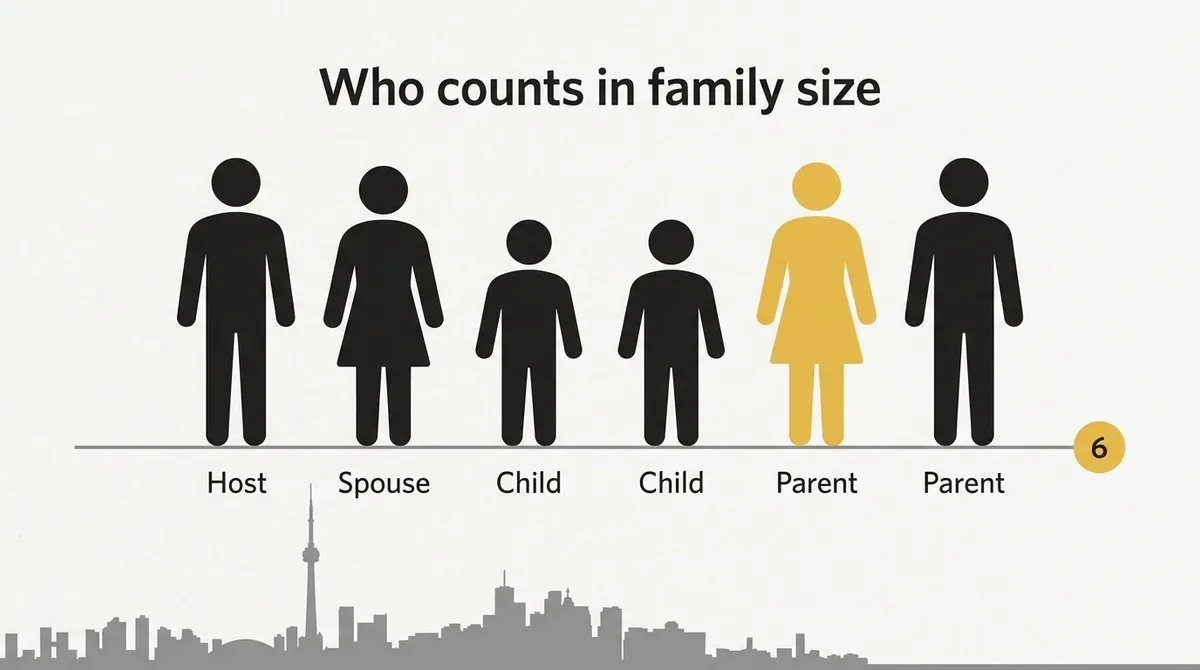
A married host with two young children inviting both parents has a family size of six. Two adults, two children, two applicants, giving a target of $72,560. The children count even though they are not part of the visa application.
A host who is divorced and shares custody of two children, inviting both parents, still counts those children in full. That is a family size of five and a target of $64,336. Shared custody does not entitle you to count a child as a half.
A host whose spouse is already hosting their own two parents on super visas must add those two people, even if they are currently outside Canada. The undertaking or invitation is what counts, not physical presence.
Two Ways to Meet the Super Visa Income Requirement
Since March 31, 2026, IRCC accepts either of the following. A host only needs to satisfy one.
Option One Uses Either of the Two Most Recent Tax Years
The host, together with a co-signing spouse or common-law partner if there is one, meets or exceeds the threshold in either of the two taxation years before the application is submitted. Not both years. Whichever of the two is stronger.
This matters for anyone whose income dipped recently. A parental leave, a job change, a slow year for a self-employed host, or a period of illness no longer disqualifies a family if the year before it was solid. The notice of assessment from the Canada Revenue Agency is the document required here.
Option Two Combines Host Income at Seventy-Five Percent With the Applicant's Own Income
If neither year clears the bar on its own, the host can qualify by reaching at least 75 percent of the threshold in the year before the application, then adding the visiting parent's or grandparent's income to cover the shortfall. The combined figure must meet or exceed the full amount.
The 75 percent floor is not optional. A host who reaches only half the threshold cannot make up the rest from the applicant's pension, however large that pension is. The applicant's income supplements the host's income and does not replace it.
Two details are easy to miss. The applicant must prove the income will continue while they are in Canada, and the document proving it has to state the currency they are paid in. Foreign income is not automatically excluded, which contradicts what several sources claim, but it does have to be documented as ongoing.
Documents That Prove the Income Requirement
Under Option One, the CRA notice of assessment is the required document, and there is no substitute for it.
Under Option Two the notice of assessment is preferred but not mandatory. If the host cannot produce one, IRCC accepts alternatives including the T4 or T1 for the last tax year, pay stubs covering the most recent twelve month period, an original employer letter stating job title, job description and salary, bank statements from the last calendar year showing investment income or regular employment and pension deposits, or proof of other income such as pension statements and rental leases showing rent amount and frequency.
An applicant contributing their own income under Option Two can use the same categories of document, minus the CRA records, plus the proof of continuing income described above.
Income Mistakes That Lead to Super Visa Refusals
- Undercounting family size. Forgetting a dependent child who lives with a former partner, or a previously sponsored relative whose undertaking is still running.
- Using net income. The threshold is a before-tax figure.
- Assuming both tax years must qualify. Under Option One, one qualifying year is enough.
- Adding the applicant's income without reaching the 75 percent floor. The combination only works above that line.
- Submitting an applicant income document with no currency stated or nothing showing the income continues after arrival.
- Relying on a relative other than a spouse. Only the host's spouse or common-law partner can co-sign and contribute income.
How the Super Visa Income Test Differs From Sponsorship
The super visa and the permanent residence route for parents and grandparents use different financial standards, and treating them as interchangeable produces the wrong number.
The super visa uses plain LICO for a single qualifying year, or the 75 percent combination. Permanent residence sponsorship under the Parents and Grandparents Program requires the minimum necessary income plus an additional 30 percent, met across three consecutive taxation years, together with a twenty year undertaking to repay any social assistance the sponsored person receives. The published rules for both sit on the IRCC page on proof of financial support.
A host who cannot meet the sponsorship standard may still comfortably meet the super visa standard. That gap is the reason the super visa remains the practical route for many families while permanent residence intakes stay limited. The legal basis for the current test is set out in the Ministerial Instructions that took effect on March 31, 2026.
If your income sits close to the threshold, or your family size is genuinely difficult to calculate, a review before filing costs far less than a refusal. SEP Immigration can assess which of the two options fits your situation and what evidence will support it.
This page is general information and not legal advice, and program details change without notice. Verify current figures and requirements against the Government of Canada super visa pages at canada.ca before applying. Information current as of September 2026.
Frequently asked questions
01Are applications filed before March 31, 2026 assessed under the new income rules?
Yes. Applications that were in processing when the current Ministerial Instructions took effect are assessed under them. Families who now qualify through one of the two calculation methods will generally need to submit the supporting documents showing they meet the requirement, since the original file may not contain them.
02Can a sibling or another relative co-sign to help meet the income requirement?
No. Only the host's spouse or common-law partner can co-sign the letter of invitation and have their income counted. Siblings, other children, and extended family cannot contribute to the calculation, regardless of what they earn.
03Is the host's income checked again after the super visa is approved?
The requirement applies from the day the application is filed until a decision is made. There is no annual reassessment of the host's income once the visa has been issued.
04Does gross or net income count toward the minimum necessary income?
Gross. The threshold is defined as a before-tax annual income figure, so the comparison is against total income before deductions.
05Does a refusal for insufficient income prevent applying again?
No. A refusal does not bar a new application, and a fresh application is assessed on the documents filed with it. If the shortfall was the reason, the practical question is whether a different qualifying tax year, a corrected family size count, or the combined income route changes the arithmetic.
Stay informed
Get our immigration updates first on Google
Add SEP Immigration as a preferred source and our latest news and guides appear more often in your Google results.
About the Author

Sepehr Falahati
CEO of SEP Immigration
- CICC Licensed
- RCIC #R533959
- IRB Member
Sepehr Falahati is a Regulated Canadian Immigration Consultant (RCIC #R533959), licensed by the College of Immigration and Citizenship Consultants (CICC).
Read more about Sepehr FalahatiReviewed By


Continue Reading