
Inland vs Outland Spousal Sponsorship
Reviewed by Mohsen Khorvash and Mahsa Barati

Couples starting a spousal sponsorship application have to pick a stream before they file anything else, and the choice is difficult to undo. It determines how long the file takes, whether the sponsored partner can leave Canada, and what happens if the application is refused.
Most guidance on this decision was written before 2023 and is now misleading. The old rule of thumb was that inland bought you a work permit at the cost of appeal rights and a longer wait. That trade-off no longer applies to a couple already in Canada, which changes the answer for a large share of applicants.
Inland and Outland Sponsorship Explained
Neither term appears on an IRCC form. They are shorthand for two different classes of application with different legal foundations.
The Spouse or Common-Law Partner in Canada Class
Inland refers to an application under the spouse or common-law partner in Canada class. It is available where the sponsored partner is already in Canada holding valid temporary status as a visitor, worker or student, and where the couple are living together. Cohabitation is a genuine requirement of the class rather than a formality, and it must continue while the file is processed.
The Family Class
Outland refers to an application under the Family Class. Despite the name, it does not require the sponsored partner to be outside Canada. A partner who is physically in Canada can be sponsored under the Family Class, and the file is still processed by a visa office abroad, normally the one serving their country of nationality or residence.
Who Can Use Each Stream
Two eligibility rules narrow the choice before anything else is considered. Only Canadian citizens may sponsor while living outside Canada, and they have to show they will return once their partner lands. A permanent resident sponsor must be residing in Canada. Separately, conjugal partner applications can only be made under the Family Class, so couples in that category have no choice to make. The same class distinctions apply to common-law partner sponsorship.
Inland vs Outland Spousal Sponsorship Compared
The differences that actually change outcomes are set out below, followed by the three that carry the most weight.
| Factor | Inland | Outland |
|---|---|---|
| Application class | Spouse or common-law partner in Canada | Family Class |
| Where the partner must be | In Canada with valid temporary status | Inside or outside Canada |
| Cohabitation required | Yes, throughout processing | No |
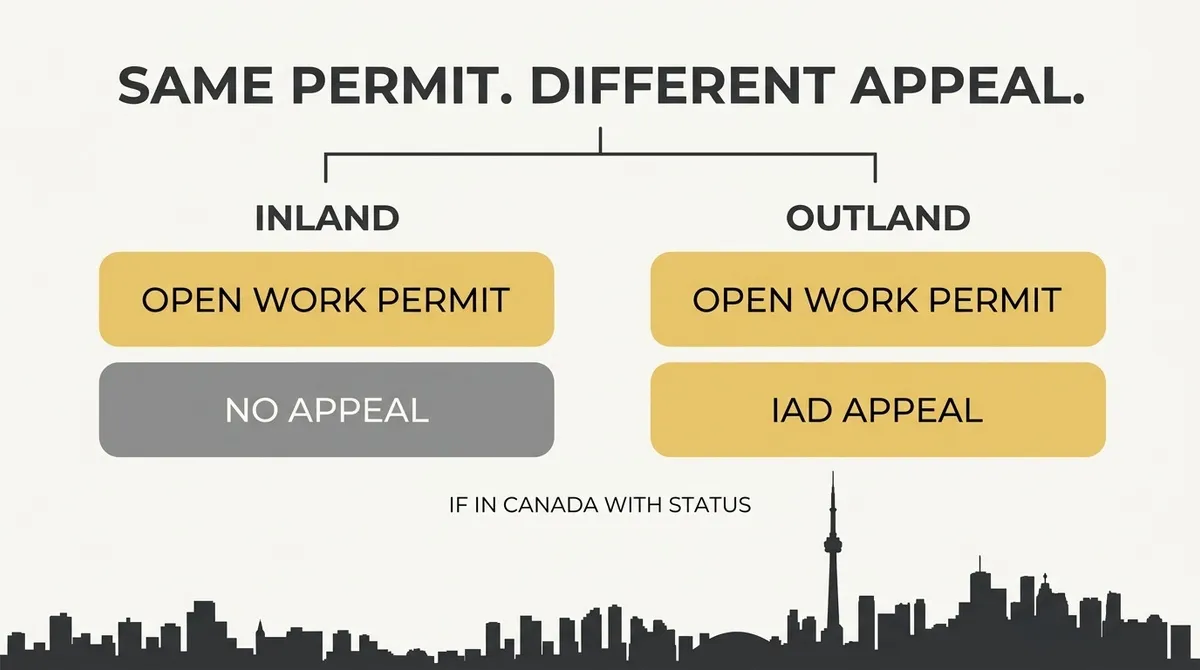
| Open work permit | Available if in Canada with status | Available if in Canada with status |
| Travel during processing | Leaving Canada carries real risk | Free to travel |
| Appeal if refused | No appeal, judicial review only | Appeal to the Immigration Appeal Division |
| Conjugal partners | Not eligible | Eligible |
| Permanent resident sponsor abroad | Not eligible | Not eligible |
Processing Times Currently Favour Outland
Outland has been faster than inland for some time, and the gap is not small. IRCC figures published in July 2026 put outland at roughly 17 months and inland at roughly 27 months for applications outside Quebec. Those are snapshots of an eighty per cent completion rate rather than promises, they move monthly, and outland times vary sharply between visa offices. Check the current figure on IRCC's processing times tool before treating any number as a planning assumption.
Appeal Rights Are Lost on Inland
This is the difference couples most often discover too late. An outland refusal under the Family Class generally carries a right of appeal to the Immigration Appeal Division, which can reconsider the relationship on its merits and accept evidence that was not in the original file. A genuine couple with a thin application gets a real second chance.
An inland refusal does not. What remains is judicial review at the Federal Court, which asks only whether the officer's decision was reasonable, not whether the relationship is genuine. It is a materially harder and more expensive route. Our page on the spousal sponsorship appeal process sets out how the Division works, and the spousal sponsorship interview guide explains why this matters most for couples called to an interview.
Travel and Status Carry Risk on Inland
The in-Canada class assumes the couple stay in Canada. A sponsored partner who leaves and is refused re-entry can lose the application itself, not merely delay it, since the class requires them to be in Canada. Outland applicants face no equivalent restriction and can come and go while the file is processed.
Maintaining status is the parallel obligation. The partner must hold valid temporary status when the inland application is filed, and letting it lapse during a two-year wait creates problems that are recoverable but slow.
The Open Work Permit No Longer Decides the Choice
The single most common reason couples pick inland is work authorization, and it has been the wrong reason since 2023.
How the Public Policy Works
A temporary public policy allows a sponsored partner who is physically in Canada with valid temporary status to apply for an open work permit under LMIA exemption code A74. The instructions cover applicants in the spouse or common-law partner in Canada class and applicants in the Family Class alike, so an outland applicant living in Canada can obtain the same open work permit an inland applicant can, on the same terms.
The permit is normally applied for after the acknowledgement of receipt arrives on the sponsorship application, and the policy conditions are assessed at the time the work permit is decided rather than when it is submitted. The policy runs to the end of December 2026 and has been extended before, but it is temporary, so its status should be confirmed rather than assumed.

What the January 2025 Restrictions Did Not Change
Open work permit eligibility was cut back sharply in January 2025 for spouses of foreign workers and again in March 2026 for spouses of international students. Neither change touches sponsored partners. Those restrictions apply to the C41 and C42 codes, where eligibility flows from the principal applicant's occupation or study programme. Eligibility under A74 flows from the sponsorship application itself, so a sponsored partner is unaffected by TEER levels and programme lists.
Who Still Cannot Work
The policy has one hard limit worth being clear about. It reaches only partners who are physically in Canada with status. A partner waiting abroad cannot obtain a work permit through the sponsorship, whichever stream was used, so for couples separated by distance the work permit is not a factor in the decision at all. The current conditions are set out in IRCC's program delivery instructions for the A74 public policy.
Choosing Between Inland and Outland
With work authorization removed from the equation, the choice comes down to where the partner is, whether they need to travel, and how much protection the couple wants if the file goes wrong.
When Outland Is the Stronger Choice
Outland suits most couples where either option is open. It has been processing faster, it preserves the appeal right, it leaves the partner free to travel for work or family emergencies, and where that partner is in Canada with status it now carries the same access to an open work permit. Couples whose relationship evidence is thin, whose courtship was short, or who have any feature likely to attract scrutiny have a particular reason to keep the appeal route available.
When Inland Still Makes Sense
Inland remains sensible for couples settled together in Canada with no intention of travelling and straightforward, well-documented relationships. It keeps the file within Canada rather than routing it through a visa office whose workload is outside anyone's control, which some couples reasonably prefer. The trade-off is that the appeal right is given up, and that should be a deliberate decision rather than a by-product of chasing a work permit.
Quebec Applications Follow a Separate Track
Couples settling in Quebec face a second stage. The province assesses the sponsorship undertaking through its own ministry before federal processing concludes, and both streams take substantially longer as a result. Quebec also sets intake limits on undertakings, so timing matters more there than elsewhere.
If you are weighing the two streams and your partner is already in Canada, the calculation has changed enough that older advice is worth setting aside. SEP Immigration, led by Sepehr Falahati (RCIC, CICC and IRB member R533959), can review your circumstances and confirm which stream fits before you file.
Frequently asked questions
01Can a permanent resident sponsor a spouse from outside Canada?
No. Only Canadian citizens may sponsor while living outside Canada, and they must show they will return once their partner becomes a permanent resident. A permanent resident sponsor has to be residing in Canada. That restricts the sponsor rather than the stream, so a permanent resident living in Canada can still file either way depending on where their partner is.
02What happens if the sponsored partner loses status during an inland application?
Falling out of status during processing is more common than most people expect and is not automatically fatal. A separate paper route exists under the public policy for applicants without valid status, but it generally requires approval in principle on the permanent residence application first. The safer course is to keep status current throughout, applying to extend well before expiry rather than relying on a recovery route.
03Can a couple switch from inland to outland after applying?
Not by amending the existing file. Changing stream means withdrawing and filing again under the other class, which means rejoining the queue and paying the fees again. Given how long these applications run, a late stream change rarely saves time, which is why the choice deserves attention before filing.
04Does a conjugal partner have a choice between the two streams?
No. Conjugal partner applications must be made under the Family Class. The category exists for couples who cannot marry or live together because of barriers outside their control, so the circumstances that qualify a couple for it are the same ones that rule out the in-Canada class.
05Is outland sponsorship processed by the visa office in the partner's home country?
Usually, though not always. Outland files are normally assigned to the office serving the sponsored person's country of nationality or residence, and workloads vary considerably between offices. Two couples filing on the same day can wait very different lengths of time purely because of which office holds the file, which is why a national average is a rough guide rather than a prediction.
Stay informed
Get our immigration updates first on Google
Add SEP Immigration as a preferred source and our latest news and guides appear more often in your Google results.
About the Author

Sepehr Falahati
CEO of SEP Immigration
- CICC Licensed
- RCIC #R533959
- IRB Member
Sepehr Falahati is a Regulated Canadian Immigration Consultant (RCIC #R533959), licensed by the College of Immigration and Citizenship Consultants (CICC).
Read more about Sepehr FalahatiReviewed By


Continue Reading