
Work Permit Options for IT Workers in Canada
Reviewed by Mohsen Khorvash and Mahsa Barati

Canada's technology hiring routes are unusually confusing, partly because several of the most publicised ones either closed years ago or were announced and never launched. Guidance still circulating online lists programs that cannot be applied to.
What follows separates the routes that are open from the ones that are not, and treats the technology sector specifically rather than the general categories set out in our guide to LMIA exemptions.
Fast-Track Work Permits Under the Global Talent Stream
This is the main route for a Canadian technology employer hiring from abroad, and it is faster than anything else available.
Category A Requires a Designated Partner Referral
Category A covers unique and specialized talent, and the employer has to be referred by a designated organisation before applying. Those partners include innovation agencies, venture and development bodies and certain research organisations. There is no occupation list to satisfy, but the referral is a real gate: an employer without an existing relationship to a designated partner usually finds Category B the more accessible route.
Category B Uses the Global Talent Occupations List
Category B works from a published occupations list covering software engineers, data scientists, developers, information systems roles and a range of engineering and research positions. The occupation code has to appear on the list, and a technical sounding job title does not qualify a role whose code is absent. The list has been revised several times since the stream launched, so it needs checking rather than assuming.
The Labour Market Benefits Plan Employers Must Submit
Instead of the transition plan required in other high-wage streams, employers commit to a Labour Market Benefits Plan setting out what the hire will deliver for the Canadian labour market, such as job creation, skills transfer or investment in training. Progress against it is reviewed, so it functions as an undertaking rather than a form.
The published service standards are ten business days for the assessment and a two-week target for the permit, which makes four to six weeks realistic end to end. That is against roughly two to six months for a standard route, and it is the reason the stream exists.
LMIA-Exempt Routes for Technology Workers
The Global Talent Stream is fast but it is still an assessment. Three routes skip the assessment entirely, and each fits a different situation.
CUSMA Professionals in Computer Occupations
American and Mexican citizens with a pre-arranged job offer in a listed profession can work without an assessment, and computer systems analysts sit on that list. The occupation has to genuinely match the listed profession rather than the job title, which is where most refusals in this category come from. Our page on the CUSMA professional work permit covers the credential requirements.
Intra-Company Transfers for Specialized Knowledge
A multinational moving an engineer or architect into a Canadian branch, subsidiary or affiliate can use Intra-Company Transfers, generally needing a year of continuous full-time employment with the foreign entity in the past three years. For technology companies this is often the cleanest option, since the corporate relationship is easy to evidence and the specialized knowledge test suits senior technical staff.
Francophone Mobility for French-Speaking Tech Workers
A French-speaking worker with a job offer outside Quebec can be hired without an assessment in any occupation category, needing intermediate French speaking and listening ability. French does not have to be the working language of the role, which makes this a genuinely underused route for francophone developers taking jobs at anglophone employers.
Technology Routes That Are Closed or Not Yet Open
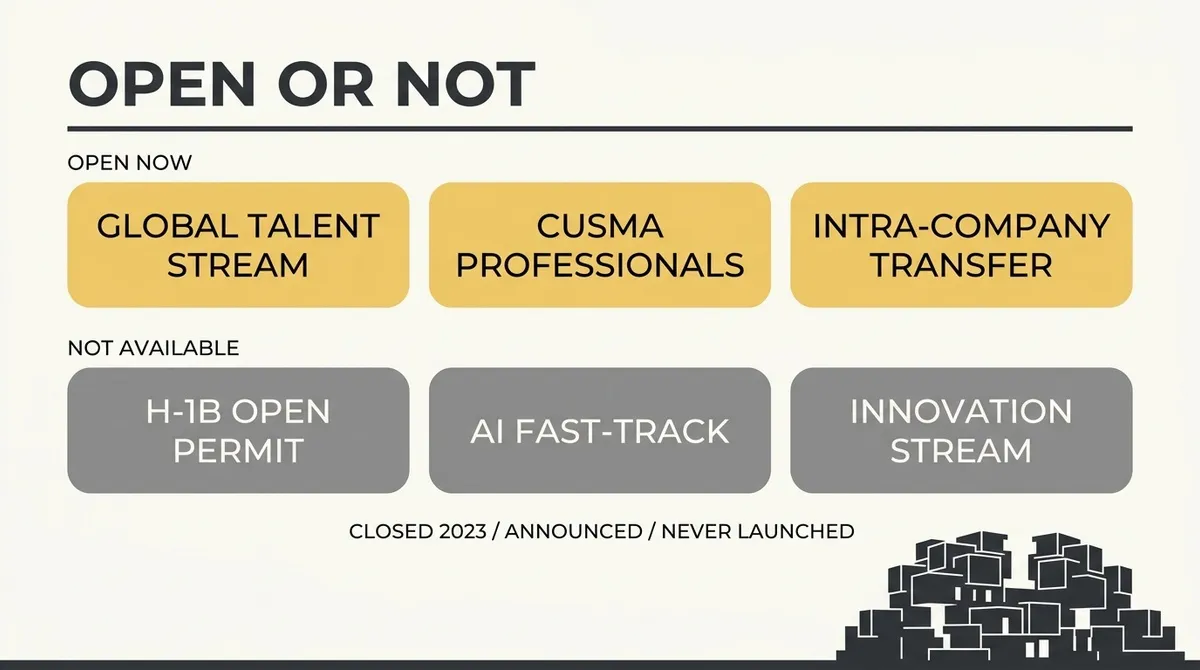
Three programs appear constantly in tech immigration coverage. None of them can currently be applied to, and this is where most wasted effort goes.
The H-1B Holder Open Work Permit Closed in 2023
Canada opened a program in July 2023 offering H-1B specialty occupation holders an open work permit of up to three years, capped at 10,000 applications. The cap was reached within days and the program has been closed ever since. It has not reopened, and pages still describing it as an option are describing a window that lasted less than a week.
The AI Fast-Track Is Announced Rather Than Launched
The national artificial intelligence strategy published in June 2026 committed to expanding the Global Talent Stream for AI professionals and aligning permanent residence measures to retain them. That is a stated commitment, not a live program, and there is no separate AI stream to apply to. The practical position is better than it sounds: data scientists, software engineers and comparable AI roles were already on the Category B list, so the existing fast track was available to them before the announcement and remains so now.
The Innovation Stream Has Not Opened
An Innovation Stream under the International Mobility Program was announced as part of the 2023 tech talent package and has not launched. Its status is worth re-checking periodically, but nobody should be building a hiring plan around it.
Working in Technology Without a Canadian Work Permit
Two situations let technology work happen in Canada with no permit at all, and both are narrower than they are usually described.
Digital Nomads Use Ordinary Visitor Status
Someone performing their job remotely for an employer outside Canada, or self-employed serving clients outside Canada, can live here for up to six months at a time on visitor status. No work permit is required and no additional documentation is expected, since the person is not entering the Canadian labour market. There is no digital nomad visa, which is the point most coverage gets wrong: this is visitor status, not a program.
Short-Term Exemptions for High-Skilled Work
Two public policies under the Global Skills Strategy exempt certain high-skilled work from the permit requirement for short consecutive periods. The conditions are strict and an initial request cannot be made from inside Canada, which rules the policy out for anyone already here. The full criteria are set out in our guide to working in Canada without a work permit.
Where the Line Actually Falls
The deciding question in both cases is who benefits from the work and who pays for it. A developer whose salary comes from a foreign employer and whose output serves that employer is outside the labour market. The same developer taking a contract with a Canadian company is inside it, whatever their physical location was when the arrangement started. IRCC's guidance on digital nomads makes the same point, noting that a permit is needed before starting work for a Canadian employer. For tech professionals whose travel is limited to cross-border meetings, vendor discussions, or sales talks, a Business Visitor Visa provides another way to visit without a work permit.
Choosing Between the Technology Routes
The right route is usually decided by facts the worker cannot change, so it is worth working through them in order.
Citizenship and Corporate Structure Decide Most Cases
An American or Mexican citizen in a listed profession should look at CUSMA first, since it avoids the assessment entirely and can often be processed at a port of entry. Similarly, eligible European professionals can evaluate comparable trade agreement options under CETA. An employee of a multinational with a Canadian entity should look at the intra-company route for the same reason. Only where neither applies does the Global Talent Stream become the primary option, because it is the only one that requires an assessment.
Permanent Residence Is Often the Faster Conversation
Technology occupations sit in TEER 0, 1 and 2, which places them inside the range the Canadian Experience Class accepts, so roughly a year of skilled Canadian work can support an Express Entry application. For a worker without a job offer, permanent residence is usually a more realistic starting point than a temporary route, since every technology work permit route requires an employer. The federal tech talent immigration page is where any new temporary stream would be announced.
Provincial Tech Pathways Recognise the Same Experience
Three provinces run nominee routes built specifically around technology occupations, and they reward the Canadian experience a work permit produces. British Columbia gives technology workers targeted invitations at lower score thresholds, set out on our page covering BC PNP Tech. Saskatchewan runs a dedicated route to permanent residence for technology and innovation sector workers holding a permanent job offer, described on the SINP Tech Talent Pathway page.
Alberta's route works differently and catches people out. The Alberta Accelerated Tech Pathway is invitation only rather than an application, so there is nothing to submit and no queue to join. It operates inside the province's Express Entry stream, which means a candidate has to be in the federal pool with an Alberta connection before the pathway can reach them at all.
If you are an employer weighing the fast-track route against an exemption, or a technology worker unsure which of these applies to your citizenship and employment situation, the answer usually turns on details worth checking before anyone files. SEP Immigration, led by Sepehr Falahati (RCIC, CICC and IRB member R533959), can identify which route fits and what it requires.
Official sources
- Employment and Social Development Canada, Global Talent Stream and the Global Talent Occupations List
- Immigration, Refugees and Citizenship Canada, attracting tech talent to Canada
- Immigration, Refugees and Citizenship Canada, temporary residents: digital nomads
- Immigration, Refugees and Citizenship Canada, international free trade agreements and business people
This article provides general information and is not legal advice, and program availability and occupation lists change without notice. Verify stream eligibility and processing standards against Employment and Social Development Canada and IRCC before applying; information current as of September, 2026.
Frequently asked questions
01Can a software developer move to Canada without a job offer?
Not on a work permit through these routes, which all require an employer. The exception is permanent residence, where Express Entry and several provincial streams accept candidates without an offer and technology occupations score well. A developer without an offer should be looking there rather than waiting for a temporary route that does not exist.
02How fast is a Global Talent Stream work permit?
The published service standards are ten business days for the assessment and a two-week target for the permit, so roughly four to six weeks end to end in good conditions. Those clocks start when a complete application is submitted, not when the employer decides to hire, and preparing the referral or benefits plan usually takes longer than the processing.
03Is the Global Talent Stream an LMIA exemption?
No, and this is the most common misunderstanding about it. The stream sits inside the Temporary Foreign Worker Program and involves a full Labour Market Impact Assessment. What it offers is speed and relaxed recruitment requirements, not removal of the assessment. Genuine exemptions sit under the International Mobility Program instead.
04Can a remote worker live in Canada while working for a foreign company?
Yes, on visitor status, for up to six months at a time. IRCC treats someone performing their job remotely for an employer outside Canada as a visitor rather than a labour market entrant, so no permit is needed and no special documentation is expected. The moment a Canadian employer is involved, a permit is required before any work begins.
05Does Canadian tech experience count toward permanent residence?
Yes. Technology occupations sit in TEER 0, 1 and 2, inside the range the Canadian Experience Class accepts, and roughly a year of skilled Canadian work can support an Express Entry application. Several provinces run technology-specific nominee pathways recognising the same experience, so a temporary permit is often the first step rather than the destination.
06Do all technology jobs qualify for the Global Talent Stream?
No. Category B works from a defined occupations list covering many but not all technology roles, and a technical sounding job title does not qualify a role whose code is absent. Category A has no list but requires a designated organisation referral, which not every employer can obtain. Confirm the route before building a hiring timeline around the fast-track speeds.
Stay informed
Get our immigration updates first on Google
Add SEP Immigration as a preferred source and our latest news and guides appear more often in your Google results.
About the Author

Sepehr Falahati
CEO of SEP Immigration
- CICC Licensed
- RCIC #R533959
- IRB Member
Sepehr Falahati is a Regulated Canadian Immigration Consultant (RCIC #R533959), licensed by the College of Immigration and Citizenship Consultants (CICC).
Read more about Sepehr FalahatiReviewed By


Continue Reading