

A visitor visa, also known as a temporary resident visa, is required to enter Canada for short-term stays such as tourism, family visits, or business. The type of visa you need depends on the purpose of your visit. Whether you're visiting for leisure, seeing family, or conducting business, you must apply with the correct documents that align with your purpose.
What is a Canada Visitor Visa?
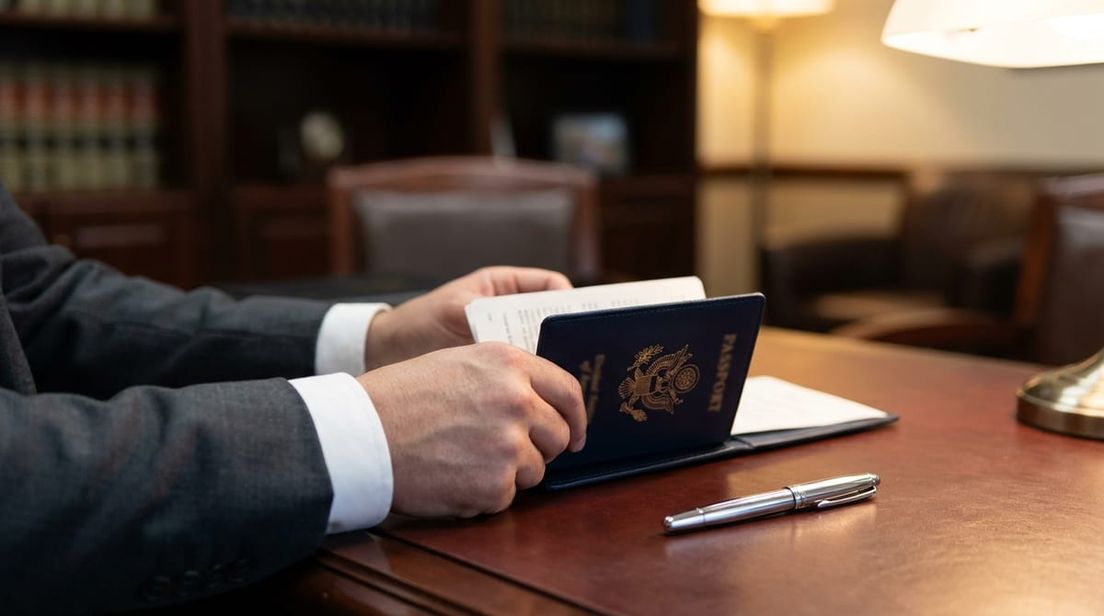
Close-up of a professional's hands reviewing a passport and travel documents on a polished mahogany desk.
A Canada Visitor Visa, also known as a Temporary Resident Visa (TRV), is an official document issued by Immigration, Refugees and Citizenship Canada (IRCC) that allows foreign nationals to enter Canada for a temporary purpose.
This visa is typically granted for short-term stays such as tourism, visiting family or friends, or attending business meetings. Depending on your case, a visitor visa may be issued as either a single-entry or multiple-entry visa.
A multiple-entry visa is more common and allows you to travel to Canada multiple times during its validity period, which can be up to 10 years or until your passport expires. However, the duration of each stay is usually limited to up to 6 months per visit, unless otherwise specified by a border officer.
It’s important to understand that holding a visitor visa does not guarantee entry into Canada. Final admission is determined by a border services officer, who will assess your purpose of travel, financial situation, and intent to leave Canada at the end of your stay.
Canada's Tourist Visa Requirements
To apply for a Canadian tourist visa, you'll need to gather and submit specific documents. The documents required depend on your reason for travel, but generally, you need:
- A valid passport from an eligible country.
- Proof of sufficient funds to cover your stay.
- Identity documents (such as passport photos).
- Travel itinerary or purpose of visit details (like a hotel booking or invitation letter).
For business visitors, documents related to your business meetings or events might be necessary. If you’re visiting family or applying as a spouse of a permanent resident, you’ll need proof of relationship.
All applicants must complete the required forms, and if someone applies on your behalf, they must submit a representative form (IMM 5476).

Specific Document Requirements
For tourists, proof of financial ability is key. You need to show you can support yourself during your stay in Canada. This often includes bank statements or proof of income.
Minors traveling alone or with one parent need consent forms, and business visitors should provide proof of their business dealings in Canada.

Types of Visitor Visas
Close-up of open and closed passports on a professional desk with a premium pen, representing different travel visa options.
A single visitor visa gives you one chance to enter Canada. Once you leave, that visa can no longer be used for another trip unless otherwise stated. For many people, this is enough — especially for a short holiday or a quick family visit.
If you plan to travel back and forth a few times over several years, a multiple-entry visa could be better. With this type, you can enter Canada more than once without having to reapply each time. These visas can be valid for up to ten years or until your passport expires, whichever comes first.
There’s also the Super Visa, which is special for parents and grandparents of Canadian citizens and permanent residents. It lets them stay for longer periods — often up to five years per visit — and is particularly helpful for family reunions that last longer than a standard six‑month stay.
Every visitor visa has its own terms. How long you can stay on a given visit is set at the border when you arrive. Most people are allowed to remain for up to six months, but an officer can shorten or extend that period.
Visitor Visa vs eTA
When someone plans a trip to Canada for sightseeing, visiting family, or attending a business meeting, they usually need permission to enter. That permission can take one of two main forms: a visitor visa or an Electronic Travel Authorization (eTA). These aren’t the same thing, and the one you need depends mostly on your nationality and how you’re travelling.
A visitor visa (also called a Temporary Resident Visa) is a physical document placed in your passport. Most travellers from countries that don’t have special visa-free arrangements with Canada must apply for this type of visa if they want to come here, whether by air, car, bus, train, or boat. It’s proof that a visa officer has reviewed your application and believes you meet Canada’s temporary entry requirements.
An eTA, on the other hand, is digital. It’s linked to your passport electronically and usually only needed if you’re from a visa-exempt country and planning to fly to Canada. If you arrive by land, sea, or rail, an eTA won’t work; in those cases you either need a visitor visa or no document at all if your passport alone is enough.
It’s important to know that you generally don’t apply for both. One document suffices — either a visitor visa or an eTA — depending on your situation. If you already hold a valid visitor visa, you don’t also need an eTA to board your flight.
One important exception: US citizens do not need a visitor visa or an eTA to enter Canada. They can enter with a valid US passport alone, regardless of whether they travel by air, land, or sea.

How Long Can You Stay in Canada With a Tourist Visa?
With a standard Canadian tourist visa, you can typically stay for up to six months at a time. However, the final duration of your stay is determined by the Canada Border Services Officer when you arrive in Canada. They may grant you a stay of less than six months, depending on your travel plans.
If you want to extend your stay beyond six months, you can apply for an extension. This must be done before your current visa status expires. Extension approval is not guaranteed, so it’s essential to apply early if you need more time in Canada.

How Long Does It Take to Get Canada's Visitor Visa?
Processing times for a Canadian visitor visa in 2026 vary significantly depending on your country of residence. For most applicants, online applications are processed in 4 to 8 weeks, though some countries experience longer waits.
| Country | Approximate Processing Time (2026) |
|---|---|
| India | ~88 days |
| Nigeria | ~85 days |
| Philippines | 4–8 weeks |
| Mexico | 4–6 weeks |
| China | 4–8 weeks |
| Pakistan | 8–12 weeks |
Applications submitted inside Canada for status extension process faster — as of March 2026, visitor visa extensions inside Canada take approximately 12 days.
These figures reflect 80% of applicants and can shift weekly. Always check the current estimate for your country using the IRCC processing time tool before planning your trip.
Canadian Visitor Visa Fee
The application fee for a Canadian visitor visa is CAD 100. If biometrics (fingerprints and a photograph) are required, there’s an additional fee of CAD 85. These fees are non-refundable, even if your application is denied, so ensure all your documents are correct and complete before applying.
You’ll need to pay these fees when you submit your application, either online or at a visa application center. Payment must be made using a valid credit or debit card. Some applicants may be exempt from biometrics, but most first-time applicants will need to provide them.

How to Apply for Canada's Tourist Visa
Applying for a Canadian tourist visa involves several steps:
- Check Eligibility: Ensure you're eligible by confirming you have a valid passport, enough funds for your stay, and a clear purpose for your visit.
- Gather Required Documents: The required documents depend on your visit's purpose. Tourists need proof of funds and a travel itinerary, while business visitors need business-related documents. Family visitors will need proof of relationship, such as birth certificates or marriage licenses.
- Submit Application: Applications can be submitted online through the IRCC website. If you can’t apply online, you can submit your application through a visa application center in your country.
- Pay the Visa Fees: Pay the CAD 100 visa fee and the CAD 85 biometrics fee (if applicable). Make sure to complete this step to avoid delays.
- Submit Biometrics: If biometrics are required, you will be notified to submit them at an authorized center. This step involves submitting fingerprints and a photograph.
- Processing: After submitting your application and biometrics, the processing time can vary from a few weeks to months. You can check the status of your application online through the IRCC portal.
- Receive Decision: Once your visa is processed, you’ll receive a decision through your online account. If approved, you’ll receive a visitor visa sticker in your passport, which you’ll need to present when entering Canada.
Enter Canada: When you arrive in Canada, a border officer will make the final decision on your stay duration. Typically, you can stay up to six months, but the officer might grant a shorter period based on your travel plans.
Common Reasons for Visitor Visa Refusal
- Visitor visa refusals are common, and in most cases, they are linked to concerns about the applicant’s intent or financial stability. Understanding these reasons can significantly improve your chances of approval.
- One of the most frequent reasons for refusal is insufficient proof of ties to your home country. Visa officers need to be convinced that you will return after your visit. Weak employment status, lack of assets, or limited family ties can raise concerns.
- Another major factor is financial insufficiency. If you cannot clearly demonstrate that you have enough funds to cover your travel, accommodation, and daily expenses, your application may be refused.
- An unclear or poorly documented purpose of travel is also a common issue. Applications that lack a detailed travel plan, invitation letter, or supporting documents often fail to meet the officer’s expectations.
- Inconsistent information, missing documents, or a weak travel history can also negatively impact your application. Even small discrepancies can reduce credibility and lead to refusal.
To avoid these issues, it is essential to present a complete, well-structured, and credible application that clearly addresses the concerns of a visa officer.

Visitor Visa for Different Situations
Every visitor visa application is unique, and your strategy should be tailored to your personal situation. Understanding how your profile affects your application is key to success.
For tourism purposes, applicants should provide a clear travel itinerary, hotel bookings, and proof of financial capability. A well-documented travel plan helps establish credibility.
If you are visiting family or friends, an invitation letter from your host in Canada can significantly strengthen your application. Supporting documents such as proof of relationship and the host’s status in Canada are also important.
For business visits requiring a Business Visitor Visa, applicants should include a letter from their employer, details of the business activity in Canada, and any relevant invitations from Canadian companies.
Applicants without a strong travel history may face additional scrutiny. In such cases, it becomes even more important to demonstrate strong ties to the home country and provide detailed supporting documentation.
Self-employed individuals, students, or unemployed applicants need to pay extra attention to financial proof and intent to return, as these profiles are often considered higher risk by visa officers.
A personalized approach based on your specific circumstances can significantly increase your chances of approval and reduce the risk of refusal.
Need help with your Canada visitor visa application? Contact SEP Immigrants today for expert guidance and assistance to make your visa process smooth and stress-free!
Frequently Asked Questions
01
How Much Bank Balance Is Required for a Canada Tourist Visa?
There is no fixed minimum amount set by IRCC. Officers assess whether your funds are sufficient relative to your travel plans, duration of stay, and personal circumstances. As a general guideline, you should be able to demonstrate enough to cover accommodation, daily expenses, return travel, and any emergencies. A well-documented application showing stable financial history is more important than a specific dollar figure. If in doubt, more is better — and a clear explanation of your financial situation strengthens your case.
02
Can I Apply for PR While on a Visitor Visa in Canada?
Yes, it is generally possible to apply for permanent residency while in Canada on a visitor visa. Canada recognizes a concept called dual intent — meaning you can genuinely intend to visit temporarily while also pursuing a long-term immigration pathway. However, you must still demonstrate to IRCC that you will respect the terms of your visitor status and leave Canada if your PR application is not approved. Having a pending PR application does not, by itself, guarantee that your visitor visa will be extended. Consulting an immigration consultant before combining these pathways is strongly recommended.
03
What Is the Difference Between a Tourist Visa and a Visitor Visa?
A tourist visa is a type of visitor visa meant specifically for tourism purposes. The term “visitor visa” covers various short-term travel reasons, including family visits and business trips. Both allow temporary stays in Canada for up to six months.
04
How Much Do I Need in My Account to Visit Canada?
IRCC does not publish a fixed required amount. The funds you need depend on your travel duration, accommodation plans, and personal situation. Rather than targeting a specific number, focus on showing a consistent financial history and documented ability to cover all costs of your trip — including a return ticket and any emergencies. Officers look at the full picture, not just your current balance.