
Spousal Sponsorship Canada Document Checklist
Reviewed by Mohsen Khorvash and Mahsa Barati
Most spousal sponsorship applications that fail never reach an officer who assesses the relationship. They are returned unopened, in effect, because a form was missing or a signature was absent. A returned application is not a refusal, which sounds like good news until you realise what it costs: the package loses its place in the processing queue entirely, and if you fix it and resubmit, the file is treated as arriving on the resubmission date.
This checklist covers what goes into the package and what triggers a return. If you are still deciding whether to apply or which class to apply under, our spousal sponsorship page covers eligibility and the process end to end. Only a Canadian citizen, permanent resident, or person registered under the Indian Act can sponsor, so if your own status is still in progress, resolve that first, whether through a permanent residence application or a Canadian citizenship grant.
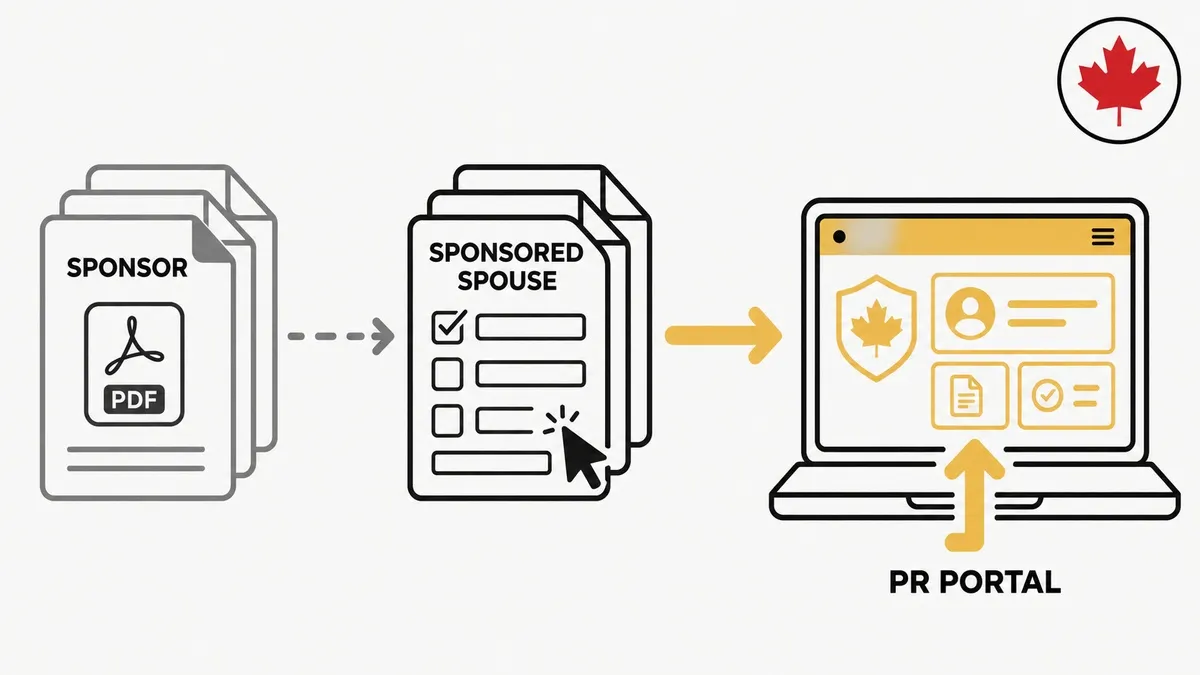
One structural point that catches people out immediately. Applying online has been mandatory since September 23, 2022, and the person who submits is the sponsored spouse, not the sponsor. Alternate formats in braille, large print or paper are available on request for accommodations including disability, but the default route for everyone else is the Permanent Residence Portal.
What the Spousal Sponsorship Checklist Actually Is
There is no single downloadable checklist that applies to every couple, which is the most common misunderstanding about this process. IRCC generates your checklist from three inputs you select on the application kit page: who is being sponsored, the country where the sponsored person lives, and the country that issued the documents you are submitting.
Those last two are separate questions on purpose. Someone living in the United States who is submitting a birth certificate issued in the Philippines needs to check the requirements for both countries, because civil document standards are set by the issuing country, not the country of residence. A generic list copied from a website will not carry those country-specific instructions, and omitting one of them returns the application.
The generated checklist also has to be uploaded into the application itself, with the correct box ticked for each item. It is a document in the package, not just a preparation aid.
Spousal Sponsorship Forms Checklist
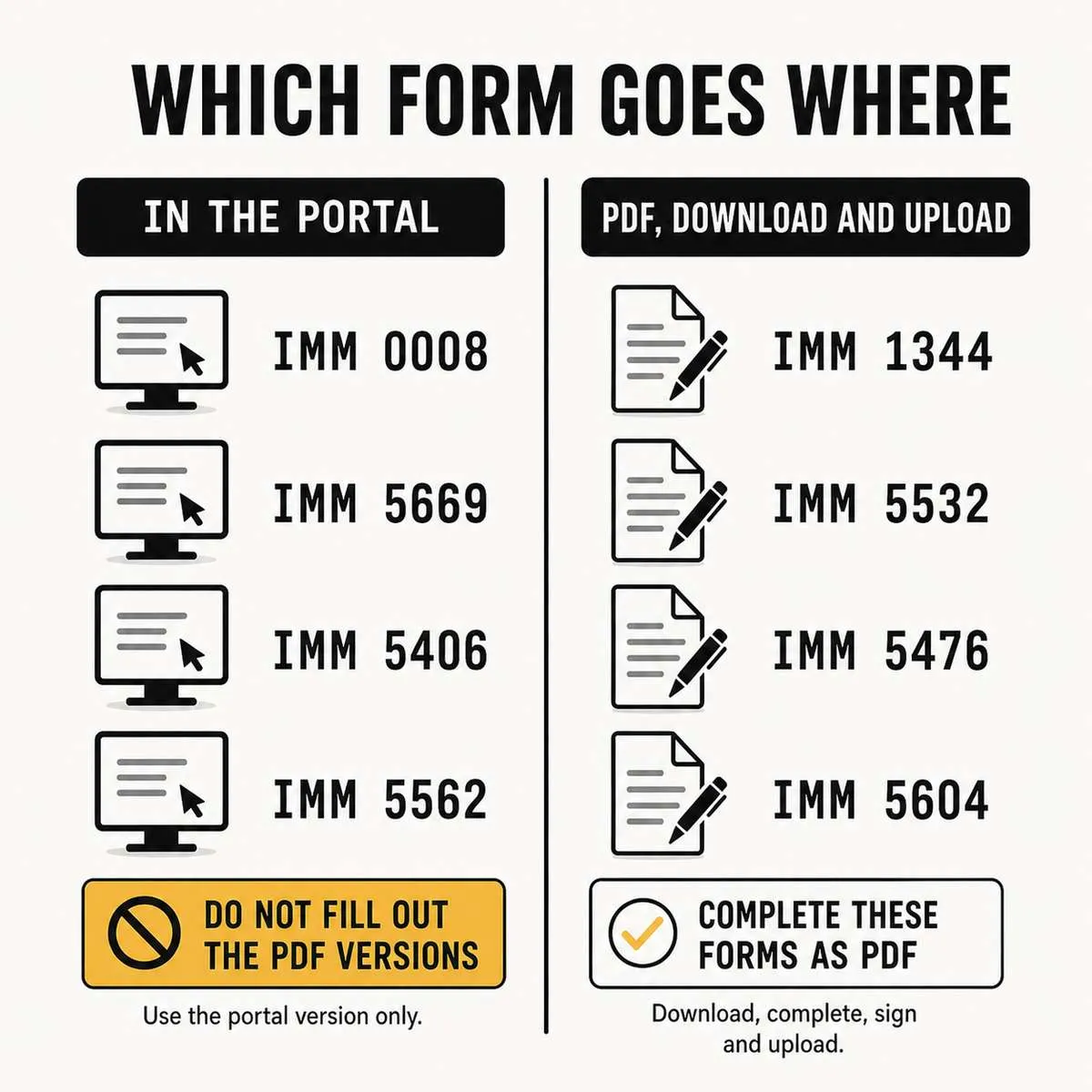
Forms fall into two groups that are handled in completely different ways. Mixing them up is a frequent cause of rejected submissions.
Digital Forms Completed Inside the Portal
These are filled out by the principal applicant directly within the portal. IRCC's instruction is explicit that you must not complete the PDF versions of these forms.
- Generic Application Form for Canada (IMM 0008)
- Schedule A, Background/Declaration (IMM 5669)
- Additional Family Information (IMM 5406)
- Supplementary Information, Your Travels (IMM 5562), where applicable
Every dependant on the file aged over 18 must complete their own separate IMM 5669, IMM 5406 and IMM 5562.
PDF Forms the Sponsor Completes and Signs
The sponsor downloads these, completes them, and sends electronic copies to the principal applicant to upload.
- Application to Sponsor, Sponsorship Agreement and Undertaking (IMM 1344), signed electronically by both the sponsor and the principal applicant
- Sponsorship Evaluation and Relationship Questionnaire (IMM 5532), for anyone sponsoring a spouse or partner
The IMM 5532 has a signing quirk worth knowing before you waste an afternoon on it. To sign it digitally, complete the form first, then select "print to PDF" to generate a version that accepts a digital signature. The original file will not take one.
Situational Forms
- Use of a Representative (IMM 5476), required for paid and unpaid representatives alike
- Declaration from Non-Accompanying Parent or Guardian for Minors Immigrating to Canada (IMM 5604), signed by hand and accompanied by photo identification from that parent
- Financial Evaluation (IMM 1283), only where a minimum income requirement applies
The representative form has a wrinkle that affects ordinary couples with no consultant involved. If the sponsor will receive correspondence on behalf of the sponsored spouse, or if the sponsor's Canadian address is given as the mailing address on the IMM 0008, then the sponsored person must file an IMM 5476 naming the sponsor as their representative. Where one representative acts for both parties, a single form signed by both is enough.
Documents Checklist for the Sponsor
The sponsor's side of the package is lighter than most people expect, because there is usually no income test. A minimum necessary income requirement applies only where the spouse or partner being sponsored has a dependent child who has a dependent child of their own.
- Proof of status: Canadian passport, citizenship certificate, permanent resident card, or Indian status document
- Proof of residence in Canada, or evidence of plans to return if the sponsor is a citizen living abroad
- Proof of separation or divorce documents from any previous marriage, including a final divorce certificate, annulment certificate, or death certificate as applicable
- Financial Evaluation (IMM 1283) only where the income test is triggered
A permanent resident living outside Canada cannot sponsor at all. A citizen living abroad can, provided they demonstrate they will live in Canada once the sponsored person lands.
Documents Checklist for the Sponsored Spouse
This is the bulk of the package and where returns usually originate.
Identity and Civil Documents
- Valid passport or travel document, regular or private, since diplomatic, official, service and public affairs passports cannot be used
- Birth certificates for the principal applicant and every included dependant
- Marriage certificate or proof of registration of the marriage
- Divorce, annulment or death certificates for any previous marriage
- Custody documentation for any dependent child, including children in the sole custody of a former partner
Two traps sit in that list. First, a record of solemnization obtained in Canada or a marriage licence is not accepted as proof of marriage. What you submit must show that the marriage was legally registered with the government where it took place. Second, marriages conducted by proxy, telephone, fax or internet, where one or both people were not physically present, are not recognised for immigration purposes at all.
Children Who Must Be Declared
Every family member has to be declared and examined, including those who will not come to Canada. A child in the sole custody of the sponsored person's former partner still has to be listed and still has to complete a medical exam, regardless of any court order or written agreement to the contrary. Skipping this does two things: it excludes that child from the family class permanently, so they can never be sponsored later, and it puts the new permanent resident's own status at risk.
The reverse situation matters too. If the sponsor is a Canadian citizen and the couple has a child together born abroad, that child may already be a citizen and cannot be sponsored. Provide the citizenship certificate or Canadian passport. If no proof exists yet, apply for proof of citizenship and include a letter explaining that the application is pending.
Proof of Relationship Documents
Relationship evidence sits inside the IMM 5532 and its supporting documents, and it deserves more attention than a checklist entry allows. Our guide to proof of relationship for spousal sponsorship covers what IRCC requires by name and the legal test officers actually apply.
For checklist purposes, one hard limit is worth flagging here because it is rarely published: proof of communication documents, meaning letters, printed messages, emails and social media conversations, are capped at a maximum of 10 pages. Anything in another language must be translated, and the translation counts. Couples who submit hundreds of pages of chat logs are not helping their file, and they may be pushing it outside the instructions.
Police Certificates and Medical Exam Requirements
Police Certificates
The sponsored person and each family member aged 18 or over, who is not already a Canadian citizen or permanent resident, needs a valid police certificate for every country other than Canada where they spent six or more consecutive months since turning 18. Time spent in a country entirely before age 18 does not require one. Certificates not in English or French need an accredited translation submitted alongside the original.
Medical Exams
Do not book the medical exam before you are asked. IRCC issues medical instructions at a point in processing it chooses deliberately, because results expire and an early exam often has to be repeated at your own expense. Once instructions arrive, the exam must be completed within 30 days, and the IMM 1017 form and instructions must be printed and brought to the appointment for each person. Every family member who is not a citizen or permanent resident is examined, including those not coming to Canada.
Spousal Sponsorship Fees in 2026
The figures below reflect IRCC's published fee list as of August 2026. Fees are payable online only, and the receipt has to be saved and uploaded, since it is the proof of payment. Underpaying returns the application.
| Fee | Amount (CAD) |
|---|---|
| Sponsor a spouse or partner, including sponsorship fee, processing fee and right of permanent residence fee | $1,260 |
| Sponsor a spouse or partner, excluding right of permanent residence fee | $660 |
| Right of permanent residence fee, if deferred | $600 |
| Include a dependent child | $180 per child |
| Biometrics, per person | $85 |
| Biometrics, family of two or more | $170 |
Paying the right of permanent residence fee upfront is generally the better call, since it has to be paid before permanent residence is granted anyway and deferring it can introduce delay. It is refundable if the application is withdrawn or refused, and it is the only fee refundable once processing has started. Dependent children are exempt from it entirely. Where a sponsorship is withdrawn because the sponsor does not qualify, all processing fees are repaid except the $85 sponsorship fee. You can check the current fee list before paying, since these figures change.
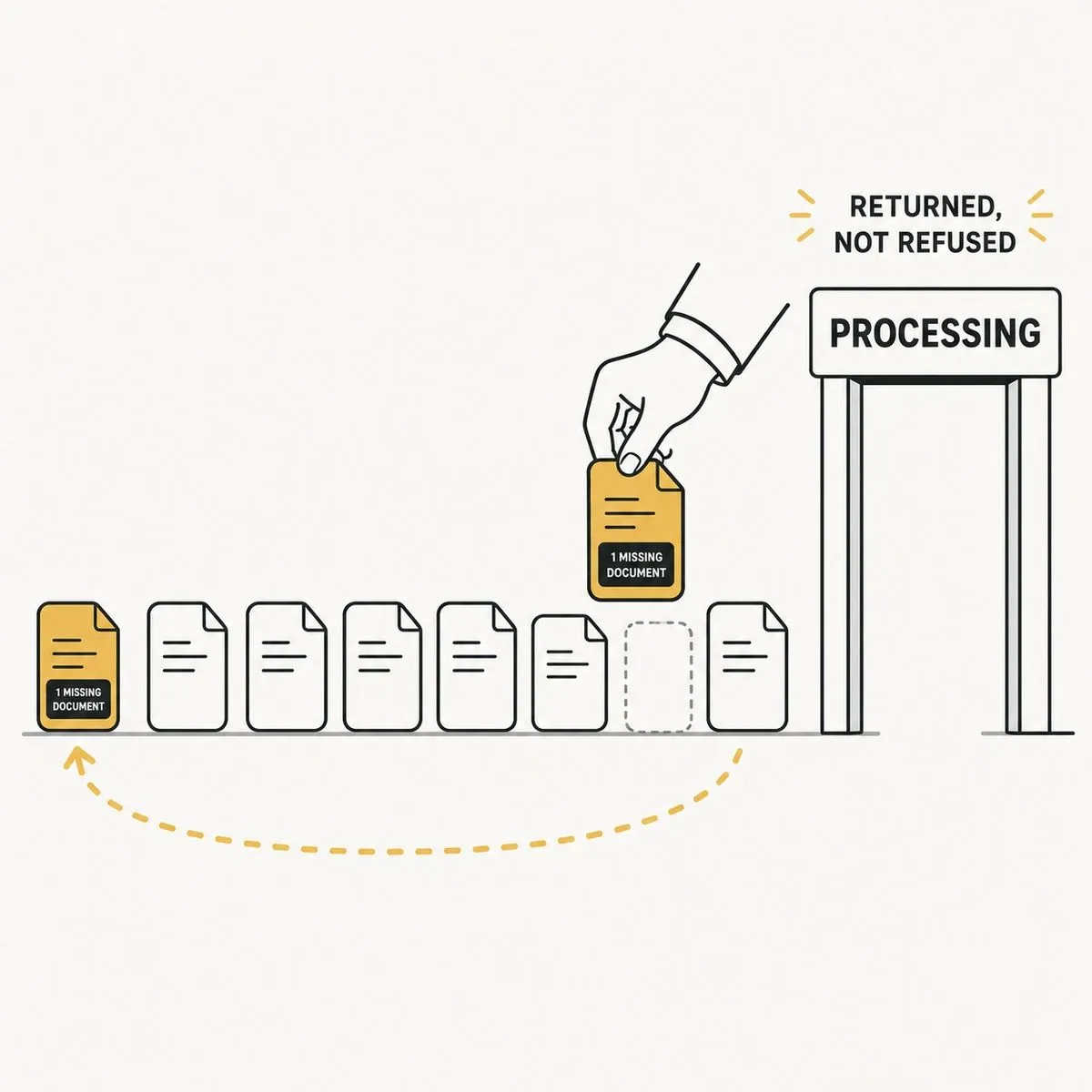
Photo Requirements for Spousal Sponsorship
One photo is needed for the principal applicant and each accompanying family member, and both the front and back must be scanned and uploaded. The specifications are unusually precise, and this photo becomes the permanent resident card image, so errors here delay the card rather than the decision.
- Taken within the past 12 months by a commercial photographer
- JPEG or PNG, between 715x1000 and 2000x2800 pixels, 4 MB or less
- Scanned, not photographed with a phone or camera
- Neutral expression, eyes open, mouth closed, no smiling
- Plain white background, no shadows, glare or flash reflection
- Back of the photo showing name, date of birth, studio name and address, and date taken, stamped or handwritten but never on a stick-on label
For digital submissions, the information required on the back can instead be provided as a separate document with confirmation from the photo studio, uploaded under additional supporting documents.
Translation and Certified Copy Rules
Any document not in English or French requires a certified copy of the original, the translation, and an affidavit from the translator unless that translator is certified in Canada.
The restriction that trips up the most families: translations may not be done by the applicant, and may not be done by a family member. IRCC names them individually, covering a parent, guardian, sibling, spouse, common-law partner, conjugal partner, grandparent, child, aunt, uncle, niece, nephew and first cousin. The identical restriction applies to certifying copies. A bilingual cousin doing the translation as a favour invalidates the document.
Where the translator is not certified in Canada, the affidavit must be sworn before a notary public, commissioner of oaths, or commissioner for taking affidavits inside Canada, or a notary public outside Canada.
Common Mistakes That Get a Spousal Sponsorship Application Returned
These are the failures IRCC itself flags, and they are procedural rather than substantive. None of them relate to whether the relationship is genuine.
- Leaving form sections blank instead of entering "Not Applicable" or "NA"
- Missing a signature, or the wrong person typing the name at the declaration stage
- Skipping country-specific requirements for either residence or document issuance
- Submitting a marriage licence rather than proof of registration
- Omitting a document without explaining why it cannot be provided
- Illegible email addresses on the IMM 5476, IMM 1344 or IMM 0008
- Paying insufficient fees or failing to upload the receipt
- Linking the application to a personal online account after appointing a representative
The point about omitted documents deserves emphasis because it is the one genuinely forgiving rule in the process. If you cannot obtain something on your checklist, you are not automatically sunk. Include a detailed written explanation of why it cannot be provided, and the application is not treated as incomplete on that basis. Silence, on the other hand, is treated as an omission. A letter of explanation should give your contact information, name the checklist item concerned, state the issue clearly, and add any context an officer would need.
Quebec Spousal Sponsorship Checklist Differences
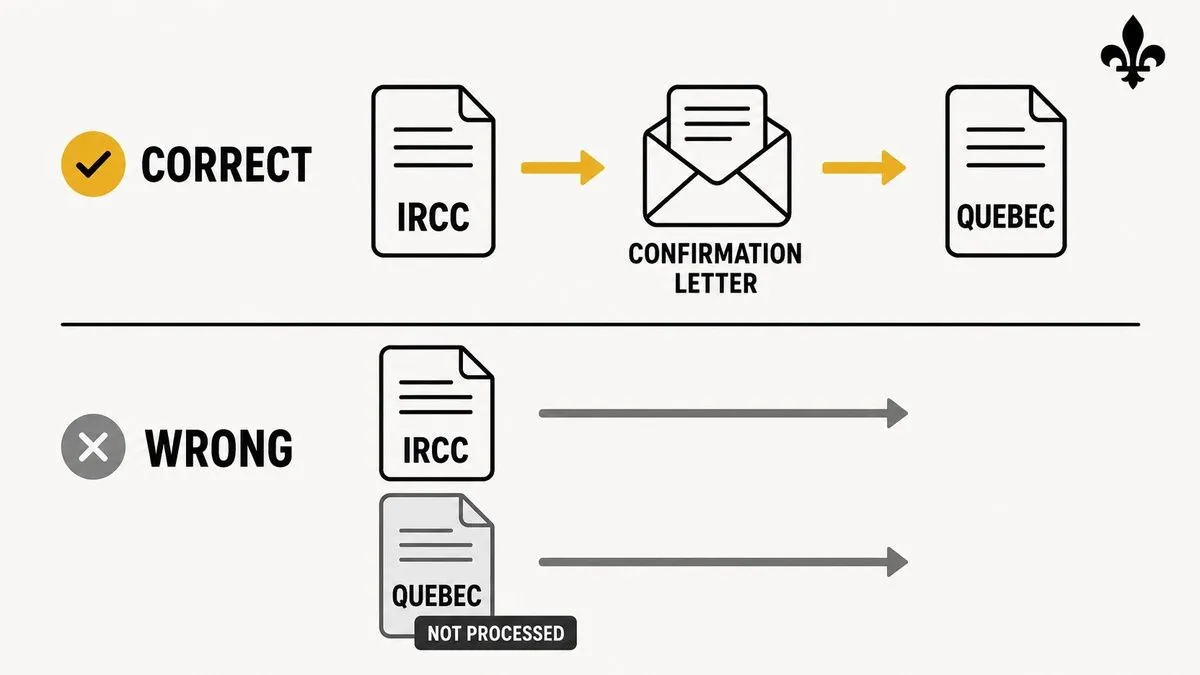
Sponsors living in Quebec have a second undertaking to complete with the provincial government, and the sequence matters more than the paperwork. Submit to IRCC first. Wait for the email or letter telling you that you meet the federal sponsorship requirements. Only then download and submit Quebec's undertaking kit, attaching a copy of that correspondence.
Submitting to Quebec early does not accelerate anything. The province will not process an undertaking that arrives before IRCC's confirmation. Quebec charges its own separate processing fee, which must not be included with the federal payment, and IRCC cannot decide the file until Quebec returns its decision on the undertaking.
Final Check Before You Submit
Work through this last, once the package is otherwise assembled.
- The generated checklist is uploaded, with the correct box ticked for each item
- Every digital form was completed in the portal, not as a PDF
- IMM 1344 carries electronic signatures from both the sponsor and the principal applicant
- IMM 5532 was converted using "print to PDF" before signing
- Each dependant over 18 has their own IMM 5669, IMM 5406 and IMM 5562
- Every family member is declared, including those not coming to Canada
- Translations are attached with affidavits, done by someone outside the family
- The fee receipt is saved and uploaded
- The principal applicant, and nobody else, typed their own name at the declaration
That last item is a legal requirement rather than a formality. A representative may prepare everything, but the electronic signature must be typed by the applicant. It is what makes the application signed under Canadian immigration law.
If a file does progress to an interview, the preparation is a separate exercise with its own stakes, covered in our guide to the spousal sponsorship interview.
How SEP Immigration Helps With Spousal Sponsorship
We assemble and review spousal sponsorship packages against the generated checklist, catching the procedural gaps that cause returns before they cost you months. Sepehr Falahati is a licensed immigration consultant with the College of Immigration and Citizenship Consultants (CICC/IRB, R533959).
Book a consultation and bring your marriage or cohabitation documents, both passports, and details of any previous marriages or children.
This page is general information, not legal advice, and IRCC forms, fees and checklist requirements change without notice. Verify your generated checklist and current fees on canada.ca, or with a licensed representative, before submitting. Figures reflect the position as of August 2026.
Frequently asked questions
01Is there one checklist for every spousal sponsorship?
No. IRCC generates it from who is being sponsored, where the sponsored person lives, and which country issued your documents. Two couples abroad get different lists.
02Who actually submits the application?
The sponsored spouse, through the PR Portal, submitting both applications together. The sponsor sends their completed PDF forms across to be uploaded.
03What does spousal sponsorship cost in 2026?
$1,260 with the right of permanent residence fee included, or $660 without it, plus $180 per dependent child and $85 per person for biometrics. Figures are current as of August 2026.
04What happens if my application is returned?
You fix it and resubmit, but you lose your position in the queue. Processing runs from the resubmission date, not the original.
05Can a relative translate my documents?
No. Applicants and family members, out to first cousins, are barred from translating or certifying copies.
06When should I book the medical exam?
After IRCC sends instructions, then within 30 days. Booking early often means paying for it twice.
07Do I need to declare a child living with my ex?
Yes, and that child needs a medical exam. Failing to declare them bars any future sponsorship of that child and can jeopardise your own status.
08Is a marriage licence enough?
No. You need proof the marriage was legally registered where it took place. A licence or record of solemnization will not do.
Stay informed
Get our immigration updates first on Google
Add SEP Immigration as a preferred source and our latest news and guides appear more often in your Google results.
About the Author

Sepehr Falahati
CEO of SEP Immigration
- CICC Licensed
- RCIC #R533959
- IRB Member
Sepehr Falahati is a Regulated Canadian Immigration Consultant (RCIC #R533959), licensed by the College of Immigration and Citizenship Consultants (CICC).
Read more about Sepehr FalahatiReviewed By


Continue Reading