
Quebec Selection Certificate (CSQ): How It Works in 2026
Reviewed by Mohsen Khorvash and Mahsa Barati

The Certificat de selection du Quebec is the document that says the province wants you. It is issued by the Ministere de l'Immigration, de la Francisation et de l'Integration, and it is the provincial half of a two-part process. The federal half, handled by Immigration, Refugees and Citizenship Canada, decides whether you are admitted to the country. Both halves have to succeed, and each can fail on its own.
That split explains most of the confusion around the certificate. People treat a CSQ as an approval to move, when it is closer to a permission slip that lets you start the real application for permanent residence. It does not grant status, it does not let you board a plane, and on its own it does not let you work. Understanding what it does and does not do is the difference between a file that moves and a file that stalls.
Because Quebec immigration operates under the Canada-Quebec Accord, the province is not a nominee province. A CSQ is not a provincial nomination, and nothing about the federal Express Entry system applies to it. A CRS score is irrelevant here, and so is anything you have read about how a provincial nominee program works.
What a Quebec Selection Certificate Is and Is Not
A CSQ confirms that Quebec has assessed you against its own criteria and selected you for permanent immigration. It names the principal applicant and any accompanying family members included in the application. It is issued after the province examines a complete permanent selection application, not at the point of invitation.
What it is not: a visa, a work authorisation, a study authorisation, a travel document, or permanent resident status. Someone holding a CSQ and living abroad has exactly the same right to enter Canada as they did before it was issued. Someone holding a CSQ inside Quebec on a work or study permit still depends entirely on that permit for their status.
Selection by Quebec Versus Admission by Canada
Quebec sets the selection criteria and issues the certificate. Canada assesses admissibility and grants permanent residence. At the federal stage you will complete a medical examination and pass criminal and security checks, and IRCC may ask for further documentation to verify what was claimed on the provincial side.
A refusal at the federal stage is possible even with a valid certificate in hand. Quebec's guidance on family reunification says this outright, warning sponsors that IRCC may refuse permanent residence to the person they are sponsoring even where the provincial file was approved and even where IRCC had earlier confirmed the sponsor was eligible.
Quebec Immigration Programs That Issue a CSQ
Several routes lead to the same certificate. The route determines the criteria, the intake rules, the fees and the waiting time, so the first question in any Quebec file is which of these actually applies.
Skilled Worker Selection Program (PSTQ)
The Skilled Worker Selection Program replaced the former Regular Skilled Worker Program on November 29, 2024 and is now the main permanent route. It runs on invitations. You file a free declaration of interest in the Arrima portal, you are scored and ranked, and the province draws candidates in periodic rounds across four streams. Meeting the requirements puts you in the pool. It does not put a certificate in your hand.
Quebec Experience Program (PEQ)
The Quebec Experience Program closed on November 19, 2025 and reopened on July 2, 2026 for a two-year period ending July 2, 2028. It now runs through defined intake windows rather than continuous intake. The first window runs to October 31, 2026 and is restricted to people who already met their stream's eligibility conditions as of November 19, 2025. Anyone who became eligible after that date is not covered by this window, and no further intake period has been confirmed. Quebec has also indicated it will reduce PSTQ invitation volumes while PEQ applications are being received, which matters if you are waiting in the Arrima pool.
Business Immigration Programs
The Investor, Entrepreneur and Self-Employed Worker programs each issue a CSQ on approval. They carry a distinct advantage the skilled worker routes do not: entrepreneurs and self-employed applicants receive a letter of support alongside the acceptance letter and certificate, allowing them to apply to IRCC for an LMIA-exempt work permit under exemption code C-60 and arrive in Quebec before permanent residence is granted.
Permanent Immigration Pilot Programs
Quebec runs pilot programs for temporary foreign workers in food processing, for orderlies, and for workers in the artificial intelligence, information technologies and visual effects sectors. Each has its own criteria and its own intake behaviour, and each produces a CSQ on approval.
Family Reunification
A CSQ is not only an economic document. Where a Quebec resident sponsors a relative, the province examines the undertaking together with a permanent selection application for the sponsored person, and issues that person a certificate on approval. The sponsor receives it by mail in a sealed envelope and must pass it to the person being sponsored. The province notes that the time taken to issue the certificate does not affect how quickly IRCC processes the permanent residence application.
How to Apply for a CSQ in Quebec
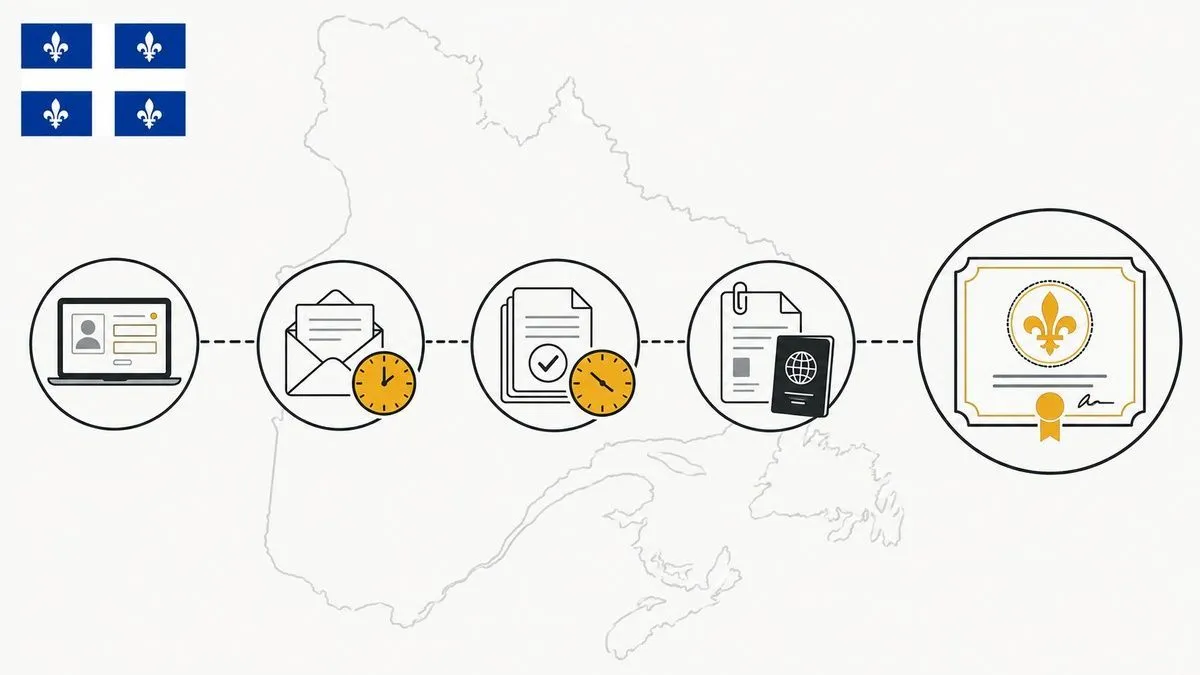
The steps below reflect the PSTQ, which is the route most applicants take. Business and family routes follow different sequences.
Step One: Submit a Declaration of Interest
Create an Arrima account and file a declaration of interest. There is no fee at this stage and no guarantee of anything beyond a place in the pool.
Step Two: Accept the Invitation Within 30 Days
If you are invited, you have 30 days from the date the invitation is issued to accept it. Miss that deadline and your declaration of interest becomes null and void and is removed from the database entirely. This acceptance step is separate from submitting the application, and treating the two as one deadline is a common and costly error.
Step Three: Submit the Application Within 60 Days
From the date of acceptance you have 60 days to submit the full application with documents and fees, if you were invited under Stream 1, 2 or 4, or under Stream 3 with proof of recognition of your qualifications already in hand. Applicants invited under Stream 3 who do not yet have that proof from the relevant regulatory authority get one year instead, reflecting how long professional recognition can take.
Step Four: Provide Complete and Compliant Documents
All documents must be scanned in colour and compiled into a single PDF, in French or English or accompanied by a translation from a recognised translator. If documents are rejected for being incomplete or in the wrong format, you receive a letter giving you 60 days to fix the problem. After that, the application is rejected. False or misleading information carries a five-year bar on all subsequent applications.
Step Five: Wait for Examination and Issue
The province examines the file and may request further information or call an interview. On approval, the certificate is issued.
CSQ Processing Time and Fees in 2026
Fees for examining a permanent selection application under the PSTQ, effective January 1, 2026, are set out below. Quebec adjusts these every January 1, and they are non-refundable even where the application is refused or rejected. Payment is by credit card, in Canadian dollars, in full.
| Applicant | Fee (as of January 1, 2026) |
|---|---|
| Main applicant | $940 |
| Spouse or common-law partner | $201 |
| Each dependent child | $201 |
On timing, the province publishes where it has reached rather than a target. As of the update posted on July 14, 2026, Quebec was examining PSTQ permanent selection applications received in October and November 2025, with some earlier files still pending where they were incomplete or required verification. The processing clock starts when the application is received, not when the invitation is issued. Since May 13, 2026, the province has been prioritising applications from temporary foreign workers whose work permits have expired or are close to expiring, and it warns those applicants to pursue a work permit renewal separately rather than assume a decision will arrive in time. Treat these figures as a snapshot and confirm current status before relying on them.
CSQ Validity Period and Expiry Rules
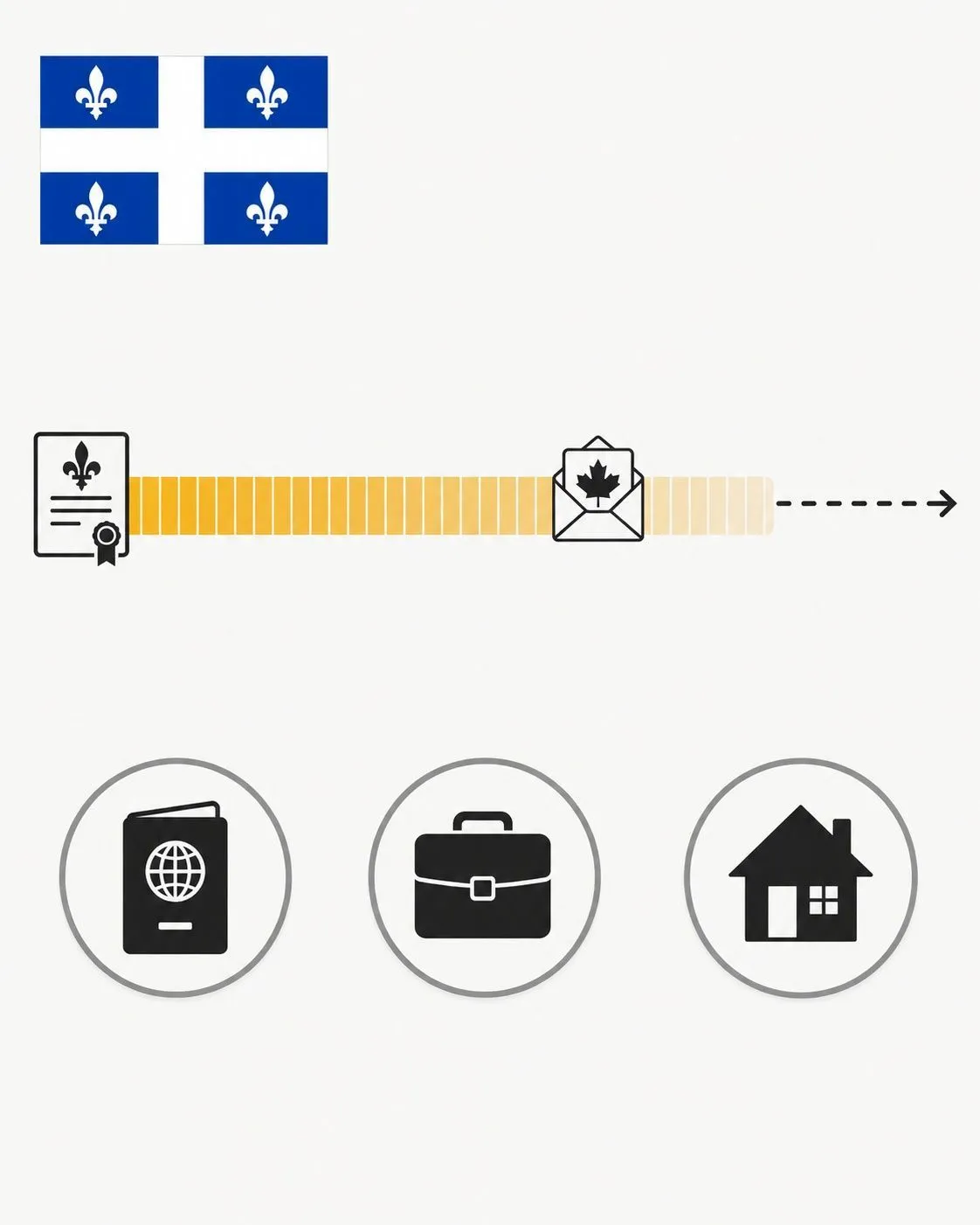
A certificate is valid for 24 months from issue. The rule that follows is the one most often stated incorrectly: if you have submitted a permanent residence application and it is being processed, the certificate remains valid until IRCC renders its decision, even after the printed expiry date has passed. An expiry date reached mid-process does not sink a file that was properly filed.
The real risk is different. If the 24 months run out and you have not filed federally, there is no extension mechanism and no renewal. You would need to qualify and be selected again under whatever program is open at that time, which may not be the program that selected you originally. The deadline that governs is the federal filing date.
Adding or Removing Family Members After Issue
Accompanying family can be added or removed after the certificate is issued. Under the PSTQ this is done on paper, using a ministry form completed, signed and mailed to the Direction du regroupement familial et de l'enregistrement in Montreal. The form is submitted without fees, and the ministry contacts you afterwards with the procedure to follow. Expect the process to take several weeks.
Working in Quebec With a CSQ
The certificate does not authorise work. What it does is open work permit routes that would otherwise be unavailable, and which route applies depends on where you are and what you have already filed.
Open Work Permits From Abroad Under IMP+
The International Mobility Program Plus allows CSQ holders living abroad or outside Quebec to obtain an open work permit valid up to three years and limited to Quebec, with an annual ceiling of 7,000 skilled workers. Eligibility runs through skilled worker certificates and the artificial intelligence, information technologies and visual effects pilot, and an accompanying spouse may also receive an open work permit.
One point carries more weight than the rest: communications inviting skilled workers to apply under IMP+ are currently suspended indefinitely. Only people who receive such a communication may apply to IRCC, and recipients have 90 days from the mailing date to do so. Anyone planning an arrival around this route should verify its status before making commitments, because a great deal of published material still presents it as routinely available.
Work Permit Options From Inside Quebec
If you are already working in Quebec, the route depends on the stage of your federal application. Without a permanent residence application filed, you can apply for an LMIA-exempt employer-specific work permit, and no CAQ is required, though your employer must take steps with IRCC and pay compliance fees through the federal Employer Portal. Once you have filed and received an acknowledgement of receipt, a bridging open work permit becomes available, again without a CAQ. Filed but no acknowledgement yet puts you back on the employer-specific LMIA-exempt route. Quebec sets out these three situations for skilled workers selected under the PSTQ.
CSQ vs CAQ: Which Certificate You Need

Two documents, one ministry, entirely different functions. Confusing them is the most frequent misunderstanding in Quebec files.
| CSQ | CAQ | |
|---|---|---|
| Purpose | Permanent immigration | Temporary stay |
| Typical holder | Selected permanent applicant | International student, some workers |
| Validity | 24 months from issue | Tied to the study program or contract |
| Grants status | No | No |
| Next federal step | Permanent residence application | Study or work permit application |
What Happens After You Receive Your CSQ
The certificate is the midpoint, not the finish. The federal application is a separate submission with its own forms, fees and processing times, filed with IRCC rather than the province.
The Federal Permanent Residence Application
You apply as a skilled worker selected by Quebec, or under the relevant category for business and family routes. Medical examinations, police clearance certificates and security screening all sit at this stage. Travel history is reviewed and additional documentation may be requested to verify what was declared provincially.
Maintaining Status While You Wait
For applicants inside Canada, the practical risk during this period is a status gap. A CSQ does nothing to maintain temporary status, and neither does a pending permanent residence application on its own. Work permit expiry dates need to be tracked against provincial and federal processing realities, not against optimistic assumptions about when a decision will arrive.
Changing Documents After Landing
Once you become a permanent resident, you apply for a permanent Social Insurance Number and a new health insurance card from the Regie de l'assurance maladie du Quebec. Health coverage may not begin for three months, and private insurance is worth arranging for that gap if you are not covered through an employer or institution. A driver's licence from your country of origin can be used for up to six months after you obtain permanent status.
How SEP Immigration Helps With Quebec Selection
We assess which Quebec program can realistically select you, prepare the provincial selection application, and carry the file through the federal permanent residence stage that follows. Sepehr Falahati is a licensed immigration consultant with the College of Immigration and Citizenship Consultants (CICC/IRB, R533959).
Book a consultation and bring your work history, NOC code, education details, French test results, and any Quebec study, work or family connection.
This page is general information, not legal advice, and Quebec program rules, fees, intake windows and processing positions change frequently. Verify current requirements against Quebec.ca and canada.ca, or with a licensed representative. Figures reflect the position as of August 2026.
Frequently asked questions
01What is a Quebec Selection Certificate?
The document confirming Quebec has selected you for permanent immigration. It is not permanent residence, not a visa, and not permission to enter Canada. A separate federal application follows.
02How long is a CSQ valid?
Twenty-four months from issue. File your federal application within that window and the certificate stays valid until IRCC decides, even past the printed expiry date.
03How much does a CSQ cost in 2026?
Under the PSTQ, $940 for the main applicant and $201 each for a spouse and each dependent child as of January 1, 2026. Fees change every January 1 and are non-refundable. Other programs charge differently.
04Can I work in Quebec with a CSQ?
Not on the certificate alone. It opens work permit routes, including an LMIA-exempt employer-specific permit with no CAQ required, and a bridging open work permit once IRCC acknowledges your permanent residence application.
05Can IRCC refuse me after Quebec selects me?
Yes. Quebec selects, Canada admits. Medical, criminal and security findings at the federal stage can end an application that cleared the provincial one.
06Can a CSQ be renewed?
No. If it expires with no federal application filed, you would need to be selected again under a program open at that time.
07Do I need to live in Quebec to apply?
Not for every program, though several current PSTQ selection rounds have applied residence in Quebec as a criterion. When you obtain a CSQ as a skilled worker you declare that you intend to settle in Quebec to work, and that intention is assessed.
08Is a CSQ the same as a provincial nomination?
No. Quebec is not a nominee province. It selects under the Canada-Quebec Accord, which is a different legal mechanism with different consequences.
Stay informed
Get our immigration updates first on Google
Add SEP Immigration as a preferred source and our latest news and guides appear more often in your Google results.
About the Author

Sepehr Falahati
CEO of SEP Immigration
- CICC Licensed
- RCIC #R533959
- IRB Member
Sepehr Falahati is a Regulated Canadian Immigration Consultant (RCIC #R533959), licensed by the College of Immigration and Citizenship Consultants (CICC).
Read more about Sepehr FalahatiReviewed By


Continue Reading