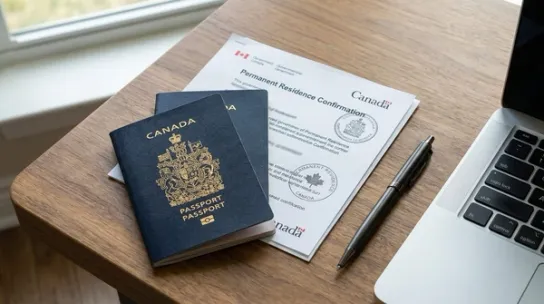

The Spouse Open Work Permit (SOWP) is an opportunity for spouses and common-law partners of certain individuals in Canada to work legally while they wait for their permanent residency. This permit is part of Canada’s immigration policy aimed at keeping families together during the immigration process.
Table of Contents
ToggleWhat Is a Spouse Open Work Permit?
A Spouse Open Work Permit allows the spouse or common-law partner of someone working or studying in Canada to take up employment without the need for a specific job offer. It’s designed to give these individuals the freedom to work for any employer, in most occupations, anywhere in Canada. In relation to other work permits, like the Labour Market Impact Assessment, the SOWP provides a more flexible option.
With the SOWP, you do not need a Labour Market Impact Assessment (LMIA) which simplifies the process compared to other types of work permits. You also do not need to have a job offer ready at the time of applying, making this a flexible option for spouses joining their partner in Canada.

What Are the Conditions for SOWP?
While the Spouse Open Work Permit provides flexibility, there are a few conditions you need to meet to apply successfully. These include:
- Relationship status: You must be the spouse, common-law partner, or conjugal partner of an individual living in Canada. Your relationship should be genuine and ongoing. If you’re a student inside Canada, you may also be eligible for this permit, provided other criteria are met.
- Sponsorship: You must be sponsored by your partner for permanent residency in Canada and have proof that your permanent residency application has been received and is being processed.
- Location: You should be living in Canada with your partner while applying for the permit.
- Valid status: You must hold valid temporary resident status in Canada, such as a visitor, student, or worker, or be eligible for restoration of your status if it has expired.
Failing to meet any of these conditions could lead to your application being denied.
Latest Changes to Spouse Open Work Permit (2026 Update)
Canada has recently introduced important changes to the Spouse Open Work Permit (SOWP) program that directly impact eligibility.
As of recent updates:
- Spouses of international students are eligible only if the student is enrolled in master’s, PhD, or select professional programs
- Spouses of workers must be employed in TEER 0, 1, 2, or 3 occupations
- Some previous pathways are no longer eligible
These changes have made it more important than ever to assess your eligibility correctly before applying.
If you’re unsure whether you still qualify, getting professional guidance can prevent delays or refusals.

Who Can Apply for a Spouse Open Work Permit?
Eligibility for a Spouse Open Work Permit (SOWP) depends primarily on your partner’s legal status in Canada.
You may qualify if your spouse or common-law partner falls into one of the following categories:
Spouse of a Skilled Worker in Canada
You may be eligible if your spouse:
- Holds a valid work permit
- Is currently employed in a TEER 0, 1, 2, or 3 occupation
- Is actively working in Canada at the time of your application
Providing strong proof of employment is essential to support your application.
Spouse of an International Student
You may qualify if your spouse:
- Is studying full-time at a designated learning institution (DLI)
- Is enrolled in an eligible program, such as a Master’s, PhD, or professional degree
Keep in mind that recent policy changes have limited eligibility for spouses of students in certain programs.
Spouse of a Permanent Residence Applicant
In specific situations, you may be eligible if your spouse:
- Has submitted a permanent residence (PR) application
- Is currently in Canada with valid status
Eligibility in this category depends on the type of PR application and supporting documentation.
Who is NOT Eligible for a Spouse Open Work Permit?
Understanding who does not qualify is just as important as knowing who does.
You may not be eligible for a SOWP if:
- Your spouse is enrolled in a non-eligible study program
- Your spouse’s occupation falls under TEER 4 or 5 (low-skilled jobs)
- Your spouse does not have valid immigration status in Canada
- You are unable to provide sufficient proof of a genuine relationship
Applications that fail to meet these requirements are at a significantly higher risk of refusal.
Spouse Open Work Permit’s Qualification and Requirements
To qualify for a Spouse Open Work Permit, certain requirements must be fulfilled. These include:
- Proof of relationship: You need to provide evidence that you are in a genuine, ongoing relationship with your partner, who is either a Canadian citizen or permanent resident.
- Proof of residence: You must show that you are living in Canada with your partner, usually demonstrated by providing proof of address.
- Permanent residency application: You must have already submitted an application for permanent residence and received an Acknowledgment of Receipt (AOR) for that application. The Federal Skilled Worker program is another pathway to consider if you’re looking at different options.
- Valid temporary resident status: You must either hold a valid visitor, student, or worker status, or be eligible to restore that status.
- Age restrictions: If you are a dependent child applying for an open work permit, ensure you meet the minimum age requirements for the province where you plan to work.

Required Documents for a Spouse Open Work Permit
To apply for a Spouse Open Work Permit (SOWP), you must submit a complete and well-documented application. Missing or unclear documents are one of the most common reasons for delays or refusals.
Below is a breakdown of the key documents you will need:
Relationship Documents
You must provide strong evidence to prove your genuine relationship, such as:
- Marriage certificate or proof of legal common-law relationship
- Photos together and communication history (chat logs, call records, etc.)
- Additional supporting documents that demonstrate the ongoing nature of your relationship
The stronger and more consistent your evidence is, the higher your chances of approval.
Spouse’s Documents in Canada
You will also need to include documents related to your spouse’s status in Canada:
- Valid work permit or study permit
- Employment verification letter or proof of enrollment at a designated learning institution (DLI)
- Recent pay stubs (for workers) or transcripts/registration confirmation (for students)
These documents confirm that your spouse meets the eligibility requirements for sponsoring a SOWP.
Applicant Documents
As the applicant, you must also provide:
- A valid passport (with sufficient validity)
- Completed application forms through your IRCC account
- Proof of funds, if requested based on your case
Additional documents may be required depending on your country of residence or individual situation.
Important Note
Incomplete, inconsistent, or poorly organized documentation is one of the leading causes of SOWP refusals.
Make sure all documents are clear, up-to-date, and aligned with the information provided in your application.
Common Reasons for Spouse Open Work Permit Refusal
Many Spouse Open Work Permit (SOWP) applications are refused due to avoidable errors that could have been prevented with proper preparation.
Understanding these common issues can significantly improve your chances of approval.
Weak Proof of Relationship
One of the most frequent reasons for refusal is insufficient evidence of a genuine relationship.
Immigration officers must be convinced that your relationship is real and ongoing. Applications that include only basic documents, without supporting evidence such as communication history or shared life details, may be considered weak.
Spouse Does Not Meet Eligibility Requirements
Your application may be refused if your spouse in Canada does not meet the required criteria, such as:
- Not holding a valid work or study permit
- Working in a non-eligible TEER category (4 or 5)
- Not being enrolled in an eligible study program
Eligibility is strictly assessed at the time of application.
Insufficient or Incomplete Supporting Documents
Missing, incomplete, or inconsistent documents are another major reason for refusal.
This includes situations where:
- Required documents are not submitted
- Information across documents does not match
- Documents are unclear or outdated
A complete and well-organized application is essential for success.
Lack of Clarity in Employment or Study Status
Your spouse’s current status in Canada must be clearly demonstrated.
Applications may be refused if there is:
- No clear proof of employment or enrollment
- Uncertainty about job role, program type, or duration
- Missing official verification letters or supporting records
Clear documentation helps IRCC assess eligibility without doubt.
Benefits of SOWP
There are several advantages to having a Spouse Open Work Permit, which can make life in Canada much easier for families:
- Flexibility: You are not tied to a specific employer or job type. This allows you to switch jobs or pursue any available opportunities without additional paperwork.
- Work anywhere in Canada: With the SOWP, you can take up employment in any part of the country, whether in major cities or smaller communities. For students outside Canada, this can also be an excellent opportunity to start a career in the country.
- No need for a job offer: You don’t need a job offer before applying, which makes the process more accessible.
- Financial support: This work permit allows spouses to earn income while waiting for permanent residency, which can significantly ease the financial burden on families during the transition period.

Spouse Open Work Permit Processing Time
Processing times for a Spouse Open Work Permit (SOWP) can vary significantly depending on several factors.
Key factors that affect processing time include:
- Your country of residence and visa office workload
- Current application volume at IRCC
- Completeness and accuracy of your application file
Average Processing Time
In most cases, processing may take a few weeks to several months.
However, this timeframe is only an estimate, and actual processing times can be shorter or longer depending on individual circumstances.
How to Avoid Delays
Submitting a complete, accurate, and well-organized application is one of the most effective ways to reduce delays.
Applications with missing documents, inconsistent information, or unclear eligibility details are more likely to face extended processing times or additional requests from IRCC.
SOWP Fees in Canada
| Category | Fee (CAD) |
|---|---|
| Work Permit Processing Fee | $155 |
| Open Work Permit Holder Fee | $100 |
| Total SOWP Application Fee | $255 |
Status Restoration Fees (If applicable)
| Category | Fee (CAD) |
|---|---|
| Restoration of Status (Worker) | $229 |
| New Work Permit Fee | $155 |
| Total Restoration Cost | $384 |
Having funds ready is crucial, especially if you’re considering a Bridging Open Work Permit later on. It’s important to have the necessary funds ready before applying, as these fees are non-refundable once the application is processed.
How to Apply for Spouse Open Work Permit in Canada
The application process for a Spouse Open Work Permit involves several steps:
- Complete the application form: You need to fill out the work permit application form, providing accurate and up-to-date information.
- Submit necessary documents: This includes proof of your relationship with your spouse, proof of residence in Canada, your Acknowledgment of Receipt (AOR) letter, and proof of valid temporary resident status. If you’re considering other work permit options like the Post-graduation Work Permit (PGWP), the process may vary slightly.
- Pay the fees: Make sure to pay the required $255 CAD fee online and attach the receipt to your application.
- Submit your application: Applications can be submitted online or by mail, depending on your circumstances. Ensure that all information is accurate to avoid delays or denials.
- Wait for approval: The processing time for SOWP can vary, so patience is key. In the meantime, ensure that your status in Canada remains valid.
Are you ready to take the next step in your immigration journey with a Spouse Open Work Permit? SEP Immigration is here to help you navigate the process with ease. Contact us today for personalized assistance tailored to your needs!
There are no specific fund requirements for a Spouse Open Work Permit, but you should have enough to cover the application fee and demonstrate financial stability while in Canada.
Yes, you can stay in Canada as long as your temporary resident status (e.g., visitor, student, or worker) remains valid during the application process.
Yes, you can leave and return to Canada while waiting for your SOWP. However, re-entry may depend on having valid travel documents, such as a visa or an Electronic Travel Authorization (eTA).
Yes, you can apply from outside Canada if you meet eligibility requirements
Yes, a SOWP is an open work permit, allowing you to work for most employers in Canada
It is usually valid for the same duration as your spouse’s permit
Yes, if eligibility or documentation requirements are not met.
Yes. A SOWP allows you to work for almost any employer in Canada without a job offer
No, a job offer is not required.
You should apply once your spouse meets eligibility requirements and your supporting documents are ready.